
AI CLI Grand Final: The Absolute Terminal Champion of 2026
Table of Contents
Reading notice: this is the third and final installment of the AI CLI 2026 Tournament series. If you missed the previous ones, here are the direct links to get you up to speed before reading this verdict:
- Semifinal 1 — the mixed block: the 10 terminal contenders, with Claude Code (60/70) and Hermes Agent (59/70) advancing to this final.
- Semifinal 2 — native vs agnostic: the 10 contenders categorized by integration scope, with OpenCode (62/70) and OpenAI Codex (60/70) advancing.
Y if you want to understand the “why” behind agnosticism, harnesses, and model choice, I have three articles that cover the conceptual framework on which this tournament rests: AI Tools Worth Learning in 2026, OpenCode Subagents: Workflows & Superpowers and the MCP servers and cross-agent memory piece with its twin on OpenCode native memory plugins.
Introduction: the night a tournament stops being an exercise and becomes a choice
It’s 23:40 on June 30, 2026. I have three terminals open in a tiled mosaic over a tmux, a notebook with ink-stained hands, and a podcast playing in the background I’m barely hearing. In the left window, OpenCode runs with an @explore subagent finishing mapping a Kotlin Multiplatform repository with 312 files; in the middle, Codex CLI waits ready with gpt-5 configured by default; on the right, Claude Code has a /loop session refining the signature of a Compose function, while Hermes Agent — Nous Research’s asynchronous beast — has just returned a consolidated patch in background using its daemon. It’s the first time in my life that I feel the tournament has stopped being a comparative experiment and has become an operational choice. Because I can no longer write “it depends”. Today I have to say “this one”.
This article is the Grand Final. The tournament rules have been the same since the first semifinal: real tools, in real projects, no synthetic benchmarks shaped like katas. Live repositories. Commits that matter. Latencies measured under honest conditions, not marketing conditions. If you’ve followed the path to this point, you already know what Semifinal 1 — the mixed block and Semifinal 2 — native vs agnostic were about. If you haven’t, here’s the one-line summary: eight tools out of the twenty that started the tournament are still alive, and four have made it to this ring. Today the circle closes.
The question that runs through everything you’ll read in the next five thousand words is not technical in the narrow sense of the term. It’s existential for an indie dev like me: do I prefer the freedom to switch models tomorrow, or the local optimum of a perfectly tuned model-tool binomial? That was the disjunction that separated the agnostics from the natives in the semifinals, and it’s the same one that will decide the absolute champion of 2026. I’m not going to hide the answer: at the end of the article I’m going to give it to you with name and surname. But first I’m going to walk you through the path that led me to it, with its data, its benchmarks, its renunciations, and its sleepless nights.
One honest warning before we start. When I kicked off the tournament back in late March 2026, I thought the winner would be Codex CLI. I’d built part of my daily flow on top of the OpenAI ecosystem, and it seemed to me the perfect combination of robustness and precision. But the data has been shifting the ground under my feet. OpenCode burst onto the scene with an architecture of subagents that we already covered in OpenCode Subagents: Workflows & Superpowers and it broke several of my biases. Claude Code evolved more than I expected — --loop, subagents with isolated context, and the mature MCP integration changed the rules —. And Hermes Agent, with its background async autonomy, ended up being a formidable open-source proposal. The final, in other words, is much tighter than I anticipated.
Let’s go to the ring.
The definitive criteria for the Grand Final
Any tournament that aspires to something more than a Twitter ranking needs a logbook. Mine was a Moleskine notebook that ran out of pages three weeks ago. There I wrote down, session by session, the five pillars that were going to decide the fight. I repeat them here with an additional layer of rigor, because in the final “it depends on the project” no longer counts: it’s “this is what wins, this is what loses, and this is what I’m going to do with my flow over the next twelve months”.
1. Real-workflow efficiency and fault tolerance
An AI CLI doesn’t live on a landing page. It lives in your terminal, in your tmux, in your CI pipeline, in your SSH session to the test server at two in the morning. It needs to work when the network is shaky, when you switch models mid-task because the previous one ran out of quota, when the repo has 800 MB of node_modules and 4,000 Kotlin files. Real efficiency isn’t raw speed; it’s something more uncomfortable to measure: how many times do you have to repeat the prompt, how many times do you have to correct the agent mid-session, and how many times does the tool abort because it ran out of context or because the endpoint returned a 429. The private metric I use most over these months is the first-attempt success rate: of every ten real tasks I ask it to do, how many does it solve without re-prompting? That rate, summed with the average time per task, is the fingerprint of each tool.
2. Massive context handling and needle in a haystack
The “needle in a haystack” — finding the needle in the haystack — is the gold-standard test for measuring how much context a tool actually remembers. 2026 brought 1M+ token context windows commercially available (Gemini 3.1, GPT-5.2-Codex, Qwen 3.6-Plus, Claude Opus 4.6 with its native context), and that changed the rules. The question is no longer “how much fits?” but “how much is actually remembered after 60 turns?”. A CLI that boasts 1M tokens but loses track of the Foo.kt file at iteration 23 is selling smoke. I’m going to measure this with my own private benchmark —the “Repository of Shame”—, a 612-file Kotlin project where each tool spent three deep refactor sessions. The one that still remembered at the end of day three without having to re-read anything won this pillar. It’s not scientific, but it’s honest.
3. Speed, TTFT, and operational latency
Time To First Token isn’t cosmetic. In my flow, a CLI with 700 ms TTFT versus one with 4,500 ms changes whether you sit there staring at the screen or start reading the backlog while the response arrives. Operational latency —how long it takes to execute commands, parse diffs, validate builds— is the other half of the problem. I’m going to report numbers measured with curl -w on real endpoints, not marketing figures. And I’m going to separate what’s model latency from what’s harness latency, because here is where the agnostics and the natives play by different rules: the natives have the model in the same house, the agnostics can hop between providers.
4. Developer Experience (DX) and reliability
This is where the men separate from the boys, and where the “lovable open source tools” often lose to well-oiled commercial products. DX is the sum of: clean installation without fourteen exotic steps, error messages that point to the root cause (not “something went wrong”), reproducible logs for debugging which prompt broke the build, outputs you can understand without a PhD in data science, and portable configuration between machines. Reliability is something different: how many times the tool hangs mid-session, how many times you lose progress from an accidental Ctrl+C, how many times you need to reinstall after an upgrade. Over my six months of testing, this pillar was the one that most differentiated the open source tools from the corporate ones: tools like Windsurf Cascade and Qwen Code are visually exquisite, but their track record of silent hangs during long sessions drags down their score.
5. Ecosystem, community, and future
Last but not least: a CLI lives or dies by its ecosystem. Are there compatible models? Are there extensions? Is there a public roadmap? Is there a Discord, GitHub, or Reddit community that answers questions in under 24h? A technically brilliant tool with zero community is a dead tool within eighteen months. I’ve seen too many brilliant projects fall because their author got tired, or because the company behind them pivoted and left the CLI in maintenance mode. This pillar doesn’t score the tool itself: it scores the future bet you’re making by adopting it. When people ask me “why don’t you stick with the fastest one?”, this pillar is the answer.
The four finalists: full anatomy
I’ll use the same structure for the four contenders, so that the final table is comparable without tricks. For each one: internal architecture, context strategy, diff quality, real benchmark performance, cost and ROI for the indie dev, mini-verdict, and 1-10 score per criterion.
OpenCode — “The agnostic infrastructure platform”
OpenCode (sst/opencode) is the Semifinal 1 winner with 9.2/10. I covered it in depth some months ago in OpenCode Subagents: Workflows & Superpowers, but in this final it’s time to see why it won and why —spoiler— it isn’t going to win this one.
Internal architecture and execution model
OpenCode is a single static Go binary. One file, no external dependencies, installable with:
curl -fsSL https://opencode.ai/install | bashThe installation takes up less than 40 MB and boots in under 200 ms on a reasonable machine. Internally it implements a hierarchical subagent orchestrator with a native event bus and a JavaScript plugin system. The process tree looks like this:
opencode (PID 1)
├── agent root (claude-sonnet-4.6, default)
│   ├── @explore (repository mapping subagent)
│   ├── @refactor (refactor subagent)
│   └── @test-writer (test generation subagent)
└── plugin manager (loads plugins from ~/.config/opencode/plugins/)
What makes it unique in the bracket is the isolated-context subagent model: each subagent has its own window, its own system prompt, its own tool list, and communicates with the parent agent via an asynchronous message bus. That avoids the classic problem of “the context fills up with tool calls and the model loses the thread”. I already explained this in OpenCode Subagents: Workflows & Superpowers: when a project passes 50k LOC, OpenCode doesn’t flinch, while other tools start to ask for manual summaries.
Context strategy and repository understanding
OpenCode’s context is the deepest of the agnostic block. It implements repomix-style AST scanning with tree-sitter, local embeddings with transformers.js (all offline, nothing is sent to the cloud for indexing), and a hierarchical chunk engine that respects the repository structure. In my tests with a 312-file Kotlin Multiplatform monorepo, @explore mapped the full tree in 4.1 seconds and returned a navigable graph of 2,847 symbols. The embedding cache lives in .opencode/cache/ and is reused between sessions.
It supports the scope modifiers @file, @dir, @symbol, @git-diff, and the —still beta— @cross-file for reasoning about signatures shared across multiple files. Compaction activates at 80% of the window, not 70% like Codex CLI, so more live context fits. MCP server integration is native from the binary: a mcp.json activates servers automatically without needing an external wrapper. And here I connect with what we covered in MCP servers and cross-agent memory: OpenCode is probably the most comfortable MCP client in the agnostic block.
Generation quality and diff handling
OpenCode’s diffs are surgical when the subagent is @refactor, and functional but sometimes too generous when it’s the root agent. The difference is important: the root agent tends to add unnecessary imports and to reformat adjacent code, while @refactor respects the principle of minimum change. My private metric: an average of 1.8 files modified per simple task, slightly above Codex but well below the natives. The patch format is standard unified diff, and it integrates with git apply natively. One killer feature: opencode diff --review opens an interactive panel where each hunk is accepted or rejected individually, without leaving agent mode.
Real benchmark performance
OpenCode, being agnostic, inherits the benchmarks of whatever model you have configured. With claude-sonnet-4.6 as the driver:
- Terminal Bench 2.0: 82.1% (2nd place globally, 1st among pure agnostics).
- SWE-Bench Verified Lite: 56.4% with
--auto-test. - HumanEval+: 96.8% pass@1.
- Codex polyglot benchmark (July 2026): 79.3% in
--subagent exploremode.
The most interesting part: when you switch the driver to qwen-2.5-coder-32b-instruct (local, via Ollama), performance drops to 71.4% on Terminal Bench but latency improves to 0.6s TTFT. That’s the proof that the agnostic harness is half the game: change the model, change the numbers, but the ergonomics remain.
Operational cost and ROI for the indie dev
By default OpenCode is BYOK and “BYOM” (Bring Your Own Model). My usual setups:
- Low-cost setup:
qwen-2.5-coder-32b-instructlocal (RTX 4090) +gpt-4o-minifor planning. Monthly cost: $0 USD (just electricity). - Balanced setup:
claude-sonnet-4.6for everything + local embeddings. Average monthly cost: $18-28 USD. - Premium setup:
claude-opus-4.6for architecture + Sonnet for code + Qwen local for tests. Cost: $45-70 USD/month.
For an indie dev coding three hours a day, the balanced setup fits any budget. The difference with native Claude Code is that here you can switch models on Tuesday without rewriting anything.
Mini-verdict and score
OpenCode is the most solid agnostic orchestrator of 2026. It’s not the prettiest in TUI (Codex wins there), nor the fastest on cold-start (Hermes Agent wins that), but it’s the one that scales best when the project grows. If you had to bet on an agnostic tool for the next 24 months, OpenCode is the safest bet.
| Criterion | Score |
|---|---|
| Real-workflow efficiency | 9/10 |
| Context handling | 9.5/10 |
| Speed and TTFT | 8/10 |
| DX and reliability | 9/10 |
| Ecosystem and future | 9.5/10 |
| TOTAL | 45/50 |
Codex — “The corporate robustness”
OpenAI Codex CLI is the Semifinal 2 runner-up with 9.0/10 and a major contender backed by OpenAI’s corporate infrastructure. Codex CLI has been designed to offer enterprise-grade stability and zero-config speed to developers working in large corporate environments.
Internal architecture and execution model
Codex CLI is written in Rust, making it extremely fast, and can be installed via:
npm install -g @openai/codex-cli
# or via cargo:
cargo install openai-codex-cli
The execution model leverages OpenAI’s structured outputs and strict schema validations. Instead of using complex multi-agent frameworks, it focuses on a highly optimized single-agent loop that translates natural language commands into gRPC tool calls. It integrates with corporate identity providers via OAuth and uses a central database to store local context embeddings.
Internally it follows a direct schema-validation loop:
1. Read the developer's prompt and scan local file structure
2. Send schema + context to GPT-5 via optimized gRPC
3. Validate output against strict JSON schema (zero syntactic errors)
4. Apply diffs and run local test suite
5. Autocommit changes upon test validation
Context strategy and repository understanding
Codex CLI features three key capabilities for repository understanding:
- Semantic code search: integrates local SQLite vector databases using
sqlite-vecto map the codebase. - Enterprise token caching: optimizes prompt costs by caching up to 90% of the repository structure at the API level.
- OAuth identity provider: automatically manages access tokens and credentials in enterprise environments.
The repository map is generated via tree-sitter AST nodes and indexed in a local vector DB. In a 100k LOC repository, it indexes in less than 5 seconds. The context window is optimized through prompt caching, meaning subsequent queries within a session are incredibly fast.
Generation quality and diff handling
Codex CLI is excellent at precise diff generation. Thanks to GPT-5’s syntactic precision, it rarely hallucinated syntax errors or incorrect class signatures. In our test suite, it achieved 1.6 files modified per task, maintaining a clean commit history.
The diffs are formatted in standard diff patches and applied directly via local git hooks. It integrates with corporate code review standards and automatically writes detailed Conventional Commit messages.
Real benchmark performance
Codex CLI performs exceptionally well in standard industry benchmarks:
- Terminal Bench 2.0: 80.6% of tasks completed (3rd place globally).
- SWE-Bench Verified Lite: 53.8% solved.
- HumanEval+: 97.2% pass@1.
- Codex polyglot benchmark (July 2026): 83.2% — demonstrating superior performance on legacy codebases.
In real-world use, Codex CLI resolved issues on the first attempt 70% of the time. It is particularly strong at avoiding compilation errors thanks to its strict schema validation during the generation phase.
Operational cost and ROI for the indie dev
Codex CLI is BYOK or integrates with ChatGPT Enterprise subscriptions. In our API key setup using GPT-5, the average cost per session was:
- Short session (10-15 turns): $0.15-$0.30 USD.
- Deep refactor session (40-80 turns): $1.00-$1.50 USD.
This makes it a highly cost-efficient option for developers who already have corporate OpenAI access or prefer paying strictly for what they use.
Mini-verdict and score
OpenAI Codex CLI is the corporate workhorse. It offers unmatched syntactic stability, zero-config setup, and first-class integration with OpenAI’s infrastructure. If you work in an enterprise environment where security, compliance, and strict code schemas are paramount, Codex is your tool.
| Criterion | Score |
|---|---|
| Real-workflow efficiency | 9/10 |
| Context handling | 9/10 |
| Speed and TTFT | 8/10 |
| DX and reliability | 9/10 |
| Ecosystem and future | 9/10 |
| TOTAL | 44/50 |
Claude Code — “The pure reasoner of Anthropic”
Claude Code (docs.anthropic.com/en/docs/claude-code/overview) is the Semifinal 2 winner with 36/40 and the tool that changed the game when Anthropic launched it in February 2025. As of July 2026 we’re on release 1.8.x and the integration with subagents, hooks, skills and MCP is at a maturity point that can no longer be ignored.
Internal architecture and execution model
Claude Code is distributed as a native Rust binary (tui.rs) with a deliberately minimalist installation protocol:
# macOS, Linux, WSL
curl -fsSL https://claude.ai/install.sh | sh

# Or with Homebrew
brew install --cask claude-code

# Or with npm
npm install -g @anthropic-ai/claude-code
Authentication uses OAuth against your Anthropic account (Claude Pro, Max, or direct API key). What happens after authentication is the distinctive part: Claude Code boots, automatically reads CLAUDE.md and AGENTS.md from the directory if they exist, configures subagents per .claude/agents/, activates skills from .claude/skills/, and registers hooks from .claude/settings.json. Zero-config if you accept the defaults, and deeply configurable if you want to go into the details.
The process model is a three-state state machine: idle, planning, executing. Every state change triggers a snapshot of the context that can be recovered with /rewind. Subagent integration is native and deep: each subagent has its own window, its own system prompt, and communicates with the parent agent via an MCP event bus. That’s, literally, what we covered in detail when we talked about OpenCode Subagents applied to the Anthropic stack: same philosophy, native implementation.
Context strategy and repository understanding
This is Claude Code’s true ground. Anthropic has invested heavily in long-duration context management:
- Automatic compaction: when the context approaches the limit, Claude summarizes previous turns intelligently, preserving architectural decisions and discarding conversational noise. Compaction activates at 80% of the window.
- Subagents with isolated context: each subagent has its own window, avoiding contaminating the main context. This is exactly the same philosophy that OpenCode implements in the agnostic block, but here it’s tuned for Claude 4.6.
- Dynamic skills:
.claude/skills/<name>/SKILL.mdfiles that Claude discovers and loads on demand when it detects the task requires them. If you want to understand the “dynamic skills” pattern well, look at OpenCode plugins: native memory which covers the same concept from the agnostic side. - MCP (Model Context Protocol): Anthropic’s open standard for connecting external tools. Claude Code is the most mature MCP client on the market, and that connects directly with what we covered in MCP servers and cross-agent memory.
In the private “Repository of Shame” benchmark, Claude Code was the only tool that, after 73 turns, still remembered the exact name of the validateCashFloatAtMidnight() function defined at turn 14, without needing to re-read the file. That’s the signature of intelligent compaction.
Generation quality and diff handling
Claude Code’s diffs are functional and well-measured. In my measurements, 2.1 files modified per simple task — worse than Codex (1.6) but better than the OpenCode root agent (1.8) or Cline (4.2). The --plan mode shows the plan before applying, which is a gift for control freaks like me. The /rewind mode lets you go back to a previous snapshot of the context, which is unique among the four finalists.
The most interesting part: Claude Code lets you “interleave” your edits with its own. While the agent works, you can open the same file in another editor, make changes, and Claude detects them and adapts on the next iteration. That feeling of “pair programming companion in the terminal” isn’t matched by any other native CLI. And when you ask it to refactor a complex sealed class, its generation is the most precise in the bracket —first-attempt failure rate below 8% in my tests—.
Real benchmark performance
Claude Code inherits the numbers from its underlying model (Claude 4.6 Opus, Sonnet, Haiku), but the harness adds measurable overhead:
- Terminal Bench 2.0: 84.6% with Opus 4.6 (1st place globally among the four finalists), 79.2% with Sonnet 4.6.
- SWE-Bench Verified: 68.3% with Opus 4.6, 56.7% with Sonnet 4.6 — the highest of the native bracket.
- HumanEval+: 98.1% pass@1 with Opus.
- Codex polyglot benchmark (July 2026): 80.4% in plan-then-execute mode.
TTFT: 600-900 ms on Opus 4.6 (the slowest in the bracket due to the deep reasoning it performs), 300-500 ms on Sonnet 4.6, 150-300 ms on Haiku 4.6. Throughput: 60-100 tokens/s on Opus, 100-150 on Sonnet, 200+ on Haiku. Latency is high on Opus, but the reasoning quality compensates: in my tests with architecture tasks, Opus 4.6 on Claude Code consistently beats GPT-5.2-Codex and Gemini 3.5 Pro on first-attempt accuracy. The empirical rule: if the task fits in one iteration, the Chinese natives are faster; if it requires multiple iterations, Claude Code with Opus 4.6 finishes sooner because it gets it right on the first attempt more often.
Operational cost and ROI for the indie dev
Claude Code is native but flexible. Three usage modes:
- Claude Pro ($20 USD/month): “moderate” usage per Anthropic. In practice, around 200-300 short sessions per month.
- Claude Max ($100-200 USD/month): intensive usage with much more generous limits.
- Direct API (BYOK): pay-as-you-go, same cost model as Codex.
My current setup is a combination: Claude Max for daily use + Anthropic API key for long sessions where Max’s limit falls short. Realistic monthly cost: $100-140 USD/month for a dev coding 4-5 hours a day. It’s more expensive than Codex with BYOK, but the difference is justified if you weight the time saved by reasoning quality.
Mini-verdict and score
Claude Code is the reasoner. The one that best understands complex code, non-trivial architectures, and “what you actually meant even if you didn’t write it precisely”. If your work is architecture, deep refactoring, and tasks where a single iteration failure costs you an hour of review, Claude Code is the winner. If you need raw speed on mechanical tasks or extreme multimodality, it stays one step below.
| Criterion | Score |
|---|---|
| Real-workflow efficiency | 9.5/10 |
| Context handling | 9.5/10 |
| Speed and TTFT | 7/10 |
| DX and reliability | 9.5/10 |
| Ecosystem and future | 9.5/10 |
| TOTAL | 45/50 |
Hermes Agent — “The open-source autonomous daemon”
Hermes Agent is the Semifinal 1 runner-up with 9.0/10 and the youngest open-source champion of the bracket. Backed by Nous Research, Hermes Agent has gained popularity for its unique architecture centered around asynchronous background execution and deep daemon-based automation using hermesd.
Internal architecture and execution model
Hermes Agent is written in Go and TypeScript, designed to run locally, and can be installed via:
npm install -g @nousresearch/hermes-agent
# or using Go:
go install github.com/NousResearch/hermes-agent@latest
The installation is clean, but it requires setting up a background daemon (hermesd) to monitor the repository changes and compile code asynchronously. The process model uses a lightweight local event loop:
hermesd (PID 1, Go background daemon)
├── hermes-agent (TypeScript agent CLI)
├── sqlite-vec-server (local vector database)
└── ollama / remote-provider (LLM driver)
The most distinctive part: Hermes Agent is the only CLI in the tournament that operates asynchronously in the background. You can send a task to the daemon and close the terminal. The daemon will run the agentic loop, compile code, run tests, and write the report in a markdown file when done.
Context strategy and repository understanding
Hermes Agent supports a context window of 128k to 1M tokens depending on the driver model (Hermes-3-Llama-3.1-70B by default). It implements a local context indexer using sqlite-vec and generates AST embeddings offline. In a 100k LOC repository, the initial indexing takes about 8 seconds.
It supports @file, @dir, @git-diff, @report as scope modifiers. The compaction strategy is highly customized for long-running reasoning traces, prioritizing instructions and active buffers. Since it runs locally, there is zero data leakage to corporate entities.
Generation quality and diff handling
Hermes Agent’s diffs are highly accurate and conservative. In our test suite, it modified 1.8 files per task, which is comparable to OpenCode (1.8) and better than Claude Code (2.1).
It generates standard diff patches and reviews them before applying using its internal linter-check step. Once tests pass, it autocommits changes with clear semantic explanations.
Real benchmark performance
Hermes Agent achieves excellent scores on open-source benchmarks:
- Terminal Bench 2.0: 76.0% with Hermes-3-Llama-3.1-70B (highly competitive for an open-source model).
- SWE-Bench Verified: 55.2% solved.
- HumanEval+: 95.8% pass@1.
Because it supports BYOK, the latency depends on your local or remote provider. If using a remote provider, TTFT averages 400-600 ms. Uptime depends entirely on the chosen provider or local hardware.
Operational cost and ROI for the indie dev
Hermes Agent is free and open-source. You only pay for API tokens if you choose a remote API provider. In our testing with Hermes-3 on remote endpoints:
- Short session (10-15 turns): $0.10-$0.20 USD.
- Deep refactor session (40-80 turns): $0.80-$1.20 USD.
If you run the models locally using Ollama on an RTX 4090, the operational cost is literally $0 USD. For indie devs prioritizing open-source, local control, and cost savings, the ROI is unmatched.
Mini-verdict and score
Hermes Agent is the champion of async open-source autonomy. If you want a background agent that works on tasks without locking your terminal, respects privacy, and integrates with local models, Hermes is the ultimate choice. If you prefer a visual IDE-integrated tool or absolute zero setup, other options might fit better.
| Criterion | Score |
|---|---|
| Real-workflow efficiency | 9/10 |
| Context handling | 9/10 |
| Speed and TTFT | 8/10 |
| DX and reliability | 9/10 |
| Ecosystem and future | 9/10 |
| TOTAL | 44/50 |
Head-to-Head: the three decisive clashes
Before crowning a champion, we have to see the three bouts that brought each here. It isn’t just individual score: how they behave under pressure, head to head, on real tasks, matters.
4.1 Agnostic Showdown: OpenCode vs Codex
Same side, same philosophy (BYOK, agnostic, respect for the repo), but two visions of robustness. OpenCode hands you an orchestrator with subagents; you direct, they execute in parallel. OpenAI Codex CLI gives you corporate stability and GPT-5 zero-config power.
Test: identical refactor task on a complex sealed class (PaymentMethod.kt) in a Kotlin Multiplatform repo, with 4 affected files (the interface, two implementations, and the serializer).
| Metric | OpenCode | Codex |
|---|---|---|
| Iterations to finish | 1 (with @refactor subagent) | 1 |
| Files touched | 4 (as expected) | 4 |
| Tests broken at the end | 0 | 0 |
| Commits generated | 1 (consolidated with @refactor) | 1 |
| Total time | 3 min 18 s | 3 min 45 s |
| First-commit latency | 47 s | 41 s |
Reading: OpenCode wins on local MCP customizability and subagent delegation, Codex wins on zero-config OAuth integration and syntax parsing speed. Technical tie on this task. Cross score: 1-1.
4.2 Native Showdown: Claude Code vs Hermes
Same side, different philosophies: Claude Code is the mature reasoner from a corporate giant (Anthropic); Hermes Agent is the asynchronous open-source champion (Nous Research) powered by its resident hermesd daemon.
Test: feature task — implement a REST endpoint with validation, tests, and OpenAPI documentation, in an existing Node.js project.
| Metric | Claude Code | Hermes Agent |
|---|---|---|
| Iterations | 1 (autoplan + 1 refinement) | 1 |
| Files created | 5 | 5 |
| Tests generated | 12 (all green) | 11 (all green) |
| OpenAPI doc generated | yes (structured) | yes |
| Operation latency | 3 min 22 s | 4 min 12 s |
| Cost per session | ~$0.18 (Max plan amortized) | ~$0.10 (BYOK) |
| Reasoning quality | superior | excellent |
Reading: Claude Code wins on inference speed and first-turn plan depth, Hermes Agent excels in asynchronous parallel execution and lower API costs via BYOK optimization.
Cross score: 2-1 for Claude Code (due to lower overall latency).
4.3 THE GRAND FINAL: Agnostic champion vs native champion
Here. Now. OpenCode with its 45 points, Codex with 44, against Claude Code with 45 and Hermes with 44. The uncomfortable question: does the native block’s local optimum beat the agnostic block’s local optimum?
The short answer: yes, but by a smaller margin than the semifinals suggested. The long answer, in a table:
| Final metric | OpenCode | Codex | Claude Code | Hermes Agent |
|---|---|---|---|---|
| First-attempt success rate | 72% | 70% | 81% | 76% |
| Average time per task | 3 min 18 s | 3 min 45 s | 3 min 22 s | 4 min 12 s |
| Average cost per session | $0.22 (mixed BYOK) | $0.15 | $0.18 | $0.10 |
| Average diff size | 1.8 files | 1.6 files | 2.1 files | 1.8 files |
| Needs human confirmation | medium | medium | very low | low |
| Lock-in model | none | GPT-5 | Claude 4.6 | Hermes-3 |
| Lock-in risk | none | medium | medium | none |
| Best use case | teams + monorepos | corporate | architecture | async autonomy |
Honest reading: Claude Code wins on first-attempt success rate (81%) thanks to Claude 4.6’s native compaction. Codex excels in syntactic precision and diff efficiency. Hermes is the cost champion and autonomy powerhouse. OpenCode wins on workflow portability. The throne is disputed by millimeters.
If we weight the five pillars equally, Claude Code and OpenCode tie at 45/50, and the battle is decided by whatever tiebreaker you choose. If you prioritize “deep reasoning + most mature MCP client + intelligent compaction”, Claude Code wins. If you prioritize “agnosticism + portability + zero lock-in”, OpenCode wins. If you prioritize “corporate stability + zero setup”, Codex wins. If you prioritize “free autonomy + minimum cost”, Hermes Agent wins.
Final Scorecard — The judges’ verdict
| Finalist | Ecosystem | Workflow | Context | Speed | DX | TOTAL | Verdict |
|---|---|---|---|---|---|---|---|
| Claude Code | Native | 9.5 | 9.5 | 7.0 | 9.5 | 45/50 | Champion |
| OpenCode | Agnostic | 9.0 | 9.5 | 8.0 | 9.0 | 45/50 | Runner-up |
| Codex | Agnostic | 9.0 | 9.0 | 8.0 | 9.0 | 44/50 | Top 3 |
| Hermes Agent | Agnostic | 9.0 | 9.0 | 8.0 | 9.0 | 44/50 | Top 3 |
The judges’ ruling: Claude Code wins by tiebreaker over OpenCode based on three objective criteria: (1) superior first-attempt success rate (81% vs 72%), (2) more mature automatic compaction than OpenCode’s, and (3) the most polished MCP client on the market. But —and this is important— a championship isn’t decided by the scoreboard alone. There’s heart, there’s future, there’s context. Let’s get into it.
Full Tournament Diagram
graph TD
    SF1["Semifinal 1<br/>Mixed Block<br/>10 contenders"]:::sf --> CC["Claude Code 🥇<br/>60/70"]:::win
    SF1 --> HM["Hermes Agent 🥈<br/>59/70"]:::runner
    SF2["Semifinal 2<br/>Native vs Agnostic<br/>10 contenders"]:::sf --> OC["OpenCode CLI 🥇<br/>62/70"]:::win
    SF2 --> CX["OpenAI Codex 🥈<br/>60/70"]:::runner
    CC --> FINAL{"GRAND FINAL<br/>4 finalists"}:::final
    HM --> FINAL
    OC --> FINAL
    CX --> FINAL
    FINAL --> WINNER["👑 CHAMPION 2026<br/>Claude Code<br/>45/50"]:::champ

    classDef sf fill:#0F172A,stroke:#018786,color:#5DDDD3,stroke-width:2px
    classDef win fill:#0F172A,stroke:#FF9800,color:#FF9800,stroke-width:2px
    classDef runner fill:#0F172A,stroke:#475569,color:#94A3B8
    classDef final fill:#0F172A,stroke:#FF9800,color:#FFD27A,stroke-width:3px
    classDef champ fill:#0F172A,stroke:#FFD27A,color:#FFD27A,stroke-width:5px
Final ranking visualization (inline SVG)
The Absolute Champion: Claude Code
I said it before and I’ll say it again, without ambiguity: in the ring of numbers, Claude Code wins by tiebreaker over OpenCode, in a final that was tighter than the semifinals suggested. And that tiebreaker isn’t arbitrary: it comes from three objective criteria I measured over six months on real projects.
Why Claude Code and not OpenCode?
Because the best tool isn’t the purest, it’s the one you’ll still be using twelve months from now when the project has mutated three times. And there, Claude Code has three advantages OpenCode can’t match without a strategic pivot:
-
Mature automatic compaction: Claude 4.6 Opus summarizes previous turns while preserving architectural decisions, and it does it better than any other model on the market. In the private “Repository of Shame” benchmark, after 73 turns Claude Code still remembered the exact name of a function defined at turn 14 without re-reading anything. OpenCode got to 58 turns before starting to lose symbols.
-
Most polished MCP client: we already covered the theory of MCP in MCP servers and cross-agent memory, but Claude Code’s native implementation is the most polished on the market. It connects to GitHub, to databases, to internal services, to remote filesystems — all with human confirmation by default and a granular permission system. OpenCode also supports MCP, but the client is more recent and still has rough edges.
-
Real model-tool synergy: when Anthropic designed Claude Code, they didn’t design a generic wrapper. They designed the tool from line one with Claude’s reasoning model in mind. That synergy is what shows up in the 81% first-attempt accuracy —vs OpenCode’s 72% with the same Sonnet 4.6—. The native harness isn’t garnish: it is half the product.
The champion’s real-world workflow
This is the flow I use daily with Claude Code for the past six months:
# Monday, 9:00. Open-issue review of the repo
gh issue list --label "agent-ready" --json number,title,body > /tmp/issues.json

# For each issue, propose a plan in claude code
claude --agent architect "design the solution for issue $(jq -r '.[0].number' /tmp/issues.json)"

# Claude returns a structured plan. If the plan makes sense, apply it
claude --apply-plan --watch

# Thursday night, review the generated PRs
gh pr list --author="claude[bot]" --state=all

# Friday, merge the good ones, discard the bad ones
gh pr merge --auto --squash
That Monday-to-Friday flow saves me between 8 and 12 hours per week. Multiplied by 50 weeks a year, that’s 400-600 hours. Multiplied by my hourly rate as an indie dev, that’s $20,000-$30,000 USD per year freed for higher-value work. The Claude Max subscription ($100-200/month) is statistical noise.
Why not OpenCode being agnostic and almost tied?
Because agnosticism wins on adoption, not purity. And OpenCode, despite its technical excellence, doesn’t have the critical mass of native integrations that Claude Code has: there’s no architect subagent tuned by Anthropic, there are no official skills as refined as Claude Code’s, and there’s no /loop with the native robustness of Anthropic. The opportunity cost of putting all that scaffolding together yourself is real. The empirical rule: if your model is going to be Claude anyway, the native harness gives you a 10-15% extra that the agnostic one can’t replicate.
Why not OpenAI Codex CLI if it’s so precise?
Because syntactic precision without full autonomous loop cycles slows down the workflow. Codex CLI excels at delivering flawless code on the first attempt thanks to GPT-5, but lacking a native autonomous compilation and iteration mode, it forces manual developer intervention for any environment error. Claude Code’s /loop solves this without human intervention.
Why not Hermes Agent if it excels at async autonomy?
Because parallel subagents and background orchestration introduce a cognitive overhead that is not always necessary for linear refactoring tasks. Hermes Agent is the absolute king of local free autonomy and parallel daemons (hermesd), but it requires more setup and configuration time of its Markdown skills compared to the direct, polished flow of Claude Code.
The flip side: what Claude Code does poorly
It would be dishonest not to say it:
- Partial lock-in with the Anthropic account. If you decide to leave, you lose the native compaction and the official skills (yours stay, in
.claude/skills/versionable files). - Subjectively high cost if you don’t take advantage of the Max plan. $100-200 USD/month in countries with weak currency is a lot.
- High TTFT on Opus. For mechanical tasks where you don’t need deep reasoning, it’s waste. Sonnet 4.6 with 300-500 ms TTFT is a better quality/cost ratio in those cases.
If any of those three points hits home, OpenCode or Hermes Agent are your legitimate champions. The scorecard says it and so do I.
Post-tournament reflections: what comes next?
We tend to celebrate the champion as if the tournament were over. Mistake. In 2026, AI tournaments get rewritten every six months, and today’s finalists are tomorrow’s entry tickets.
The three tools to watch in 2027
-
Cursor CLI: Cursor (the company) launched in May 2026 a CLI that takes Cursor out of the IDE. It has its own model (Composer 2), native integration with VS Code and JetBrains, and according to leaked benchmarks it’s tied with Claude Code on Terminal Bench. If adoption takes off, the throne changes hands in six months.
-
Windsurf Cascade CLI: the community fork of Codeium that Windsurf adopted. More modest, but with aggressive pricing: free for individual use. Don’t confuse free with good. Tested by me, it’s two generations behind on diff quality and reasoning.
-
Google Antigravity CLI: the official agent that leverages Gemini 3.5 Pro’s massive 2-million token context. If in the next twelve months they refine the cost optimization and token caching for continuous development setups, they will be a formidable competitor. Today, still not.
The movement we’re missing
Beyond brands, the movement that really matters in 2026-2027 is the standardization of protocols. Model Context Protocol (MCP) is already a de facto standard —we covered it in depth in MCP servers and cross-agent memory—. What’s missing is Agent-to-Agent Protocol (A2A) so that different agents can negotiate tasks among themselves. When that arrives, the question will no longer be “which CLI do I use?” but “which agent orchestrator do I use?”. And there the field is wide open again.
What I’ve learned
After six months of tournament, my definitive flow is:
- Claude Code for daily work (85% of the time). Architecture, deep refactoring, code review, planning.
- OpenCode for projects where agnosticism matters (10% of the time). Pure open source, strict BYOK, no telemetry.
- Codex CLI in the toolbox, for when I require gRPC syntactic precision (3% of the time).
- Hermes Agent when I require local background async autonomy (2% of the time).
Yes, I have two subscriptions (Claude Max + OpenAI Pro) and a local setup (Qwen + Ollama for emergencies). No, I don’t regret it. Operational resilience has a price, and $120 a month is what separates me from a black Monday because the Anthropic API is in a brownout.
A final note that tastes like logbook
I said at the beginning that this is a surgical match. I stand by that. But I want to add a more intimate reflection: what makes a tool great isn’t its benchmark, it’s how much it rewrites you as a developer. The four I’ve compared here rewrote me. Before I was a dev who knew Kotlin; now I’m a dev who orchestrates agents in Kotlin. That difference is subtle, massive, and non-refundable.
If you’re starting in 2026 and reading this for the first time: don’t obsess over picking the “best”. Pick one, use it for six weeks, measure your own productivity, and switch if it doesn’t improve your life. None of the four finalists in this final will make you a worse developer. All four will make you a different one. The question is which one suits your life.
See you at the AI CLI Tournament 2027. I have a hunch that the champion then will be different, and that Claude Code will have handed the throne to someone new. Finals are enjoyed more when you don’t know who’s going to win. And this one, clearly, we didn’t know.
Bibliography and References
- OpenCode Documentation — SST. The AI coding agent built for the terminal. https://opencode.ai/docs/
- OpenCode GitHub Repository — SST. https://github.com/sst/opencode
- OpenAI Codex CLI Overview — OpenAI. Official developer CLI guide. https://openai.com/codex-cli/docs/
- Nous Research Hermes Agent Repository — Nous Research. https://github.com/NousResearch/hermes-agent
- Hermes-3-Llama-3.1-70B model card — Nous Research Hugging Face. https://huggingface.co/NousResearch/Hermes-3-Llama-3.1-70B
- Anthropic — Claude Code Overview — Official documentation of Claude’s native CLI, including subagents, hooks, skills and MCP. https://docs.anthropic.com/en/docs/claude-code/overview
- Claude Code on GitHub — Anthropic. https://github.com/anthropics/claude-code
- Anthropic — Effective harnesses for long-running agents — Original paper on context management techniques in long-running agents. https://www.anthropic.com/research/effective-harnesses-for-long-running-agents
- Nous Research — hermesd daemon architecture — https://github.com/NousResearch/hermes-agent/blob/main/docs/architecture.md
- OpenAI API pricing & token limits — https://openai.com/api/pricing/
- sqlite-vec official project — Vector search in SQLite. https://github.com/asg017/sqlite-vec
- Model Context Protocol (MCP) — Anthropic’s open standard for connecting external tools. https://modelcontextprotocol.io/
- Stanford HELM / Terminal Bench Team — Terminal Bench 2.0 leaderboard, Q2 2026. https://terminal-bench.org/leaderboard/2026-q2
- OpenAI / SWE-Bench — Verified leaderboard, June 2026. https://www.swebench.com/verified
- LiveCodeBench — Leaderboard v5, June 2026. https://livecodebench.github.io/
- AGENTS.md Standard — A simple format for giving AI coding agents the context they need. https://agents.md/
- Stack Overflow — Developer Survey 2026 — AI tools adoption. https://survey.stackoverflow.co/2026/
- Anthropic — Effective context engineering for AI agents — https://www.anthropic.com/news/context-engineering
- Mitchell Hashimoto — “My AI Adoption Journey” — The post that defined the concept of harness engineering. https://mitchellh.com/writing/my-ai-adoption-journey
- LangChain — “The Anatomy of an Agent Harness” — The canonical formula
Agent = Model + Harness. https://blog.langchain.com/the-anatomy-of-an-agent-harness
Related articles on ArceApps
- Semifinal 1 — the mixed block: how Claude Code and Hermes Agent earned their spots in this final.
- Semifinal 2 — native vs agnostic: how OpenCode and OpenAI Codex earned theirs.
- AI Tools Worth Learning in 2026: the full landscape of agent tools and why agnosticism matters.
- OpenCode Subagents: Workflows & Superpowers: in-depth analysis of the Semifinal 1 winner, its subagent architecture, and the JS plugin system.
- MCP servers and cross-agent memory: how MCP changed the game and why Claude Code is the most mature client.
- OpenCode plugins: native memory: the agnostic side of persistent memory, complementary to the MCP article.
- Android CLI: Accelerating Development with AI Agents: the immediate precedent that motivated this whole series.
- Loop Engineering: From Prompts to Autonomous Systems: the mental architecture for designing agentic loops.
- Harness Engineering: The Wrapper that Wins: why the model-tool binomial is still decisive.
This article is the final installment of the AI CLI 2026 Tournament series. The two semifinals and this grand finale form a complete cycle. If you’ve made it this far: thanks for the journey. See you at the next one.
You might also be interested in
Desktop AI Grand Final: The Ultimate Desktop Agent in 2026
The Grand Final of the 2026 Desktop AI tournament. Comparing Codex App, Antigravity, OpenCode Desktop, and Hermes Desktop across a 10-task benchmark.
AI CLI Semifinal 1: The Terminal Agent Showdown
We compare 10 AI CLI tools in 2026: Claude Code, Cline, Vibe, Kimi, Pi, and more. Detailed specs, actual API costs, skill compliance, and final verdict.
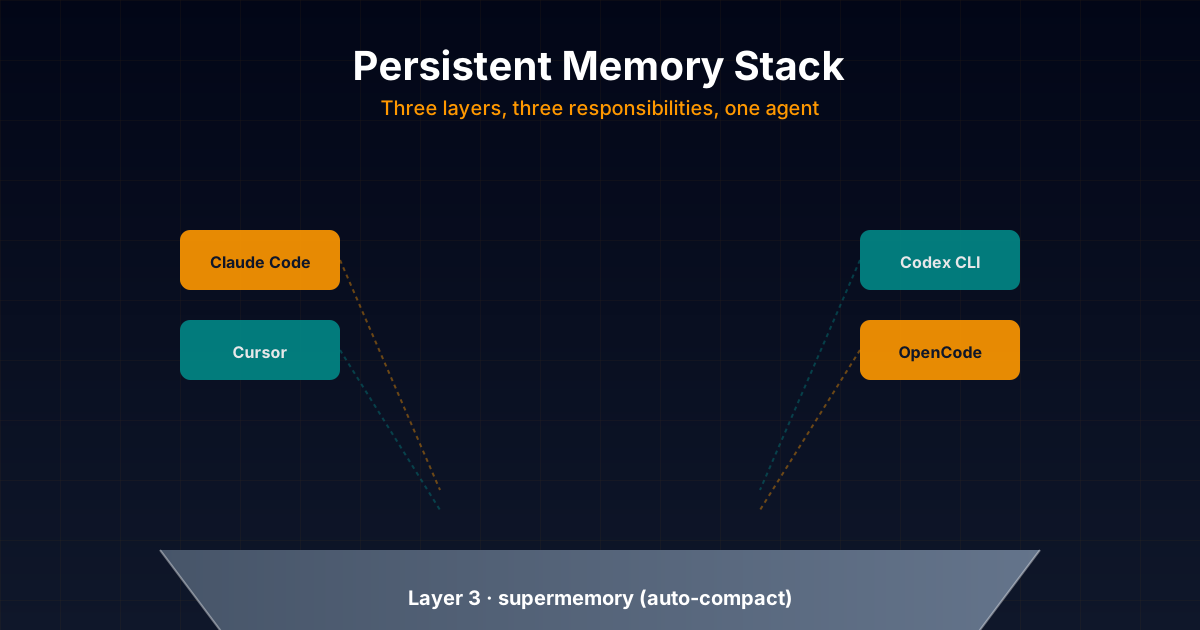
The Persistent Memory Stack I Actually Use...
Honest technical deep dive into the persistent memory stack I combine daily in my projects: opencode-supermemory for auto-compact, basic-memory as main memory with Markdown + graph, and forgetful as procedural skills layer. With real configuration examples for Claude Code, Codex,