
Table of Contents
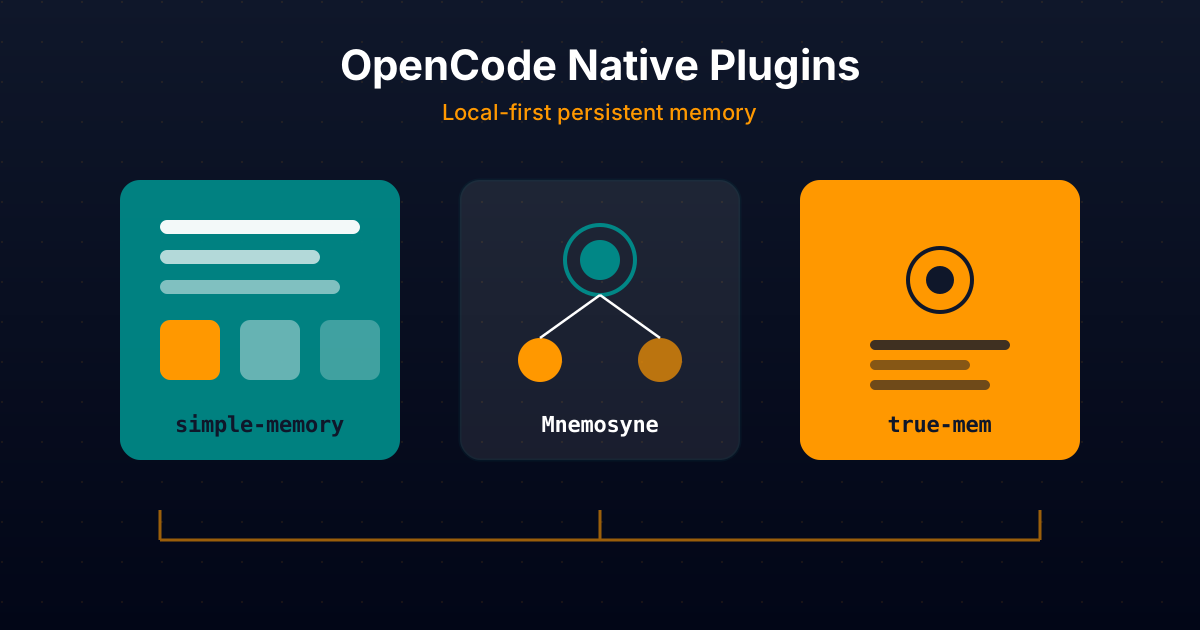
If you have been working with coding agents for a while, you know the “amnesiac agent syndrome”: every session starts from zero, you re-explain your architecture, your preferences, and the decisions you made yesterday. In The Architecture of Persistent AI Agent Memory I already covered the theoretical framework (OpenClaw, QMD, Mem0, Cognee). Today we get hands-on with three real plugins you can install in OpenCode right now.
The Concrete Problem: Three Sessions, Three Different Agents
I work on Kotlin projects for Android, I maintain this Astro site and every now and then I pick up a Python script I left half-finished three weeks ago. My natural flow is to open OpenCode, write “continue where we left off with the Kotlin parser”, and expect the agent to know what “the Kotlin parser” is, why I chose it over kotlinx-parser, and what architectural decisions I made last time.
The problem is that without persistent memory, I open a session and the agent is a polite stranger. It has the superpowers of the model, but zero context about me, my project, my quirks. I have to give the TED talk again about “this repo uses X, not Y, for reason Z”.
That pushed me to seriously try the persistent memory plugin ecosystem for OpenCode. And here I bring the three that have served me best when I want something native, local-first, and installable in five minutes. In the second article of this series we will cover the heavier but more versatile MCP servers, and in the third article we go deep into day-to-day usage.
Comparison Criteria
Before diving in, let us set the axes along which I will evaluate each plugin. This helps me not fool myself, and helps you understand why I reach the conclusions I reach:
- Persistence model: plain text files, local SQLite, external binary, remote database? This determines auditability, portability, and infrastructure dependency.
- Installation curve: required commands, system prerequisites, downloaded model size.
- Extraction model: must you remember explicitly or does the plugin detect automatically? Does it support global vs. project scope?
- Search and retrieval: simple token matching, BM25, vector search, hybrid. This matters when your memory grows to hundreds of notes.
- Multilingual and noise handling: if you work in Spanish and mix code, you need the plugin not to go crazy with the agent’s own meta-conversation.
- Maturity: GitHub stars, commit frequency, open issues, current version.
- Compatibility with the rest of the OpenCode stack: does it interfere with other plugins, compaction hooks, sub-agents?
With that in mind, let us dig in.
1. opencode-plugin-simple-memory: The Pragmatist of Logfmt Files
Repository: github.com/ApplauseLab/opencode-plugin-simple-memory (also published as @knikolov/opencode-plugin-simple-memory on npm).
Author: cnikolov / ApplauseLab.
Stars: ~124. Active version: regular releases.
Language: TypeScript 100%. Persistence: daily logfmt files.
Design Philosophy
simple-memory is the plugin you write when you are fed up with complexity. Its data model is deliberately minimalist: every memory is a line in a YYYY-MM-DD.logfmt file under .opencode/memory/. No SQLite, no embeddings, no MCP server. Plain text with space-separated fields, easily parseable and, above all, human-readable with cat.
I love this approach because it fulfills the property I value most in a memory tool: I can audit what my agent knows with a shell command.
Installation
The installation is the simplest of the three:
// ~/.config/opencode/opencode.jsonc
{
  "$schema": "https://opencode.ai/config.json",
  "plugin": ["@knikolov/opencode-plugin-simple-memory"]
}
And optionally, to enable auto-load and auto-save:
{
  "plugin": [
    [
      "@knikolov/opencode-plugin-simple-memory",
      {
        "autoLoad": true,
        "autoSave": true,
        "contextLimit": 5,
        "contextMaxChars": 1200
      }
    ]
  ]
}
However, there is an important detail few people mention: OpenCode does not auto-update plugins. If you install version 0.5 today and 0.6 comes out tomorrow with a bug fix that affects you, you have to clear the cache manually:
rm -rf ~/.cache/opencode/node_modules/@knikolov/opencode-plugin-simple-memory
opencode
This happened to me once and cost me twenty minutes wondering why a new feature did not show up.
Memory Model
Each memory record is a logfmt line of this form:
ts=2026-05-28T10:00:00.000Z type=context scope=api content="Remember this" issue=#51 tags=backend,currentSupported fields:
type:decision,learning,preference,blocker,context,pattern. Useful for categorizing without inventing a taxonomy.scope: free string, typically something likeuser,project, or a subsystem name (api,tests,deploy/staging).tags: comma-separated list for secondary filtering.content: the actual text.
Deleted memories are logged in deletions.logfmt, which is an audit detail I appreciate. No “memory was lost” without traceability.
Tools Exposed to the Agent
The plugin registers nine tools: memory_remember, memory_recall, memory_update, memory_forget, memory_list, memory_export, memory_import, memory_compact, memory_context. The names are self-explanatory, and memory_compact can be run with dryRun: true to preview changes before applying them.
The Good
- Extreme auditability: open any
.logfmtfile invimand understand exactly what the agent knows. - Zero external dependencies: no Python, no Go, no Docker, no internet connection required after installing the npm package.
- Rich filters in
memory_recall: by scope, type, query, tags, date (since/until), matching mode (contains,exact,prefix). This partially compensates for the lack of semantic search. - Portable:
logfmtfiles are trivially versionable with Git. You cangit diff .opencode/memory/and see what the agent learned this week. - Smooth migration: the format is backwards compatible. Old entries without quotes remain readable.
The Not-So-Good
- No semantic search: if you say “JWT” and previously saved “JSON Web Token”, it will not relate them. Past a few hundred memories you will notice the limit.
- No native multi-agent: OpenCode only. If you migrate to Claude Code tomorrow, you have to migrate manually with
memory_export/memory_import(which supportsjsonl,jsonandlogfmt). - Relevance scoring is word-matching:
contextMinScoreis binary, not gradual. Automatic injections lose context when memories use different terminology.
Verdict
simple-memory is the plugin I would recommend to someone who wants to start today and does not want surprises. If your project fits in a few hundred notes and you value auditability over sophistication, it is hard to beat.
I use it as a second layer: basic-memory (covered in the second article) handles my semantic project memory, and simple-memory handles the quick operational notes I do not want indexed vectorially.
2. opencode-mnemosyne: Total Offline with Go Binary and ONNX
Repository: github.com/gandazgul/opencode-mnemosyne.
Author: gandazgul.
Stars: ~13 (young project). Active version: v0.2.4 (April 2026).
Plugin language: TypeScript 100%. Backend: standalone Go binary at github.com/gandazgul/mnemosyne.
Persistence: SQLite with sqlite-vec for local vector search.
Design Philosophy
Mnemosyne is for those who see a 500MB downloaded model binary and say “perfect, now we are talking”. It is the only one of the three that does not depend on any cloud service for anything: neither for embeddings, nor for LLM, nor for storage. Everything runs on your machine.
They position it explicitly as “the local/offline alternative to opencode-supermemory”. And they deliver.
Installation
Here is where Mnemosyne starts to differentiate. It is not npm; it is a Go binary:
git clone https://github.com/gandazgul/mnemosyne.git
cd mnemosyne
task install
This requires:
- Go 1.21+
- GCC (to compile sqlite-vec with C bindings)
task(the Go task runner)
Once the mnemosyne binary is installed (in $PATH), the OpenCode plugin is configured trivially:
// ~/.config/opencode/opencode.json
{
  "$schema": "https://opencode.ai/config.json",
  "plugin": ["opencode-mnemosyne"]
}
The first time it runs, it automatically downloads the ML models (~500MB one-time, cached locally). This is a showstopper if you have limited bandwidth, but a non-issue if you always work from the same network.
Memory Model
Mnemosyne operates with two scopes:
project: collection named after the project directory. Persists across sessions of the same project.global: shared collection. Created on firstmemory_store_global.
And two criticality levels per scope:
- Normal: memories that can decay with context compaction.
core: memories marked as critical that survive compaction and are always available. Documentation recommends using them sparingly.
The plugin recommends adding this block to the project’s AGENTS.md so the agent uses memory proactively:
## Memory (mnemosyne)

- At the start of a session, use memory_recall and memory_recall_global to search for context
  relevant to the user's first message.
- After significant decisions, use memory_store to save a concise summary.
- Delete contradicted memories with memory_delete before storing updated ones.
- Use memory_recall_global / memory_store_global for cross-project preferences.
- Mark critical, always-relevant context as core (core=true) — but use sparingly.
- When you are done with a session, store any memories that you think are relevant
  to the user and the project.
This is a pattern I really like: the plugin defines the usage contract via convention, not code. The agent decides when to save based on the instructions.
Real Hybrid Search
Here is where Mnemosyne shines technically. It combines:
- Full-text search via SQLite FTS5 with BM25 ranking.
- Vector search via
sqlite-vecwith cosine similarity using thesnowflake-arctic-embed-m-v1.5model. - Reciprocal Rank Fusion (RRF) to combine both rankings.
All ML inference runs locally via ONNX Runtime. Your memories never touch the network after the initial model download. For me, who often works from cafes with shared WiFi, this is pure gold.
Compaction Hook
A very interesting detail: the plugin registers a hook on experimental.session.compacting that injects instructions about the memory tools into the compaction prompt. This means that when OpenCode compacts the context, the agent knows it still has memory available and can query before summarizing.
The Good
- Absolute privacy: nothing leaves your machine. Not even embeddings.
- Real hybrid search without external services.
- The compaction hook is elegant: it integrates memory with the context lifecycle.
- Clear documentation on when to use
coreand when not to (with concrete example: “memories of a known critical bug”).
The Not-So-Good
- Higher installation curve: you need Go, GCC and task. If you come from pure Node (like me with many projects), there is a small initial friction.
- Young project: 13 stars is a small user base. If you find a bug, you may have to read the Go code yourself.
- Limited multi-agent: OpenCode only for now. The binary backend could integrate with other agents via MCP, but there is no official integration outside OpenCode.
- 500MB of model: not huge, but on a laptop with a small SSD it matters.
Verdict
Mnemosyne is what I would recommend to a privacy-paranoid user, someone working in air-gapped mode, or an indie dev who hates cloud dependencies. If your biggest fear when using supermemory is “who reads my memories?”, Mnemosyne is your answer. The trade-off is a more frictionful installation and a smaller community.
3. true-mem: Cognitive Psychology Applied to AI Memories
Repository: github.com/rizal72/true-mem.
Author: rizal72.
Stars: ~192. Active version: v1.4.1 (April 2026).
Language: TypeScript 100%. Persistence: SQLite via bun:sqlite (with fallback to node:sqlite for Node 22+).
License: MIT.
Design Philosophy
true-mem is, conceptually, the most interesting of the three. While simple-memory bets on simplicity and Mnemosyne on offline privacy, true-mem bets on modeling memory as if it were a human brain.
Its author draws explicit inspiration from:
- Ebbinghaus forgetting curve: episodic memories fade over time (default 7 days), but preferences and decisions are permanent. Like your brain: you forget what you had for dinner last Tuesday but remember your favorite color.
- 7-feature scoring model: every memory is scored by Recency, Frequency, Importance, Utility, Novelty, Confidence, and Interference. The scoring determines which memories get promoted from STM (short-term) to LTM (long-term).
- STM/LTM dual-store architecture with automatic promotion.
- 4-layer defense system against false positives.
- Reconsolidation: when new information contradicts existing memories, the system intelligently decides whether to merge, keep them as complements, or resolve the conflict.
This makes it, technically, the most sophisticated of the three at the level of computational psychology.
Installation
Installation is trivial, similar to simple-memory:
// ~/.config/opencode/opencode.jsonc
{
  "plugin": ["true-mem"]
}
OpenCode automatically downloads the plugin from npm. On first run, it creates ~/.true-mem/ with the SQLite database and debug logs. You will see a toast notification confirming it is loaded.
The config file is created automatically at ~/.true-mem/config.jsonc:
{
  // Storage location: "legacy" = ~/.true-mem/ (default), "opencode" = ~/.config/opencode/true-mem/
  "storageLocation": "legacy",
  // Injection mode: 0 = session start only (recommended), 1 = every prompt
  "injectionMode": 0,
  // Sub-agent mode: 0 = disabled, 1 = enabled (default)
  "subagentMode": 1,
  // Embeddings: 0 = Jaccard similarity only, 1 = hybrid (Jaccard + embeddings)
  "embeddingsEnabled": 0,
  // Maximum memories to inject per prompt (10-50 recommended)
  "maxMemories": 20
}
Memory Model
true-mem automatically classifies extracted memories into:
| Type | Decay | Store | Scope | Example |
|---|---|---|---|---|
constraint | Never | STM | Global | ”Never use var” |
preference | Never | STM | Global | ”Prefers functional style” |
learning | Never | LTM | Global | ”Learned bun:sqlite API” |
procedural | Never | STM | Global | ”Run tests before commit” |
decision | Never | LTM | Project | ”Decided SQLite over Postgres” |
semantic | Never | STM | Project | ”API uses REST, not GraphQL” |
episodic | Yes (7d) | STM | Project | ”Yesterday we refactored auth” |
The key here is that episodic memories are the only ones that fade. This is exactly what human memory does: we remember what matters (preferences, decisions, technical knowledge) and forget the mundane (what we ate yesterday).
Automatic Detection with Four Defense Layers
Where true-mem especially shines is in what it decides to save and what it decides to discard. Unlike simple-memory (which only saves when you say “remember”) or supermemory (which detects keywords like “remember this”), true-mem runs a classifier with four layers:
- Question Detection: filters questions before classifying. If you say “Do you remember this?”, it does not get saved.
- Negative Patterns: detects the AI’s own meta-conversation (“Goal: The user is trying to…”), list selections (“I prefer option 3”), and first-person recall (“I remember when we fixed that”). Supports 10 languages.
- Multi-Keyword + Sentence-Level: requires 2+ signals in the same sentence to consider storing.
- Confidence Threshold: only saves if the confidence score is ≥ 0.6.
This is hugely important because it solves a real problem: how do you prevent the agent from saving its own thoughts as if they were yours? It is the classic problem of “the agent has learned it likes TypeScript” when you were really saying “I prefer TypeScript”. The role-aware extraction (role-patterns.ts) explicitly separates Human vs Assistant messages.
Real Multilingual
true-mem supports 15 languages: English, Italian, Spanish, French, German, Portuguese, Dutch, Polish, Turkish, Russian, and five more. I have tested it in conversations mixing Spanish and English, and classification works surprisingly well.
The global scope system is also multilingual: “siempre”, “ovunque”, “toujours”, “immer”, “sempre” — all these words trigger global scope in their respective languages.
The Good
- Most realistic memory model: the combination of decay + scoring + dual-store reflects how human memory works. This is the only one of the three where I thought “this feels right”.
- Excellent noise filters: meta-talk detection is something I have suffered with in other plugins and is elegantly solved here.
- Truly multilingual: not an afterthought. 15 languages with native patterns.
- No native dependencies: uses built-in
bun:sqlite(ornode:sqlite). You do not need to install external binaries. - Optional embeddings: you can enable them if you want (
embeddingsEnabled: 1), but by default uses Jaccard (faster and less resource-hungry).
The Not-So-Good
- OpenCode only: just like
simple-memoryandMnemosyne, no native integration with Claude Code, Cursor or Codex. - Default injections are at session start (
injectionMode: 0). This means new memories created during a long session do not appear until you restart. The option to inject on every prompt (injectionMode: 1) has a token cost. - Embeddings are experimental: the docs are honest about this. They work, but Jaccard mode is the production-stable one.
- Confidence threshold can be strict: in my tests, the plugin sometimes discards valid preferences because they do not exceed 0.6. Adjustable, but you need to know it exists.
Verdict
true-mem is what I recommend to anyone who wants the most sophisticated memory model without sacrificing ease of use. If you care about the agent not just storing, but prioritizing what it stores, and forgetting what it should forget (not what it should remember), this is your plugin.
I have it installed permanently. The difference between this and simple-memory is that with true-mem I rarely need to review what it saved, because the filtering system is good enough.
Quick Comparison Table
| Feature | simple-memory | Mnemosyne | true-mem |
|---|---|---|---|
| Stars | ~124 | ~13 | ~192 |
| Backend | logfmt files | Go binary + SQLite | SQLite (bun:sqlite) |
| Search | Keyword matching | Hybrid FTS5 + vector (ONNX) | Jaccard / experimental embeddings |
| Multi-agent | No (OpenCode only) | No (OpenCode only) | No (OpenCode only) |
| Installation | Trivial (npm) | Medium (Go + GCC + task) | Trivial (npm) |
| Auto detection | Keyword only | By AGENTS.md convention | Automatic with 4 layers |
| Privacy | Total (local files) | Total (local binary) | Total (local SQLite) |
| External dependency | None | 500MB ONNX model | Optional (embeddings) |
| Decay model | No | No | Yes (Ebbinghaus) |
| Learning curve | Low | Medium | Low-medium |
| Best for | Auditability, Git-friendly | Total privacy, offline semantic search | Noise filtering, multilingual, cognitive model |
When to Use Each One
If I had to pick one to start today, my honest answer is: it depends on your developer personality.
- If you value radical transparency and want to read your memories with
cat:simple-memory. - If you work in air-gapped mode or with sensitive data:
Mnemosyne. - If you want the plugin to “think” for you about what to save and what to forget:
true-mem.
And if you want to try several (like me), know that they can coexist because each writes to different directories: .opencode/memory/ (simple-memory), <project> or global of Mnemosyne, and ~/.true-mem/ (true-mem). I have not found conflicts, although obviously each plugin has its own knowledge base and they do not sync with each other.
What Is Coming in the Next Article
These three plugins are fantastic, but they all share a common limitation: they only work with OpenCode. If tomorrow you decide to try Claude Code for a serious project, or Cursor for a quick refactor, or Codex CLI on the CI server, you will not be able to take the memory with you.
In the second article of this series we cover the three cross-agent MCP servers I have found most mature: opencode-supermemory (cloud-first with auto-compact), basic-memory (Markdown + knowledge graph), and forgetful (atomic Zettelkasten + entities + skills). These are more infrastructure, but the versatility pays off.
And in the third article I tell you exactly how I combine the best ones in my daily flow with real configuration examples for Claude Code, Codex and OpenCode.
References and Further Reading
- opencode-plugin-simple-memory repository
- OpenCode plugin documentation
- opencode-mnemosyne on GitHub
- Mnemosyne backend binary
- true-mem on GitHub
- Ebbinghaus forgetting curve (Wikipedia)
- A-MEM: Agentic Memory paper (arXiv)
- logfmt format documentation
- SQLite FTS5 (official docs)
- Reciprocal Rank Fusion (original paper)
- Previous article: Architecture of Persistent AI Agent Memory
- Previous article: OpenCode Subagents
You might also be interested in
The Persistent Memory Stack I Actually Use...
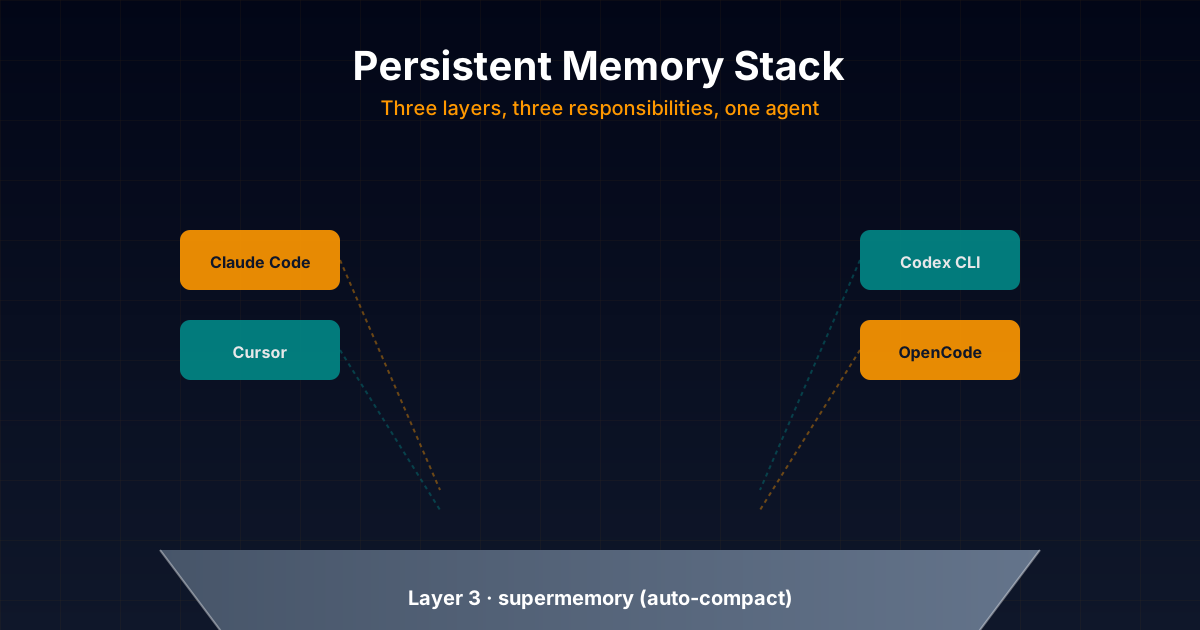
Honest technical deep dive into the persistent memory stack I combine daily in my projects: opencode-supermemory for auto-compact, basic-memory as main memory with Markdown + graph, and forgetful as procedural skills layer. With real configuration examples for Claude Code, Codex,
Cross-Agent MCP Servers for Persistent
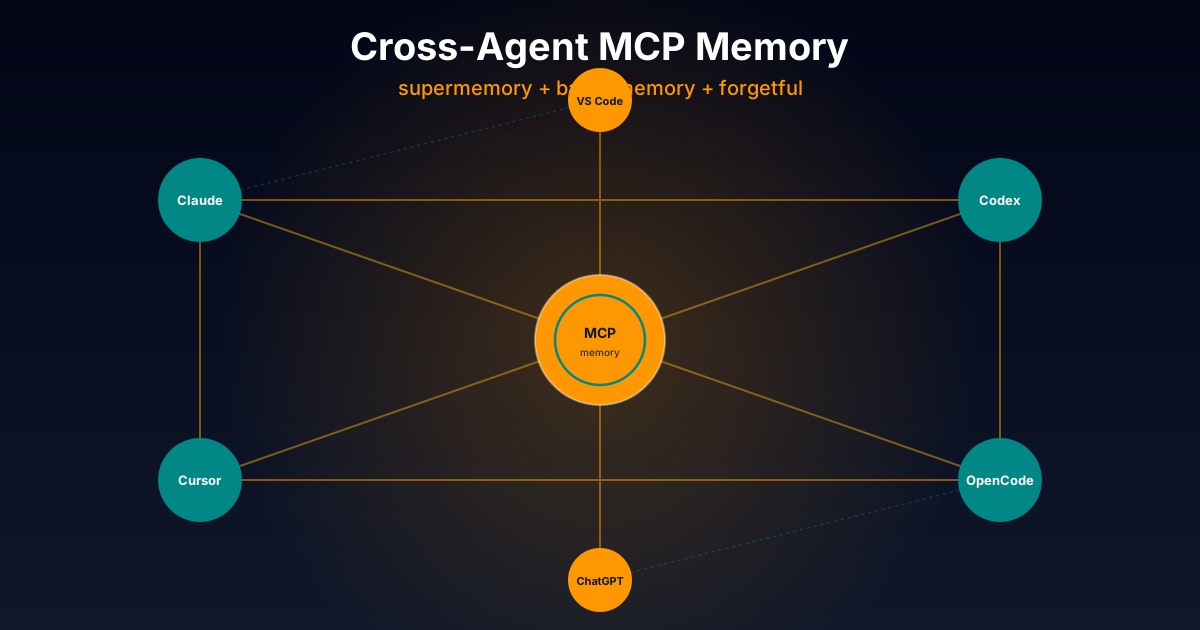
Exhaustive technical comparison of three cross-platform MCP servers to give AI agents persistent memory: opencode-supermemory (cloud), basic-memory (Markdown + graph), and forgetful (atomic Zettelkasten). Works with Claude Code, Codex, Cursor and more.
Awesome OpenCode: The Ecosystem Zoo
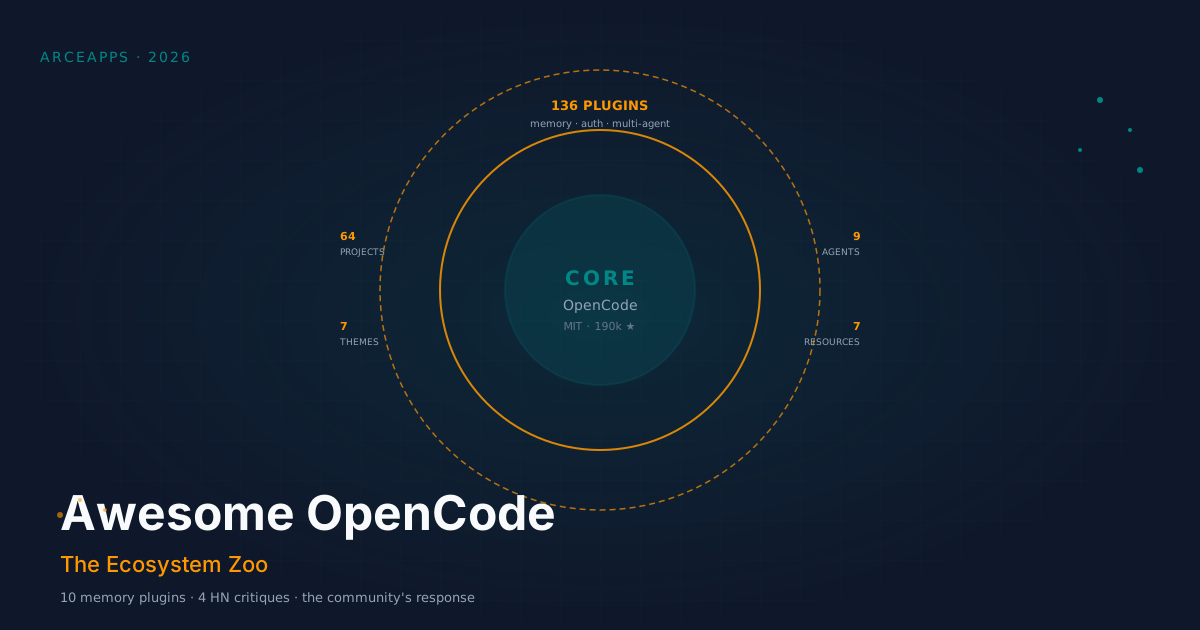
A curated map of the OpenCode ecosystem in 2026: 10 persistent-memory plugins no blog has shown you, 4 real Hacker News critiques, and the indie community's defensive response.