
PlugMem: Microsoft Research's Task-Agnostic Memory Module That Every LLM Agent Needs
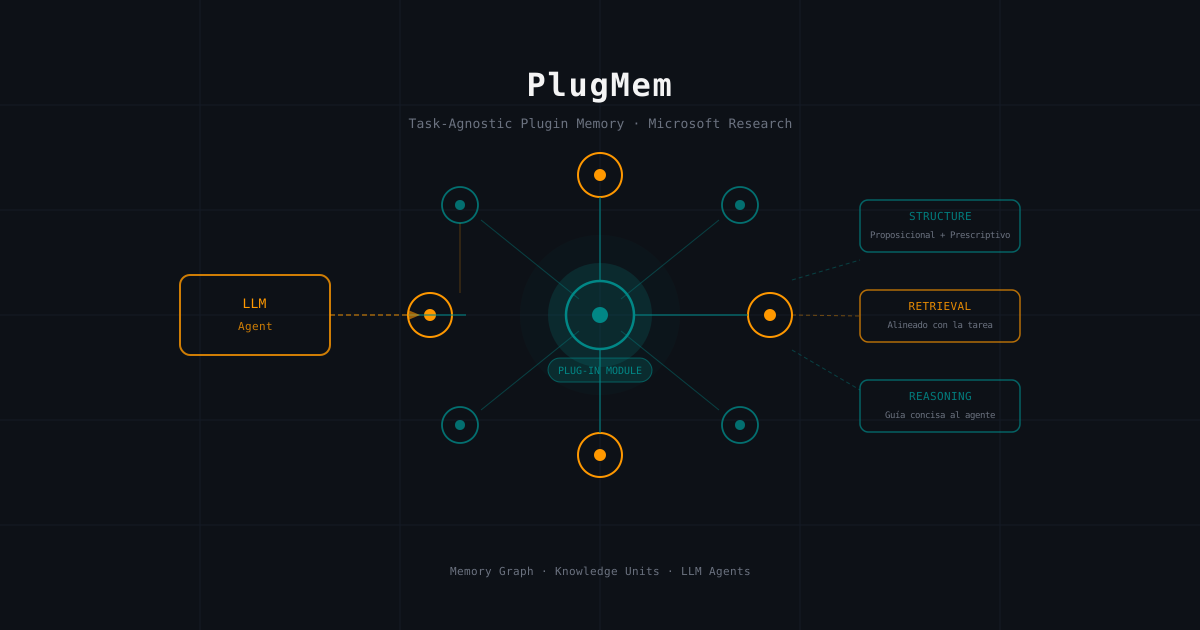
Table of Contents
This article is a direct complement to the agentic memory series on this blog. If you have not yet read the broad analysis of persistent memory frameworks, start with The Architecture of Persistent AI Agent Memory. For the security and privacy angle, check out Agentic Memory: Security, Privacy, and the Future of the AI Second Brain. This article covers a specific angle we had not addressed yet: Microsoft Research’s proposal to fully decouple agent memory through a task-agnostic plugin module.
The Problem PlugMem Tries to Solve
We have been talking about memory in LLM agents as if it were a problem every team has to solve independently. Every agent framework ships with its own memory system: LangChain has its ConversationBufferMemory and VectorStoreRetrieverMemory, CrewAI builds shared context between agents, AutoGPT has its own storage system. The result is brutal fragmentation: every time you switch frameworks, you start from scratch with memory.
But there is a deeper problem than fragmentation. Most of these memory systems are designed for a specific task. A coding agent’s memory is not the same as a legal reasoning agent’s. A trading agent has different retrieval needs than a customer support agent. And this means that in practice, most memory systems are basically glorified RAG with some summarization logic on top.
PlugMem is Microsoft Research’s answer to this question: can you design a memory module that is genuinely task-agnostic and works with any LLM agent without modifications?
Their answer is yes, and the architecture they have developed to prove it deserves a detailed analysis.
What PlugMem Actually Is
PlugMem (introduced in the paper “PlugMem: A Task-Agnostic Plugin Memory Module for LLM Agents” from Microsoft Research and the TIMAN Group at the University of Illinois) is a memory module designed to function as a plugin on top of any existing LLM agent.
The premise is simple but powerful: instead of trying to make the agent “remember” things by itself, an intermediate specialized layer is introduced that:
- Observes the raw agent interactions (conversations, actions, outcomes).
- Transforms those interactions into structured, reusable knowledge.
- Retrieves relevant knowledge when the agent needs it.
- Distills that knowledge into concise guidance the agent can consume efficiently.
The design is inspired by how human long-term memory works: we do not store literal transcripts of our experiences, but transform them into abstract knowledge (facts) and procedural knowledge (skills). PlugMem applies this same distinction to the LLM agent domain.
The Three-Component Architecture
Component 1: Structure
This is the most innovative component of PlugMem. Most agent memory systems simply compress or summarize previous conversations. PlugMem does something qualitatively different: it transforms interactions into propositional and prescriptive knowledge, organizing it into a memory graph.
Propositional knowledge is facts. Statements about the state of the world, about the user, about the task domain. For example, if the agent is helping with Android code and the user mentions they use Kotlin with MVVM architecture, that is extracted as a propositional fact that will be relevant in all future interactions.
Prescriptive knowledge is skills or strategies. Patterns of action that worked well in the past. If the agent discovered that for this specific user approach A works better than approach B, that gets stored as prescriptive knowledge: “When the user asks for X, use strategy Y”.
The distinction is critical. Propositional knowledge answers “what is true?”. Prescriptive knowledge answers “what to do?”. And both are organized in a graph where nodes are knowledge units and edges represent semantic relationships between them.
This graph is not static. It gets updated incrementally with each new interaction, preserving the history of how knowledge evolved over time.
Component 2: Retrieval
Once you have a knowledge graph, the problem becomes retrieval: given the current task context, which knowledge units are relevant?
PlugMem’s retrieval component is designed to be task-agnostic in two senses. First, it makes no assumptions about the type of task (it does not assume you are doing code, legal reasoning, or anything else). Second, it uses the semantic description of the current task to guide retrieval, not hard-coded patterns.
Retrieval works in two steps:
- Semantic retrieval: The relevance of each graph node to the current task is computed using semantic similarity.
- Graph expansion: The initial selection is expanded by following graph edges to include related knowledge that may not be directly similar but is contextually relevant.
This second step is what differentiates PlugMem from a simple vector store. The graph structure allows it to capture relationships that embedding similarity cannot.
Component 3: Reasoning
The third component closes the loop: once relevant knowledge is retrieved, it must be converted into something the agent can use efficiently.
Here is PlugMem’s efficiency trick. Instead of injecting all retrieved knowledge nodes directly into the agent’s context (which could consume many tokens), the reasoning component distills that knowledge into concise and actionable guidance.
It is like the difference between giving someone a textbook before an exam versus giving them a cheat sheet with the key points. The textbook (raw retrieved knowledge) might be far more complete, but the cheat sheet (distilled knowledge) is what you actually need when it is time to act.
The result is that the agent receives compact guidance that integrates relevant knowledge from its history, without saturating the context window.
Why “Task-Agnostic” Matters More Than It Sounds
We have an elegant architecture. But why does it matter that it is task-agnostic?
Because the agent ecosystem is fragmenting at an alarming rate. Every week brings a new framework, a new agent type, a new application. If you have to re-implement memory for every new task or framework, the adoption cost is prohibitive.
PlugMem offers a different proposition: a memory module that works as a plugin. You add it to your existing agent with minimal modifications. The module observes the agent’s interactions without requiring changes to the agent’s core logic.
This has important practical implications:
- You can add persistent memory to agents that did not have it without rewriting them.
- You can migrate between agent frameworks while preserving the accumulated memory graph.
- You can share the same memory module across multiple specialized agents working in the same domain.
In the context of Agent Skills work we have explored on this blog, PlugMem would be the component that makes skills learned in one session available in the next, regardless of which specific agent executes them.
Results and Performance
The results reported in the paper are what make PlugMem especially interesting for an indie developer working with limited resources.
The central finding is that PlugMem outperforms task-specific memory designs while using fewer context tokens. This combination is unusual because in machine learning there is normally a tradeoff between performance and efficiency. PlugMem suggests that the structure of knowledge matters more than the quantity of knowledge injected.
The intuition behind this makes sense: one well-extracted and structured fact is worth more than ten paragraphs of raw conversation. The quality of knowledge representation matters more than its volume.
For an indie developer, this translates to lower API call cost without sacrificing (and in fact improving) agent response quality. It is the kind of optimization that changes the economics of agent projects.
Limitations and Critical Considerations
It would be dishonest to present PlugMem without mentioning its current limitations.
This is research, not production. The Microsoft Research paper and the GitHub repository are research prototypes. There is not (yet) a well-maintained PyPI library you can add to your project with pip install plugmem. Implementing PlugMem in production requires understanding the repository code and adapting it to your stack.
The structure component has a computational cost. Transforming raw interactions into propositional and prescriptive knowledge requires additional LLM calls. There is real overhead in the structuring phase that must be accounted for in system design.
Graph quality depends on extraction quality. If the structure component fails to correctly extract a fact or skill, that information is lost (or worse, misrepresented). The memory graph can accumulate noise over time if there are no cleanup mechanisms.
Graph scalability is not fully resolved. For long-running agents that accumulate thousands of interactions, graph management (when to consolidate, when to remove stale nodes) is an open problem that the paper addresses partially but does not definitively solve.
How It Fits with the Current Ecosystem
PlugMem does not directly compete with frameworks like Mem0 or Cognee that we analyzed in The Architecture of Persistent AI Agent Memory. Rather, it is an architectural proposal that those frameworks could adopt internally.
The key distinction PlugMem brings to the debate is the explicit separation between propositional knowledge and prescriptive knowledge. Many memory systems treat all information equally (as embeddings in a vector space). PlugMem argues that facts and skills are cognitively different and should be stored and retrieved differently.
This distinction resonates with what we have explored on this blog about using the PARA method to organize agent memory. The separation between “what I know” (propositional) and “how I do things” (prescriptive) is analogous to the distinction between reference areas and active projects in the PARA method.
For those interested in dynamic context and Agent Skills, PlugMem’s prescriptive knowledge is essentially the automatic, learned equivalent of the skills you configure manually: strategies that worked well in the past that the agent should apply in similar future situations.
Practical Perspective: When to Implement PlugMem
If you are an indie developer working with LLM agents, the practical question is: when does it make sense to invest time in implementing a PlugMem-inspired architecture?
It makes sense when:
- Your agent performs the same class of tasks repeatedly and should learn from past experiences.
- You have a limited token budget and need memory to be efficient.
- You work with multiple agents that should share common knowledge.
- Your agent’s domain is stable enough that learned “skills” remain relevant over time.
It makes less sense when:
- Each session of your agent is completely independent and there is no value in persisting knowledge.
- You work with highly variable tasks where past skills have little transferability.
- You are in the early prototyping phases and adding memory complexity would slow down iteration.
The general rule: implement the memory complexity that your use cases actually require, not the one that sounds most technically impressive.
Conclusion
PlugMem represents a genuinely different approach to the problem of memory in LLM agents. Instead of building ad-hoc memory systems for each task, it proposes an abstraction layer that separates knowledge representation from agent logic.
The most valuable part of the paper is not just the system itself, but the conceptual framework it introduces: the distinction between propositional and prescriptive knowledge, and the idea that knowledge structure matters more than knowledge volume for agent efficiency.
As an indie developer, I found particularly relevant the finding that PlugMem uses fewer tokens while producing better results. It is the kind of optimization that allows building more capable agents without API costs spiraling out of control. And in an ecosystem where every API call has a real cost, that is not a minor detail.
The repository is available on GitHub for those who want to explore the reference implementation. And the full paper is on Microsoft Research. If you are actively working with LLM agents, it is worth reading even if you do not implement PlugMem directly: the conceptual framework enriches how you think about memory design in general.
References
-
PlugMem: A Task-Agnostic Plugin Memory Module for LLM Agents — Microsoft Research & TIMAN Group, University of Illinois (2025). Original PlugMem paper describing the three-component architecture and evaluation experiments.
-
PlugMem — GitHub Repository — TIMAN Group (2025). Reference implementation of the PlugMem module with examples and configuration.
-
The Architecture of Persistent AI Agent Memory — ArceApps Blog (2026). Broad analysis of agentic memory frameworks including Mem0, Cognee, and OpenClaw.
-
Agentic Memory: Security, Privacy, and the Future of the AI Second Brain — ArceApps Blog (2026). Analysis of security and privacy risks in persistent agent memory.
-
The PARA Method and File-Based AI Memory — ArceApps Blog (2026). Exploration of the local file-based memory approach using Markdown and the PARA method.
You might also be interested in
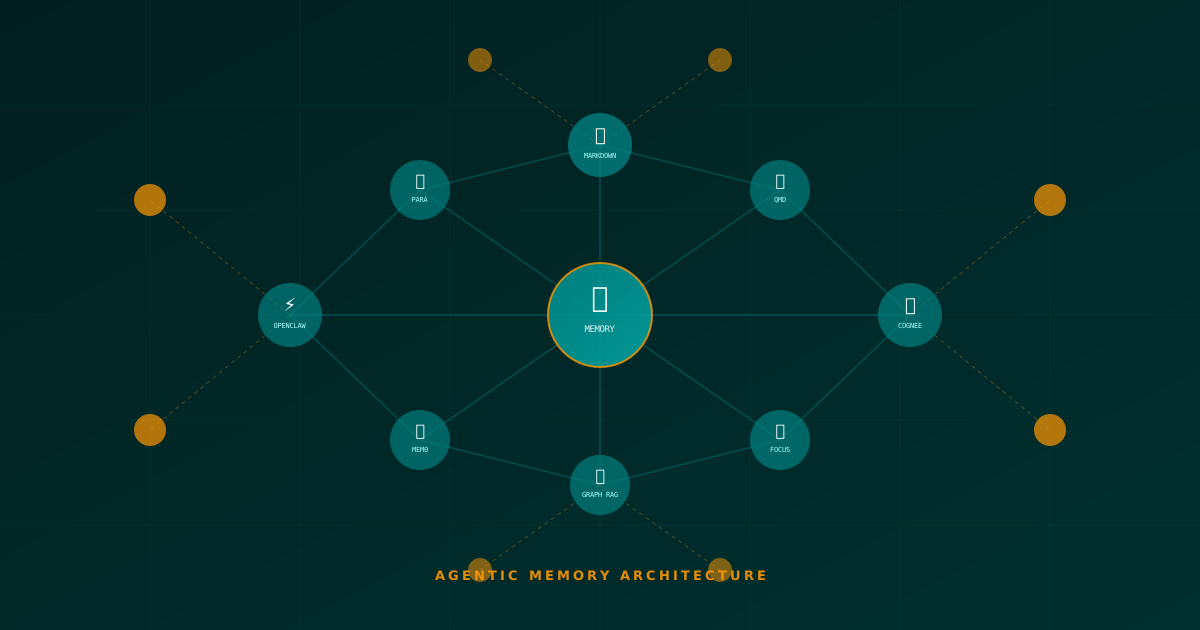
The Architecture of Persistent AI Agent Memory: Frameworks, Methodologies and the Evolution of Personal Knowledge Management
A deep technical analysis of how AI agents persist, consolidate and retrieve information autonomously. From OpenClaw and QMD to Mem0, Cognee and neurobiological memory models.
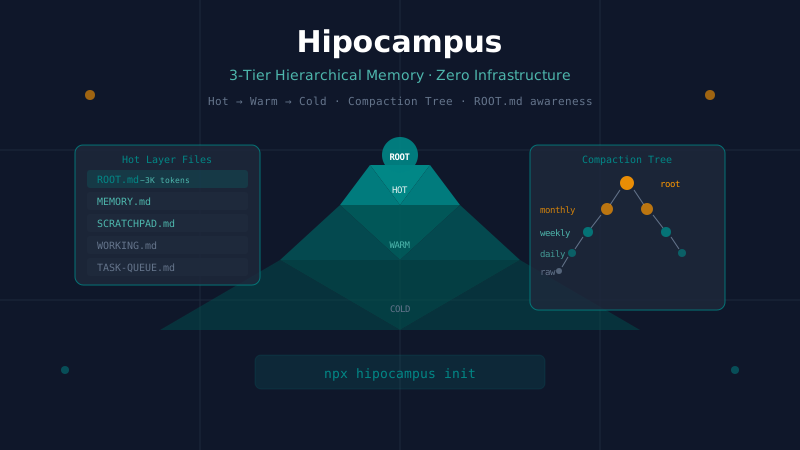
Hipocampus: Zero-Infrastructure Hierarchical Memory for AI Agents
A technical deep-dive into Hipocampus, a drop-in memory harness for AI agents that uses a 3-tier Hot/Warm/Cold architecture and a 5-level compaction tree. How ROOT.md enables constant-cost memory awareness and how it compares to hmem, Mem0, and Letta.
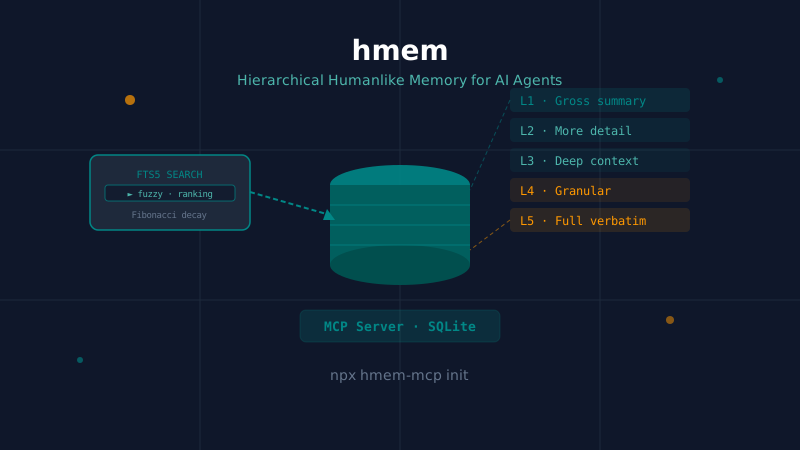
hmem: Hierarchical SQLite Memory for AI Agents That Actually Persists
A technical deep-dive into hmem (Humanlike Memory), an MCP server that models human memory in five lazy-loaded levels backed by SQLite + FTS5. How Fibonacci decay, logarithmic aging, and a curator agent solve the context window problem across sessions and machines.