
First Principles Reasoning and AI Audit: Q...
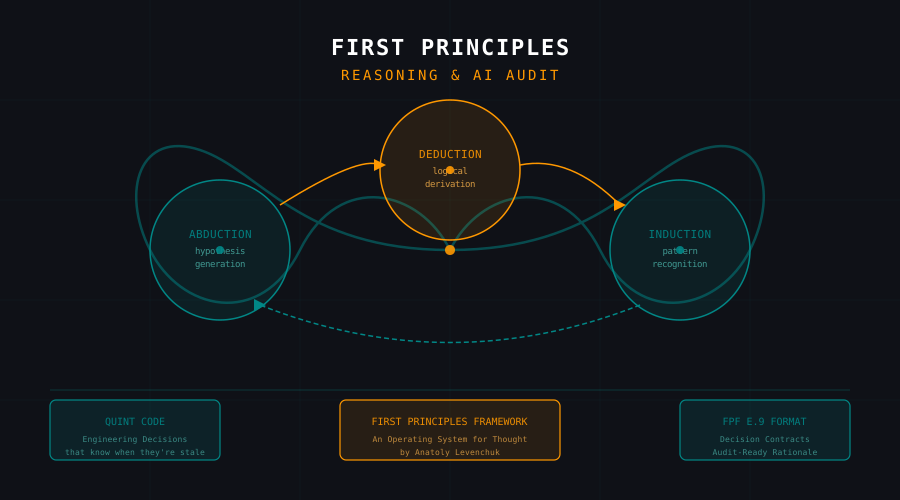
Table of Contents
Related reading: Spec-Driven Development with Agentic AI · AI Agent Skills: Dynamic Context Injection · Reasoning Models: From o1 to R1
🧠 The Problem with Confident AI Opinions
There is a peculiar danger in working with modern AI coding assistants: they are exceptionally good at sounding right. A large language model (LLM) trained on billions of code tokens will produce architecturally coherent responses almost every time, regardless of whether those responses are actually appropriate for your specific context, constraints, or long-term maintainability.
This is not a bug in the model. It is a feature that becomes a liability when we mistake fluency for reasoning. An AI that can explain three different database indexing strategies with equal confidence is not the same as an AI that has genuinely evaluated which strategy is best for your workload, your read/write ratio, and your operational constraints.
The gap between “confident generation” and “structured reasoning” is where most software quality problems with AI-assisted development actually live. And it is exactly the gap that the First Principles Framework (FPF) and Quint Code were designed to close.
This article is a deep technical exploration of these two tools and the philosophical framework they embody — particularly the Abduction–Deduction–Induction (ADI) cycle applied to engineering decisions. We will look at how enforcing structured reasoning changes the quality of AI-generated decisions, and why building an audit trail for your AI agent is not optional in serious software work.
📐 First Principles: The Philosophical Foundation
The phrase “first principles thinking” is overused to the point of becoming meaningless in pop tech culture. Let us be precise.
First principles reasoning means decomposing a problem to its foundational constraints — the things that cannot be derived from anything else within your domain — and building your reasoning upward from there, rather than by analogy, convention, or authority.
In physics, first principles calculations start from quantum mechanics without empirical fitting parameters. In software engineering, first principles means asking: what is the actual problem we are solving, stripped of all the assumptions about how it has been solved before?
The First Principles Framework (FPF) — authored by Anatoly Levenchuk and described as “an operating system for thought” — is a rigorous, transdisciplinary specification that formalizes this intuition into a machine- and human-readable architecture. It is not a methodology like Agile or a pattern language like Gang of Four. It is an episteme of method: a structured specification of how to think.
FPF is built on a small, non-negotiable kernel:
- Local meaning, explicit translation. Terms live inside bounded contexts. When you reuse a term across contexts, you need an explicit bridge — not an assumption of shared meaning.
- One underlying reality, many lawful views. Engineering, management, research, and assurance perspectives should be projections of the same underlying work, not disconnected documents.
- Separate actors, methods, and executed work. Plans, capabilities, descriptions, and actual execution are fundamentally different things.
- Trust has structure. Every claim should declare its formality, its scope, and the evidence supporting it.
- Keep search wide before selection. In open-ended work, diversity of options is a structural requirement before selecting a winner.
- Build from first principles when categories break. When existing patterns stop being adequate, grow new abstractions instead of forcing the problem into ill-fitting boxes.
This is the intellectual DNA that Quint Code inherits.
♾️ The ADI Cycle: Abduction, Deduction, Induction
At the core of disciplined reasoning in engineering — and at the core of what Quint Code implements — is the ADI cycle: three complementary modes of inference that Charles Sanders Peirce identified in the 19th century and that modern philosophy of science has validated as the structure of genuine inquiry.
Abduction: Generating the Hypothesis
Abduction is the inference to the best explanation. Given a surprising fact, you reason backward to the most plausible hypothesis that would explain it.
In software engineering: you observe a problem (unexpected latency, a failing test, an architectural smell), and you generate the most plausible explanation. This is not jumping to a solution — it is framing the problem correctly before anything else.
The Quint Code command /q-frame implements this stage. It forces you — and the AI agent — to answer: What is actually broken? What is the real problem, not just the symptom? Without this step, every subsequent action is built on an unexamined assumption.
/q-frame → problem frame:
  - Observable symptom: API endpoint exceeds 500ms p95
  - Bounded context: User authentication service
  - Invariants: Must not break existing JWT contract
  - What we do NOT know yet: whether the bottleneck is I/O or computation
The abductive stage produces a problem frame, not a solution. This distinction is deceptively simple and systematically violated in most software teams — including those augmented by AI.
Deduction: Deriving What Must Follow
Deduction moves from general principles to specific conclusions. If you have established a problem frame and chosen a hypothesis, deduction tells you what must be true if that hypothesis is correct — what predictions it makes, what invariants it implies.
In engineering: given the problem frame, characterize what dimensions matter (/q-char), and then derive what a valid solution space looks like. This is the stage where you define your comparison dimensions with mathematical honesty: latency, throughput, memory footprint, dev complexity, blast radius of failure.
Quint Code’s /q-char and /q-explore commands inhabit this phase:
/q-char → dimensions:
  - Latency (target: p95 < 200ms, observable metric)
  - Memory overhead (constraint: < 50MB additional)
  - Cache invalidation complexity (cost dimension, not optimizable metric)
  - Backward compatibility (invariant, non-negotiable)

/q-explore → variant space:
  - Variant A: Redis-based session cache
  - Variant B: In-process LRU with probabilistic refresh
  - Variant C: Database read replica with connection pooling
  - (Diversity check: are these genuinely different? Yes — different tradeoff profiles)
The deductive stage enforces parity: every variant must be evaluated on the same dimensions. This sounds obvious. In practice, it is the step most commonly skipped, especially when an AI agent has already “decided” on an answer during generation and is post-hoc constructing justifications.
Induction: Closing the Loop from Evidence
Induction generalizes from observed evidence to update beliefs about a theory. In engineering: you measure, you observe the outcome, and you update your decision record.
This is the stage most systems completely ignore. A decision is made, implemented, and forgotten. Six months later, nobody knows why that Redis cache was added, whether it achieved its target, or whether the original problem frame was even correct.
Quint Code’s computed trust score R_eff is a direct implementation of inductive updating: as evidence ages, as benchmarks expire, as the context changes, the trust score degrades. The system prompts you to reopen the decision — not just to document it once and forget it.
/q-status → trust degradation:
  decision: "Redis session cache" (90 days old)
  R_eff: 0.41 (degraded from 0.91)
  reason: benchmark expired, team size changed
  action: /q-refresh → waive, reopen, supersede, or deprecate
This is the loop closing. Evidence decay triggers review. Induction is not a one-time event; it is an ongoing process of belief revision.
⚙️ Quint Code: FPF as an Engineering Tool
Quint Code (github.com/m0n0x41d/quint-code) describes itself as giving your AI agent “an FPF-native operating system for engineering decisions.” In practice it is a CLI tool and MCP (Model Context Protocol) server that implements the ADI cycle as structured commands available to AI agents like Claude Code, Cursor, Gemini CLI, and Codex.
Installation and Setup
# Install the binary
curl -fsSL https://raw.githubusercontent.com/m0n0x41d/quint-code/main/install.sh | bash

# Initialize for Claude Code (default)
quint-code init

# Or for other tools
quint-code init --cursor    # Cursor
quint-code init --gemini    # Gemini CLI
quint-code init --codex     # Codex CLI / Codex App
quint-code init --all       # All tools simultaneously
After initialization, the tool registers six MCP tools available to the AI agent:
| Tool | Phase | What It Does |
|---|---|---|
quint_problem | Abduction | Frames the problem, defines comparison dimensions with roles |
quint_solution | Deduction | Explores variants with diversity check, compares with parity |
quint_decision | Synthesis | FPF E.9 decision contract, impact measurement, evidence tracking |
quint_note | Micro | Micro-decisions with validation + auto-expiry (90 days) |
quint_refresh | Induction | Lifecycle management — waive, reopen, supersede, deprecate |
quint_query | Search | Status dashboard, file-to-decision lookup, surfacing related past decisions |
The /q-reason Command: The Full ADI Loop
The primary interface is /q-reason, which auto-selects the depth appropriate for the problem and runs the full ADI loop:
/q-reason should I use Kotlin Flow or LiveData for this ViewModel?An un-augmented AI agent might respond immediately with a confident recommendation. With Quint Code, the agent first:
- Frames the problem — what is the actual question? What invariants exist? What do we NOT know?
- Characterizes dimensions — coroutine scope, lifecycle awareness, testability, migration cost, team familiarity
- Explores variants genuinely — not just the two named, but also Channel-based approaches, StateFlow specifically
- Compares with parity — every option evaluated on every dimension, with explicit notation of “observation” metrics (to prevent Goodhart’s Law violations)
- Records the decision in FPF E.9 format — a decision contract that a new engineer can read six months later and understand completely
The FPF E.9 Decision Contract
The FPF E.9 format is one of the most practically useful outputs of the entire system. A decision contract contains:
## Decision Contract: Kotlin StateFlow for ViewModel

**Problem Frame:** LiveData lifecycle coupling creates test complexity
in unit tests where a LifecycleOwner is unavailable.

**Decision:**
- Invariants: Must expose reactive state to Composables
- DO: Use StateFlow for all new ViewModels; wrap in collectAsStateWithLifecycle()
- DON'T: Mix LiveData and Flow in the same ViewModel

**Rationale:** StateFlow integrates with Kotlin coroutines natively,
removes LifecycleOwner dependency from unit tests, and aligns with
the broader coroutines ecosystem already in use.

**Consequences:**
- Positive: Simpler unit tests; consistent reactive API
- Negative: Team needs to understand hot flows vs. cold flows
- Risk: migration complexity for existing LiveData-based features

**Evidence:** [link to benchmark or measurement plan]
**R_eff:** 0.91 (fresh, expires: 2026-06-25)
This is not documentation written after the fact. It is the reasoning process itself, externalized and made auditable. The decision “knows” when it was made, what it was based on, and when it needs to be revisited.
🔍 Why AI Agents Need Structured Reasoning Frameworks
The argument for Quint Code is not that AI agents are bad at reasoning. It is that unstructured generation is fundamentally different from structured reasoning, and the difference matters at scale.
Anti-Goodhart: Preventing Metric Optimization
Goodhart’s Law states: when a measure becomes a target, it ceases to be a good measure. In AI-assisted development, this manifests as agents optimizing for the observable proxy (test coverage percentage, linter warnings, benchmark score) rather than the underlying goal (system reliability, user experience, maintainability).
Quint Code’s “observation” tag on dimensions is a direct countermeasure. You can mark certain dimensions as observable-only — they should be tracked but not optimized. This forces the AI agent to explicitly separate measurement from optimization.
Memory Across Sessions: Decisions as First-Class Citizens
Every new conversation with an AI agent starts from scratch. Without external memory, the agent has no knowledge of the decisions made last week, the failed approaches that were already tried, or the invariants that were negotiated with the team.
Quint Code’s quint_query tool gives the agent access to the full decision history. When you frame a new problem, the agent automatically surfaces related past decisions. When you explore solutions, it checks for similar variants that were already tried and rejected (with documented reasons).
This transforms AI-assisted development from a series of isolated conversations into a continuous engineering process with institutional memory.
The Trust Score as a Living Document
Traditional architecture decision records (ADRs) are written once and rarely updated. They become stale and misleading. The FPF-derived R_eff (effective reliability) score degrades as evidence ages, forcing a living document model:
R_eff = f(evidence_freshness, benchmark_validity, context_drift)When R_eff drops below a threshold, the tool flags the decision for review. This is induction in practice: the system updates its beliefs based on the passage of time and context changes, not just on explicit human action.
🏗️ Practical Integration: FPF Thinking in Your Daily Workflow
You do not need to install Quint Code to benefit from FPF-style reasoning. The principles can be applied manually:
Before Any Technical Decision
Frame the problem explicitly. Write down:
- What is the observable symptom?
- What is the bounded context (not the whole system)?
- What invariants cannot change?
- What do we NOT know yet?
Before Comparing Options
Define dimensions before listing variants. If you find yourself comparing two frameworks before you have defined what “better” means, you are in deductive mode without the abductive foundation. Stop and characterize first.
After Implementation
Measure against the dimensions you defined. Not whatever is easy to measure — the dimensions you committed to before choosing. If you cannot measure them, note that explicitly in the decision record. This is the inductive close.
When Revisiting Decisions
Treat stale decisions as bugs. A decision made under different context that is still driving behavior without review is a liability, not a feature. Schedule decision reviews the same way you schedule dependency updates.
🔄 The Lemniscate: When the Loop Closes
The ADI cycle is not a linear process — it is a lemniscate (∞), a figure-eight loop. Induction feeds back into abduction. The patterns you recognize from measured evidence generate new hypotheses, which require new deductive exploration, which produces new predictions to measure.
This is why FPF uses the lemniscate as a metaphor for its reasoning cycle. Engineering is not a pipeline from requirements to delivery. It is an ongoing process of belief formation, prediction, measurement, and revision.
Quint Code’s R_eff decay and /q-refresh lifecycle are the mechanical implementation of this loop. The system is designed to never let reasoning go stale — to keep forcing the loop to close.
🎯 Conclusion: Audit-Ready AI Engineering
The shift from vibe-coded AI assistance to structured, reasoning-driven AI development is not about constraining the AI. It is about giving both the AI and the human engineer a shared, auditable reasoning process.
Quint Code and the First Principles Framework are not silver bullets. They are tools that encode a philosophical commitment: that engineering decisions should be justified, their justifications should be testable, and the tests should update the justifications.
In a world where AI agents are writing more and more of the code that runs our systems, the ability to audit why a decision was made — not just what was decided — becomes a fundamental engineering requirement, not a nice-to-have.
The ADI cycle — Abduction, Deduction, Induction — is how rigorous engineering has always worked. Quint Code simply makes it available to AI agents at scale.
📚 References and Further Reading
- Quint Code GitHub Repository — The source, documentation, and installation guide.
- First Principles Framework (FPF) by Anatoly Levenchuk — The transdisciplinary reasoning specification that underpins Quint Code.
- Quint Code Documentation — Detailed guides on decision modes, DRR format, computed features, and lifecycle management.
- Peirce, C.S. — Collected Papers (Volumes 5–6) — The original source for abductive, deductive, and inductive logic.
- Spec-Driven Development with Agentic AI — How SDD complements FPF-style structured reasoning.
- Reasoning Models: From o1 to R1 — The AI model-level perspective on structured reasoning.
You might also be interested in
The Persistent Memory Stack I Actually Use...
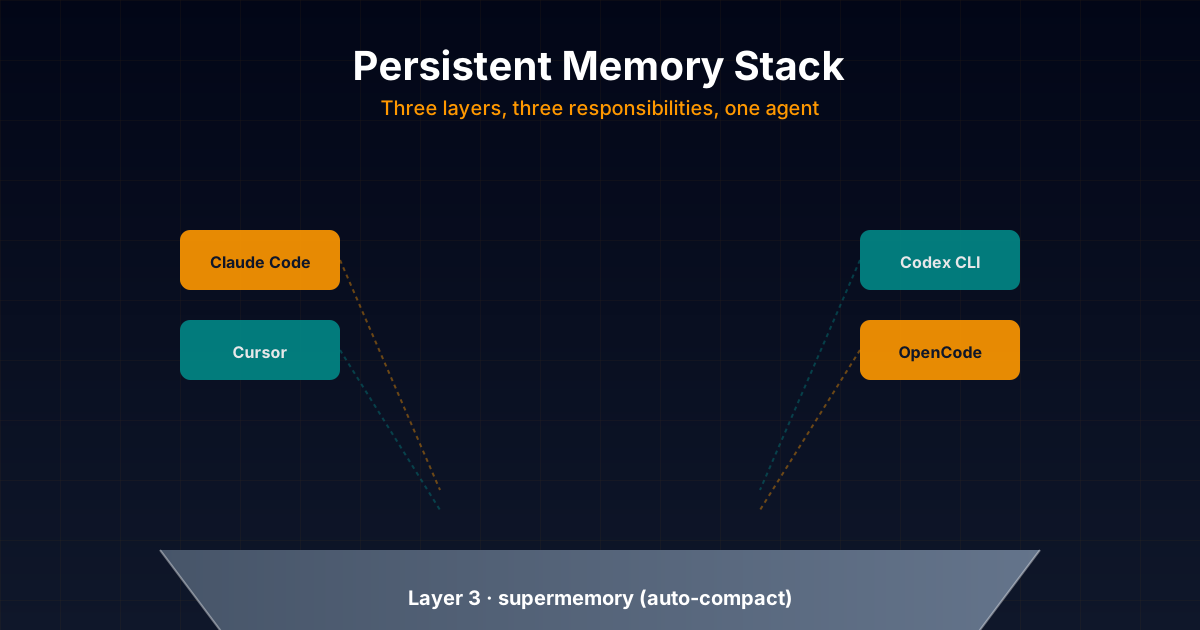
Honest technical deep dive into the persistent memory stack I combine daily in my projects: opencode-supermemory for auto-compact, basic-memory as main memory with Markdown + graph, and forgetful as procedural skills layer. With real configuration examples for Claude Code, Codex,
Alternative Paradigms and Emerging Methodo...
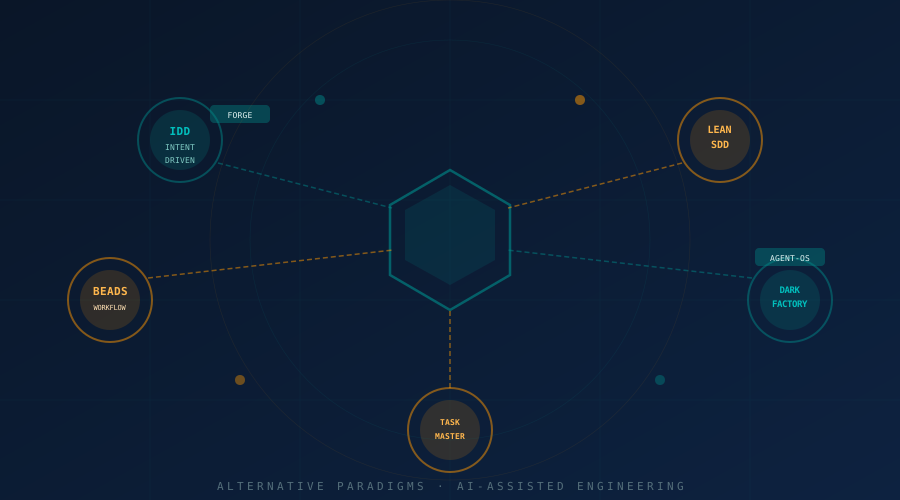
A deep dive into IDD, Lean SDD, BEADS Workflow, Agent OS, and the Dark Factory concept: emerging methodologies that challenge conventional development flows and raise the abstraction level in the age of autonomous AI.

Agents.md Standard: Blueprint for AI-Ready Projects
Introducing the Agents.md standard. A file convention to context-load AI agents with project architecture, coding rules, and domain knowledge.