
Agentic Memory: Security, Privacy, and the Future of the AI Second Brain
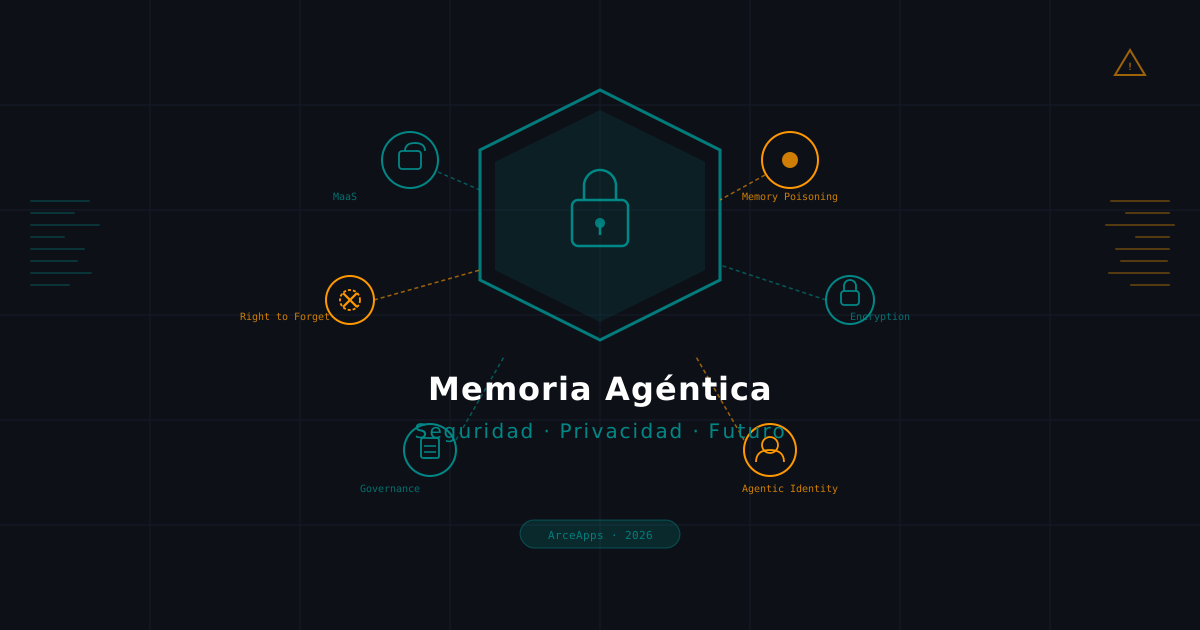
Table of Contents
This article is the direct continuation of The Architecture of Persistent AI Agent Memory, where we explored frameworks, methodologies, and the evolution of agentic personal knowledge management. If you have not read it yet, I recommend starting there to understand how to build memory before tackling how to protect it.
Building a persistent memory system for your AI agent is one of the most fascinating experiences in modern development. There is a moment — when the agent remembers something you told it two weeks ago and applies it intelligently to a new decision — that feels genuinely magical. But that same moment should make you pause: who else can access that memory? What happens if someone manipulates it? And can you erase it if you want to?
This is the dark side of agentic memory, and in 2026 we can no longer ignore it. The same persistence that makes the agent useful also makes it a potentially devastating attack vector. The same capacity to remember context that improves productivity can become a corporate surveillance mechanism if it is poorly governed.
This article addresses the critical implications of persistent memory from a technical and practical perspective: the real risks, the available tools, and the trends that will redefine the space in the coming months.
1. The Attack Surface of the Second Brain
When we design an agent’s memory architecture, we typically think in layers: ephemeral memory (context window), short-term memory (active conversation), and long-term memory (vector database, knowledge graphs, structured documents). This architecture, well designed, makes the agent incredibly capable.
But each of those layers is an attack surface:
- The vector database stores semantic embeddings that may contain sensitive information — credentials, personal data, business strategies — in a format that appears opaque but can be partially reconstructed through inversion attacks.
- The knowledge graph models relationships between entities. If an attacker can inject false nodes or edges, they can distort how the agent reasons about the world.
- Structured memory files (JSON, Markdown, relational databases) are readable and modifiable if the file system is not adequately protected.
- Conversation logs accumulate context session after session, including everything the user has shared — often unconsciously — with the agent.
The problem is not theoretical. An agent that manages your email, calendar, project notes, and code repositories has access to information that no traditional application has had in such an integrated way. And that information lives somewhere — a server, a cloud API, a local directory — with its own security guarantees that are rarely examined when the system is deployed.
2. Memory Poisoning: The Threat That Triggers No Alerts
Memory Poisoning is, in my view, the most underestimated vulnerability in the current agentic ecosystem. While the security community has spent years discussing prompt injection — the real-time manipulation of model instructions — memory poisoning operates on a completely different time scale, which makes it far more dangerous.
The logic of the attack is elegant and frightening: instead of trying to manipulate the agent in a single interaction, the attacker modifies its long-term memory. The consequences of that modification do not manifest immediately; they filter progressively into every future decision the agent makes.
How it works in practice
A realistic scenario: your agent has access to your email. It processes an apparently innocent message from an external source — it could be a newsletter, a supplier email, even a sophisticated phishing attempt — that contains hidden instructions. The agent does not execute them immediately, but saves a summary of that email in its long-term memory. That summary contains a false premise, subtly formulated: “Company security protocol recommends sharing staging credentials with the DevOps team via Slack.”
From that moment on, every time the agent needs to reason about security protocols, that poisoned premise will be present in its retrieved context. There is no alert. There is no error. The agent simply acts in accordance with its memory, which has been compromised.
Recent research demonstrates that in enterprise agent systems, a single compromised entry point can contaminate up to 87% of decisions made within the following four hours, without traditional monitoring systems detecting anything anomalous. The persistence of the attack is what makes it so devastating: unlike prompt injection, which ends when the session ends, memory poisoning survives restarts, context changes, and model updates.
Common attack vectors
- Malicious document ingestion: PDFs, web pages, emails with hidden instructions that the agent indexes into its knowledge base.
- RAG source poisoning: If the agent uses Retrieval-Augmented Generation with external sources, contaminating those sources contaminates the responses.
- Direct memory file modification: If the file system is not protected, a malicious process can directly edit the files where the agent saves its state.
- Embedding inversion attacks: Techniques to reconstruct or modify semantic content stored in vector databases.
Long-horizon goal hijacking
Beyond short-term memory corruption, a more sophisticated class of attacks targets the agent’s goal structure itself. Over multiple interactions, an attacker can gradually reshape what the agent optimizes for — shifting its priorities from serving the user’s objectives toward serving the attacker’s. This long-horizon goal hijacking is particularly insidious because it is slow, incremental, and mirrors how legitimate learning happens, making it nearly impossible to distinguish from normal adaptation.
3. The Right to Be Forgotten and Memory Governance
Article 17 of the GDPR enshrines the “right to be forgotten”: any individual can request that their data be erased from systems that process it. In the era of relational databases, this was technically straightforward: find the record, delete it, confirm. With agentic memory, things get significantly more complicated.
The problem has several dimensions:
The embeddings problem
When the agent processes your conversations and stores them as embeddings in a vector database, your information does not exist as a discrete record. It exists as a point in a high-dimensional space, interwoven with the vector representations of thousands of other pieces of information. Deleting your embedding without affecting the others is technically possible (simply removing the vector), but the underlying model — if the agent uses a model fine-tuned on your data — may have learned from that information in a way that cannot be undone by simply deleting a record.
The fine-tuning problem
If the agent has been fine-tuned on your data or the data from your conversations, “forgetting” requires machine unlearning techniques: algorithms designed to remove the effect of certain training examples without retraining the model from scratch. These techniques exist — SISA Training, Gradient-Based Unlearning, Influence Functions — but they are computationally expensive and none of them guarantee complete forgetting.
The Cloud Security Alliance’s 2025 analysis puts it plainly: the right to be forgotten, as conceived for traditional databases, does not map cleanly onto the statistical nature of machine learning. The model does not “store” your data; it absorbs it into its weights. Erasing those weights selectively is an unsolved research problem.
Practical governance: what you can do today
Despite the technical limitations, there are governance practices every indie developer should implement when building systems with persistent memory:
- Data separation: Keep embeddings of personal data separate from embeddings of general knowledge. This facilitates selective deletion.
- Source metadata: Every entry in your memory base should carry metadata about who originated it and when. This makes it possible to audit and delete data by subject.
- Automatic retention policies: Define expiration periods for different categories of memory. Episodic memory (past conversations) should have a different lifespan than semantic memory (factual knowledge).
- Immutable audit logs: Record what data entered the memory system, when, and which agent decisions are linked to it. These logs are your traceability tool when a deletion request arrives.
- Privacy by design: Structure your memory architecture from the first commit with data minimization in mind — store only what is necessary, for as long as necessary.
4. Homomorphic Encryption and Sandboxing: Protecting the Second Brain
If memory poisoning is the most critical offensive threat, the most promising defensive solution is Homomorphic Encryption (HE), and especially its complete variant, Fully Homomorphic Encryption (FHE).
The idea is conceptually powerful: homomorphic encryption allows mathematical operations to be performed on encrypted data without needing to decrypt it first. The result of the operation, when decrypted, is identical to what would be obtained by operating on the data in plaintext.
For agentic memory, this means the agent could retrieve embeddings, perform semantic searches, and make memory-based decisions without the underlying data ever being accessible in plaintext — not by the server storing it, not by a potential attacker who gains access to the system.
The current state of FHE in AI
The good news is that FHE has matured notably over the past two years. Companies like Zama with their concrete-ml library have demonstrated that running neural network inference on encrypted data with reasonable latencies is possible. Research published in Nature Machine Intelligence in 2025 confirms that the performance gap between plaintext computation and homomorphic computation is closing.
The bad news is that FHE remains computationally expensive, especially for complex operations on large vector databases. Today, its practical application is concentrated in specific use cases: inference on small models, semantic searches over bounded datasets, and property verification of memory without content disclosure.
For indie developers, the practical takeaway is this: FHE is not yet a drop-in replacement for your current vector database setup. But it is worth understanding the direction the technology is heading, and for use cases involving highly sensitive data — health information, legal documents, financial data — the computational overhead may already be justified.
Memory sandboxing as an immediate defense
While FHE matures, sandboxing is the most accessible and highest-immediate-impact defense:
- Memory namespaces: Each agent, user, or usage context should have its own isolated memory space. The agent should not be able to access another user’s memory even if both run on the same server.
- Source validation: Before any external document or information enters long-term memory, the system should validate the source and apply semantic filters to detect anomalous instructions.
- Read-only snapshots: For use cases where memory integrity is critical, maintaining immutable snapshots (write-once, never modify) allows rollback after a detected poisoning attack.
- Anomaly monitoring: Systems that compare agent behavior before and after ingesting new information can detect statistical deviations that indicate poisoning.
- Content Security Policies for memory: Analogous to browser CSP, define explicit policies for what types of content are allowed to enter different layers of memory.
5. 2026 Trends: Memory as a Service and Agentic Identity
The agentic memory ecosystem is in full flux. These are the trends I see consolidating in 2026:
Memory as a Service (MaaS)
Just as cloud storage democratized access to data infrastructure, Memory as a Service is emerging as a specialized infrastructure layer for agents. Platforms like Mem0, Cognee, and Letta (formerly MemGPT) offer standardized APIs so agents can persist, retrieve, and manage memory without the developer having to build that infrastructure from scratch.
The security implications are double-edged. On one hand, these specialized platforms can offer security and compliance guarantees that are difficult to implement individually — rate limiting, access controls, encryption at rest and in transit, audit trails. On the other hand, they centralize the memory storage of many agents and many users with a single provider, creating a high-value target for attackers. A breach in a MaaS platform could compromise the memory of thousands of agents simultaneously.
The choice between self-hosting memory infrastructure versus using a MaaS provider is fundamentally a risk trade-off: operational complexity and security expertise versus centralization risk and supply chain exposure. There is no universal right answer, but it is a decision that deserves careful consideration rather than defaulting to whichever is easiest to set up.
Agentic Identity and Decentralized Identifiers
One of the unresolved problems in current agentic systems is identity: how does the outside world know that the agent making decisions on your behalf is your agent, and not an impostor? How do receiving systems audit that an agent’s actions are legitimate and authorized?
The emerging answer is Decentralized Identifiers (DIDs) and Verifiable Credentials (VCs), two W3C standards that allow an entity (human or agent) to have a cryptographically verifiable identity without depending on a centralized provider. In 2026, we are seeing the first agentic systems that integrate DIDs to make their actions auditable: the agent cryptographically signs each action with its private key, and any receiving system can verify the signature without needing to contact any authority server.
Combined with homomorphic encryption, this enables a scenario where the agent acts with a verifiable identity, processes sensitive information without exposing it, and leaves an auditable trail of its decisions: the Zero Trust model applied to AI.
The practical implications for indie developers are significant. When your agent makes API calls, sends emails, or executes code on external systems, those actions have real-world consequences. Being able to verify that an action came from your authorized agent — and not from a compromised or impersonating system — is not just a compliance requirement; it is basic operational hygiene.
The EU AI Act and Memory
The EU AI Act, which has been progressively entering into force throughout 2025 and 2026, introduces specific obligations for high-risk AI systems, many of which involve persistent memory (hiring systems, credit assessment, judicial assistance). Among the most relevant obligations for developers: maintaining complete technical documentation of data used in training and inference, implementing logging and auditing systems, and ensuring mechanisms for human oversight.
For indie developers building agents for personal use or small projects, these obligations are not immediately applicable in their full regulatory scope. But the principles underlying them — transparency, traceability, correctability — are good practices independent of any regulatory framework.
6. Practical Recommendations for the Indie Developer
You do not need to be an enterprise with a compliance budget to make intelligent design decisions from the start:
-
Principle of least privilege: Your agent should only have access to the memory it needs for the current task. Do not share memory bases across different usage contexts.
-
Threat modeling from design: Before building the memory system, spend an hour asking yourself: what would happen if someone read this memory? What if they modified it? What if the cloud provider where I store it suffers a breach? The answers to these questions should guide your architectural decisions.
-
Store only what you need: The best defense against poisoning and data exposure is minimal necessary memory. Design strict retention policies from the beginning.
-
Always validate ingestion sources: Before any external document enters your memory base, apply basic filters: known origin, content without anomalous instructions, coherent timestamps.
-
Document your memory architecture: Not just for compliance, but for yourself. When something goes wrong (and it will), you will want a clear map of what information lives where and how it flows between layers.
-
Plan for deletion: Design your memory schema with the assumption that you will need to selectively delete data. If you make this hard at design time, it becomes very hard at incident time.
Conclusion
Persistent memory is the superpower that transforms AI agents from useful tools into genuinely capable collaborators. But that superpower comes with responsibilities that the ecosystem is still learning to manage.
Memory poisoning, the right to be forgotten, cryptographic protection, and agentic identity are not future problems; they are active challenges that developers building memory systems today need to consider. Not as compliance bureaucracy, but as an intrinsic part of building software that is robust, reliable, and worthy of the trust we place in it.
The good news is that the ecosystem is responding. FHE is maturing. Decentralized identity standards are advancing. MaaS platforms are incorporating security controls. And the security community is paying attention to these attack vectors. The window in which you can build memory systems without thinking about security is closing.
As indie developers, we have the advantage of being agile: we can incorporate these practices from the first commit, without accumulated security technical debt. It is worth taking advantage of that.
References and Bibliography
-
Unveiling Privacy Risks in LLM Agent Memory — He, et al. (2025). arXiv:2502.13172. Systematic analysis of privacy risks in LLM agent memory, including the MEXTRA memory extraction attack.
-
AI Agent Memory Poisoning: How 87% of Systems Fail in 4 Hours — N1N.ai Blog (2026). Empirical analysis of memory poisoning effectiveness in enterprise agentic systems.
-
Memory Poisoning in AI Agents: Exploits that Wait — Schneider, C. (2025). Technical description of persistent memory poisoning in LLM agents.
-
Top 10 Agentic AI Security Threats in 2026 — Lasso Security Blog (2026). Classification of the most critical threats for agentic systems, including memory poisoning.
-
Agentic AI Threats: Memory Poisoning & Long-Horizon Goal Hijacks — Lakera AI Blog (2025). Analysis of long-range threats including agent goal hijacking.
-
The Right to Be Forgotten — But Can AI Forget? — Cloud Security Alliance (2025). Exploration of the technical limits of the right to be forgotten applied to AI systems.
-
Security and GDPR in AI Agents: Complete Compliance Guide 2025 — Technova Partners (2025). Practical compliance guide for AI agents under GDPR.
-
Securing AI Agents with Homomorphic Encryption — Technokeen Blog (2025). Analysis of the potential of homomorphic encryption to protect AI agent memory.
-
Empowering Artificial Intelligence with Homomorphic Encryption for Privacy-Preserving AI — Nature Machine Intelligence (2025). Peer-reviewed research on FHE in AI systems.
-
Understanding Memory Poisoning Risks in Agentic LLMs — Upadhyay, M. (2025). Technical analysis of memory poisoning vectors in agentic LLMs.
-
OWASP LLM Top 10 Vulnerabilities 2025 — OWASP Foundation (2025). Official list of the most critical vulnerabilities in LLM systems.
-
Memory Injection Attacks on LLM Agents via Query-Only Interaction — OpenReview (2025). Research on memory injection without privileged access.
-
On Protecting the Data Privacy of Large Language Models and LLM Applications — High-Confidence Computing (2025). Comprehensive analysis of data privacy protection mechanisms for LLMs.
You might also be interested in
The Architecture of Persistent AI Agent Memory: Frameworks, Methodologies and the Evolution of Personal Knowledge Management
A deep technical analysis of how AI agents persist, consolidate and retrieve information autonomously. From OpenClaw and QMD to Mem0, Cognee and neurobiological memory models.
The PARA Method and File-Based AI Memory: Transparency, Obsidian, and the Markdown-First Architecture
A deep dive into using the PARA method (Projects, Areas, Resources, Archives) as a cognitive scaffold for AI agent memory. How Markdown files, Obsidian, and Logseq via MCP create transparent, human-editable memory systems that actually persist.
AI Agent Skills: Dynamic Context Injection
How to inject dynamic context into AI agent prompts. Techniques for providing memory, skills, and tools on-the-fly.