
The Architecture of Persistent AI Agent Memory: Frameworks, Methodologies and the Evolution of Personal Knowledge Management
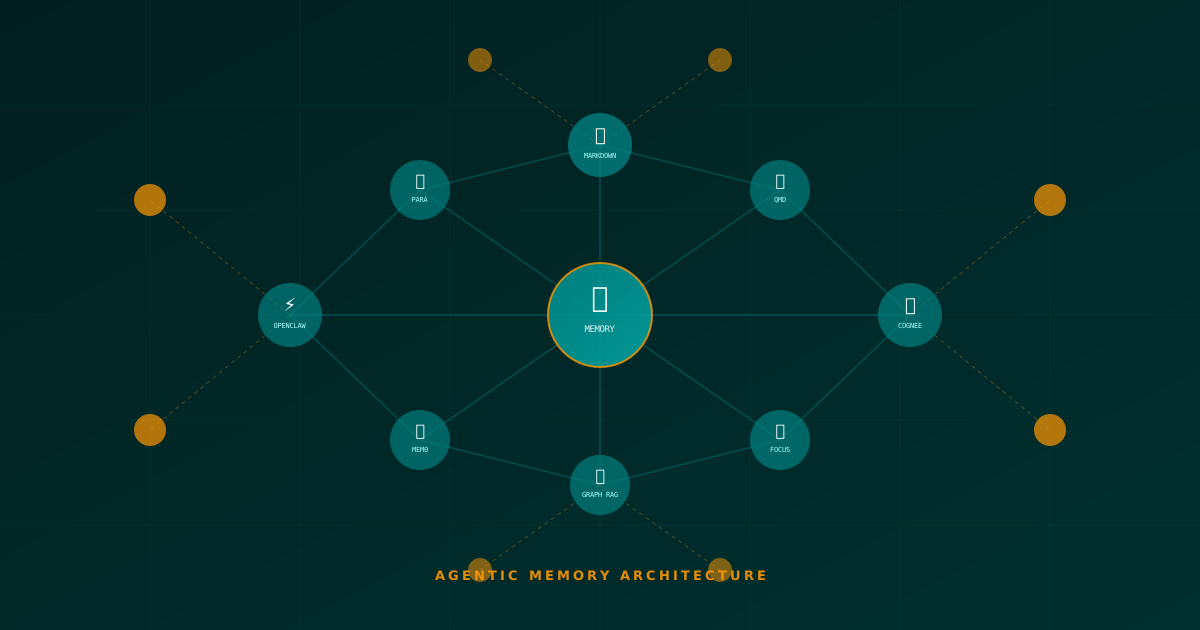
Table of Contents
This article was inspired by a post from Nat Eliason (@nateliason), one of the most thoughtful voices exploring how AI agents can work with truly persistent memory systems. His research and practical experiments with tools like OpenClaw and the PARA method were the spark that led me to dive deep into this topic. All credit to him for the initial conceptual framing.
The Stateless Problem: Why AI Agents Forget Everything
If you have worked with any LLM-based tool for more than a couple of sessions, you have probably experienced what I call context fatigue. You explain your architecture. You detail your preferences. You set the rules of engagement. And then the next day, you open a new chat window and have to start from scratch.
This is not a minor inconvenience. It is a fundamental architectural limitation. Traditional large language models operate within rigid, ephemeral context windows. Once the token limit is exceeded, the system suffers total amnesia. Every conversation is a blank slate. For a casual chatbot, this is acceptable. For an autonomous agent executing multi-step tasks over days or weeks, it is a complete showstopper.
The transition from stateless LLM tools to truly agentic, persistent, stateful AI systems is one of the most significant paradigm shifts happening right now in software. And as an indie developer who builds tools for fun and efficiency, I am obsessed with understanding it deeply.
This article is a comprehensive analysis of how the best frameworks and methodologies approach this problem today. We will dissect OpenClaw, QMD, Mem0, Cognee, EcphoryRAG, and several other approaches. By the end, I will share my own synthesis: the approach I find most effective for solo developers and indie builders.
Part 1: The Agentic PKM Paradigm
The concept of Personal Knowledge Management (PKM) is not new. Systems like Zettelkasten, the PARA method by Tiago Forte, and tools like Roam Research or Obsidian have been helping humans organize their knowledge for years. The cognitive load of maintaining these systems, however, often led to passive digital accumulation and eventual abandonment.
The game-changer is introducing autonomous agents into the maintenance and utilization of these knowledge bases. When an AI agent can read, write, organize, and retrieve information from your PKM system without constant human intervention, the whole calculus changes. Organization becomes a background process. The system improves over time without you actively curating it.
This is precisely the vision that Nat Eliason articulated in his explorations with tools like OpenClaw. The idea is elegantly simple: give the AI agent access to a local file system structured with good semantic organization, and it will do the rest.
Why Local Files? The Case Against Cloud-First Memory
Before diving into specific frameworks, it is worth addressing a philosophical fork in the road: cloud-first vs. local-first memory.
Cloud-based memory solutions (like various hosted vector database services) offer scalability and multi-device access. But they come with significant trade-offs:
- Opacity: You cannot inspect or version your own memory easily.
- Vendor lock-in: Your agent’s brain lives on someone else’s server.
- Privacy risk: Sensitive operational context gets stored externally.
- Latency costs: Every memory retrieval is a network round-trip.
Local-first approaches, by contrast, give you a readable, versionable, inspectable memory layer. You can use Git to track how your agent’s knowledge evolves over time. You can manually correct errors. You can audit what the agent knows. For solo developers and small teams, this is an enormous practical advantage.
Part 2: OpenClaw and the Markdown Memory Architecture
OpenClaw is an open-source AI agent platform designed to execute terminal commands, manipulate files, and navigate the web on macOS, Windows, and Linux. Its core memory architecture is built on plain Markdown files in the workspace, making it the most transparent and hackable memory system available today.
The Dual-Layer Memory Model
OpenClaw implements a two-layer memory design that mimics short-term and long-term retention:
Layer 1: The Daily Journal (Short-Term)
Sessions are logged in append-only files stored as memory/YYYY-MM-DD.md. This captures real-time operational history and session context. At the start of each new session, the agent automatically loads the current day’s and previous day’s logs, providing an immediate context buffer without flooding the model window with weeks of history.
This is elegant in its simplicity. It mirrors how humans actually work: we remember what happened yesterday with high fidelity, but older memories require more deliberate retrieval effort.
Layer 2: The Long-Term Memory File (MEMORY.md)
This is the curated, distilled repository of the user’s preferences, operational safety rules, and accumulated tacit knowledge. When deployed in a working environment, the system defaults to the uppercase MEMORY.md file, using a lowercase version only as a fallback, ensuring a strict read hierarchy.
The combination of these two layers solves the core tension in agent memory design: you need recent context immediately available, but you also need deep accumulated knowledge that persists across sessions. The daily journal provides the former; the MEMORY file provides the latter.
The Semantic Power of Markdown
The decision to use Markdown as the memory substrate has deep operational implications. It bridges the gap between machine-readable data structures and human-readable interfaces. This creates a shared cognitive ledger that you can inspect, version with Git, and manually edit.
More importantly, Markdown files are just files. They live on your disk. They can be backed up, searched with grep, synced with Git, or processed with any text tool. The memory is not locked inside a proprietary system. It is sovereign and transparent.
Part 3: PARA as a Cognitive Scaffolding
Applying the PARA methodology (Projects, Areas, Resources, Archives) to the Markdown memory substrate gives the agent invaluable semantic scaffolding.
The agent inherently understands that:
- Files in the Projects directory represent active, deadline-driven tasks
- Files in Areas contain ongoing responsibilities without a defined end date
- Files in Resources hold reference material for future use
- Files in Archives contain completed or inactive items
This spatial organization prevents the agent’s context window from flooding with irrelevant data. PARA functions not just as a filing system, but as a topological ontology that dictates the agent’s attention mechanisms.
When assigned a specific programming project, the agent automatically restricts its high-priority semantic search to that project’s folder, dramatically reducing token spend and computational latency. This is a practical, measurable efficiency gain.
Implementing PARA with OpenClaw
In practice, a well-structured OpenClaw workspace looks something like this:
workspace/
├── MEMORY.md              # Long-term distilled knowledge
├── memory/
│   ├── 2026-03-16.md     # Yesterday's session log
│   └── 2026-03-17.md     # Today's session log
├── Projects/
│   ├── my-android-app/
│   └── client-website/
├── Areas/
│   ├── personal-health/
│   └── skill-development/
├── Resources/
│   ├── kotlin-references/
│   └── architecture-patterns/
└── Archive/
    └── completed-projects/
The agent navigates this structure not through brute-force vector similarity searches across all files, but through contextually informed directory targeting. The organizational structure itself is part of the memory system.
Part 4: QMD — Local Hybrid Search for Your Documents
While OpenClaw handles the reading and writing of memory, QMD (Query Markdown Documents) addresses a crucial complementary problem: how do you efficiently search and retrieve relevant content from a large local knowledge base?
QMD is a mini CLI search engine specifically designed for Markdown documents, knowledge bases, meeting notes, and any local text content. Its key innovation is implementing hybrid search entirely locally:
- Semantic vector search: Finds conceptually similar content even when exact keywords do not match.
- BM25 keyword search: Traditional TF-IDF relevance scoring for precise term matching.
- Hybrid re-ranking: Combines the results of both approaches using Reciprocal Rank Fusion (RRF) to maximize retrieval quality.
This hybrid approach is significant because pure vector search alone has a well-documented weakness: it sometimes retrieves semantically similar but factually wrong content. Pure keyword search misses conceptually relevant documents that use different terminology. The hybrid combination mitigates both failure modes.
For local-first memory architectures, QMD fills the gap that hosted vector databases occupy in cloud architectures. You get state-of-the-art retrieval quality without surrendering control of your data to a remote service.
The tool integrates with various agent orchestration systems via MCP (Model Context Protocol), making it a natural companion to any agent that uses a local Markdown knowledge base.
Part 5: The Vox System — Merging Visual Tools with Terminal Agents
The integration of command-line AI agents with visual PKM tools like Obsidian demonstrates the enormous practical potential of this architecture. Obsidian, a local Markdown-based knowledge base application, serves as the long-term memory substrate, while tools like OpenClaw or Claude Code act as the active processing and retrieval layer.
An advanced implementation of this concept is the Vox system — an architecture designed to function simultaneously as a programming assistant, project partner, and persistent digital brain. Vox diverges from traditional chat memory by operating directly inside the Obsidian vault, reading and writing its own state.
The vault is divided into specialized cognitive zones:
| Component | File/Function | Operational Purpose |
|---|---|---|
| Vault Dashboard | VAULT-INDEX.md | Maintains active state and current priorities |
| Procedural Memory | CLAUDE.md | Stores operational rules, folder structures, allowed commands |
| Identity/Personality | vox-core.md | Defines base behavior, tone, and ethical parameters |
| Startup Ritual | Boot command sequence | Loads daily context, reviews calendars, scans async instruction drop folders |
| Shock Buffer | Temporary working memory file | Enables exact state recovery if the agent process is interrupted |
The startup ritual concept is particularly powerful. Every time the agent launches, it runs a deliberate sequence: load the vault index, review pending tasks, check for new instructions, and establish the current priority stack. This mirrors how a human expert starts their work day: reviewing notes, checking messages, and establishing mental context before diving into work.
The temporary working memory buffer is also an underrated design choice. If the agent crashes mid-task, the working state is preserved in a file rather than lost. Recovery is deterministic rather than requiring a replay of the whole session.
Part 6: Mem0 — Universal Memory as a Service
Mem0 takes a different architectural approach. Rather than a local-first system, it positions itself as a universal memory layer for AI agents that can be integrated across multiple systems.
Mem0’s key features include:
- Adaptive personalization: Remembers user preferences, interaction history, and contextual nuances
- Multi-level memory: Individual user memory, shared session memory, and agent-level memory as distinct addressable layers
- Automatic conflict resolution: When new memories contradict existing ones, the system resolves conflicts before committing to the store
- Cross-agent memory sharing: Multiple agents can access the same memory namespace
The automatic conflict resolution is a critical differentiator. Without it, a memory store degrades over time as contradictory information accumulates. Mem0’s approach forces explicit resolution by sending new memories along with conceptually similar existing ones to the LLM, asking it to synthesize or arbitrate before writing.
Research data from Mem0’s team shows approximately 26% accuracy improvement on memory-intensive tasks compared to baseline approaches. This is not a trivial gain — it represents a meaningful step toward agents that actually remain aligned with user context over extended time periods.
The Redis-Backed Architecture
For high-performance production deployments, Mem0 integrates with Redis for in-memory operations. This provides:
- Sub-millisecond memory retrieval for time-sensitive agent operations
- Semantic caching to avoid redundant LLM calls for similar queries
- Efficient working memory management for context windows
The Redis integration makes Mem0 viable for enterprise scenarios where thousands of agent sessions might be running concurrently, each requiring fast, isolated memory access.
Part 7: Cognee — Knowledge Graph Memory Architecture
Cognee represents the most structurally sophisticated approach to agent memory among the frameworks we are examining. Instead of flat vector stores or file systems, Cognee organizes agent knowledge in ontologically backed knowledge graphs.
Why Knowledge Graphs?
A vector database stores embeddings and retrieves by semantic similarity. This is powerful, but it has an important limitation: it cannot represent explicit relationships between entities. Knowing that “Python is a programming language” and “Django is a Python framework” requires either implicit vector proximity or explicit relationship encoding.
Knowledge graphs solve this by encoding relationships as first-class data structures. You can ask: “What frameworks does this user typically use for their web projects?” and traverse the graph edges to find the answer, rather than hoping that a semantic similarity search returns the right result.
Cognee builds on top of graph database backends (like Memgraph or Neo4j) and combines:
- Entity extraction: Identifying key concepts from agent interactions
- Relationship mapping: Encoding how concepts relate to each other
- Multi-hop reasoning: Traversing multiple relationship edges to answer complex queries
- Temporal versioning: Tracking how the knowledge graph evolves over time
The multi-hop capability is particularly important for long-running agents. Questions like “What was the architectural decision we made last month that affected this component?” require traversing several relationship edges: the project node, the decision node, the date node, and the component node. Vector search alone cannot reliably answer this.
Security in Distributed Memory Systems
The introduction of persistent memory also introduces new attack surfaces. A static LLM is intrinsically secure in that its internal state is annihilated at session close. An agent that persists state across months becomes susceptible to:
- Indirect prompt injection: Malicious content in retrieved memories can hijack agent behavior
- Long-term data poisoning: Gradually corrupting the knowledge store through crafted interactions
- Cross-tenant data leakage: In multi-user deployments, memory isolation failures
Cognee addresses these with strict tenant isolation, OTEL-based audit trace collectors, and ingestion filters that explicitly prevent hypothetical speculation from being encoded as factual operational truths. The distinction between “the user mentioned X” and “X is true” must be maintained in the memory store.
Part 8: Neurobiological Memory Models — EcphoryRAG and Focus
The frontier of agent memory research is drawing inspiration from human cognitive neuroscience. Two frameworks exemplify this direction:
EcphoryRAG: Associative Memory for Lifelong Agents
EcphoryRAG (named after the concept of “ecphory” — the process by which a retrieval cue triggers a memory trace) reimagines RAG through the lens of human associative memory.
Traditional RAG retrieves the top-k most similar documents to a query vector. EcphoryRAG instead maintains a dynamic associative memory network where memories activate other related memories through spreading activation, similar to how human memory works. A cue does not just retrieve the most similar stored item; it propagates activation through a network of associated concepts, surfacing contextually relevant memories that a pure similarity search would miss.
This is significant for lifelong agents that accumulate months of context. As the knowledge base grows, simple similarity searches degrade in quality because there are too many semantically similar items. Associative networks maintain retrieval quality at scale because they leverage structural relationships, not just content similarity.
Focus: Autonomous Context Compression
The Focus architecture addresses a different but equally critical challenge: context window management at scale. As agents operate over long time horizons, their context windows threaten to overflow with accumulated history.
Focus implements autonomous memory compression: the agent continuously monitors its context window utilization and proactively summarizes, abstracts, and prunes older content. Older, less-recently-accessed memories are compressed into higher-level summaries. Summaries of summaries are maintained for very old content. Specific details can be retrieved on demand from the full archive, but the working context stays lean.
This mirrors a well-documented human cognitive phenomenon: we naturally abstract specific episodic memories into generalized semantic knowledge over time. We forget the exact words of a conversation but remember the key takeaway. Focus implements this computationally.
Part 9: Team-Level Shared Memory — Smriti
While most of the frameworks above address individual agent or user memory, Smriti targets a different use case: shared memory for AI-powered engineering teams.
The core idea is that when multiple developers are each using AI coding assistants (Claude Code, Cursor, Codex, etc.), they are all starting from scratch on every new session. There is no shared organizational context. Smriti addresses this by providing a shared memory layer that captures, indexes, and recalls conversations across multiple agents and users, synchronized through Git (no cloud required).
Key design principles:
- Git-based sync: Memory is committed to version control alongside code, making organizational knowledge versioned and auditable
- Local-first: No cloud dependency means no privacy concerns and no vendor lock-in
- Cross-agent compatibility: Works with Claude Code, Cursor, Codex, and other agent platforms via MCP
For indie developers who occasionally collaborate, or for small teams, this is a compelling middle ground between individual local memory and enterprise-scale cloud solutions.
Part 10: Comparative Analysis
Let me synthesize the trade-offs across these approaches:
| Framework | Architecture | Local/Cloud | Best For | Key Weakness |
|---|---|---|---|---|
| OpenClaw + PARA | File system (Markdown) | Local | Solo dev, full transparency | Scales poorly beyond ~10k files |
| QMD | Hybrid search index | Local | Retrieval from large local bases | Index rebuild overhead |
| Vox (Obsidian) | Visual + terminal hybrid | Local | Knowledge workers, writers | Requires Obsidian setup |
| Mem0 | Vector + relational DB | Cloud-first (OSS available) | Multi-user, production apps | Network latency, privacy concerns |
| Cognee | Knowledge graph | Hybrid | Complex reasoning, enterprise | High setup complexity |
| EcphoryRAG | Associative network | Research/hybrid | Lifelong agents, large archives | Computationally expensive |
| Focus | Compressed context | In-process | Long-running agent sessions | Lossy compression risks |
| Smriti | Git-synced shared store | Local + Git | Small teams | Limited to text/coding context |
No single framework wins across all dimensions. The right choice depends heavily on your context.
Part 11: My Own Recommendation — The Pragmatic Indie Synthesis
After studying all of these approaches, here is the memory architecture I actually use and recommend for indie developers and solo builders:
The Layered Local Stack
I call it the Layered Local Stack, and it combines the best pragmatic elements from several frameworks:
Layer 0: Immutable Rules (AGENTS.md / MEMORY.md)
A single, manually curated file that encodes your non-negotiable rules, preferences, and architectural decisions. This is the agent’s “constitution”. It never gets auto-written by the agent. Only you edit it. Keep it under 500 lines. If it gets longer, something is wrong.
The immutability is critical. One of the biggest failure modes in persistent memory systems is the agent gradually corrupting its own operational rules through drift. Locking this layer to human-only writes prevents this entirely.
Layer 1: Daily Session Journals (Auto-written)
Automatic append-only logs following the YYYY-MM-DD.md convention from OpenClaw. The agent writes to these freely. You can review them. They are kept for 30 days and then archived. This is cheap, transparent, and reversible.
Layer 2: Project Context Files (Collaborative)
One Markdown file per active project, co-written by you and the agent. Stores architectural decisions, current status, key decisions made, and technical constraints. When you open a session focused on a project, you load only this file plus Layer 0 and the last two days of Layer 1. Token budget stays predictable.
Layer 3: QMD Index (Search on demand)
For older or broader knowledge, QMD is used for hybrid retrieval rather than auto-loading. The agent can call QMD to find relevant past context when needed, rather than preloading everything. This keeps the default token footprint small while still providing access to the full archive.
Layer 4: Git for Everything
All of the above lives in a Git repository. Memory evolves transparently. You can audit, rollback, and branch. This is free, fast, and requires no special infrastructure.
Why This Works Better Than the Alternatives
The key insight is that different types of memory deserve different volatility and access patterns:
- Operational rules should be immutable and immediately available (Layer 0)
- Recent session context should be auto-loaded and mutable (Layer 1)
- Project-specific context should be targeted and semi-curated (Layer 2)
- Deep historical context should be retrievable on demand, not preloaded (Layer 3)
- All of it should be auditable and reversible (Layer 4)
Heavy-weight solutions like Cognee are impressive but overkill for solo projects. Fully cloud-hosted memory creates dependencies and privacy concerns. Pure vector stores without structure lead to retrieval noise as the knowledge base grows.
The Layered Local Stack is boring in the best possible way: it uses text files, Git, and a minimal CLI search tool. It scales from a personal laptop to a small team. It can be inspected with any text editor. And it gives the agent enough structured context to be genuinely useful over months and years of work.
The Key Principle: Intentional Forgetting
One dimension I have not seen enough tools address explicitly is structured forgetting. Human memory is not a perfect archive. We abstract episodic details into semantic knowledge. We allow unimportant memories to decay. This is not a bug; it is a feature that keeps our cognitive working memory from overflowing.
Good agent memory systems should do the same. The Layer 1 rolling 30-day window is one implementation of this. But I would go further: periodically (perhaps weekly), a summarization step should run across recent logs and extract key insights into Layer 2 project files. The detailed logs can then be archived or deleted. The agent retains the wisdom without the noise.
This is the part I am still experimenting with actively. Automating the distillation step without losing important context is harder than it sounds. But the direction is clear: a good memory system is one that curates, not just accumulates.
Conclusion
The evolution of agentic memory represents one of the most practically impactful areas of AI development for developers like us. The frameworks analyzed here — from the pragmatic file-system approach of OpenClaw to the sophisticated graph structures of Cognee — each address different real problems with genuine architectural insight.
What unites them is the pursuit of temporal continuity and contextual awareness. An agent that cannot remember is, by definition, just a reactive tool. An agent that remembers, synthesizes, and dynamically prunes its own cognitive substrate matures into a genuine long-term collaborator.
For indie developers, the practical takeaway is this: you do not need enterprise-grade infrastructure to get most of the value of persistent memory. A well-structured local Markdown system with a hybrid search engine and rigorous Git hygiene will take you further than most people realize, and with full transparency and control over your own data.
The next frontier is not bigger vector stores — it is better curation algorithms, biologically-inspired retrieval, and intelligent forgetting. The agents that learn to forget well will ultimately be the most useful ones.
References and Further Reading
- Nat Eliason’s original post that inspired this article: https://x.com/nateliason/status/2017636775347331276
- OpenClaw official documentation on memory: https://docs.openclaw.ai/memory
- QMD GitHub repository: https://github.com/tobi/qmd
- Mem0 documentation: https://docs.mem0.ai
- Cognee knowledge engine: https://cognee.ai
- EcphoryRAG paper (OpenReview): https://openreview.net/forum?id=EcphoryRAG
- Smriti shared memory for teams: https://github.com/zero8dotdev/smriti
- Active Context Compression paper (arXiv): https://arxiv.org/abs/2404.00573
- Agentic Note-Taking with Obsidian and Claude: https://stefanimhoff.de
- Reddit thread on persistent AI assistant with Claude Code + Obsidian + QMD: https://reddit.com/r/Rag
- Milvus blog on token optimization in OpenClaw: https://milvus.io/blog
You might also be interested in
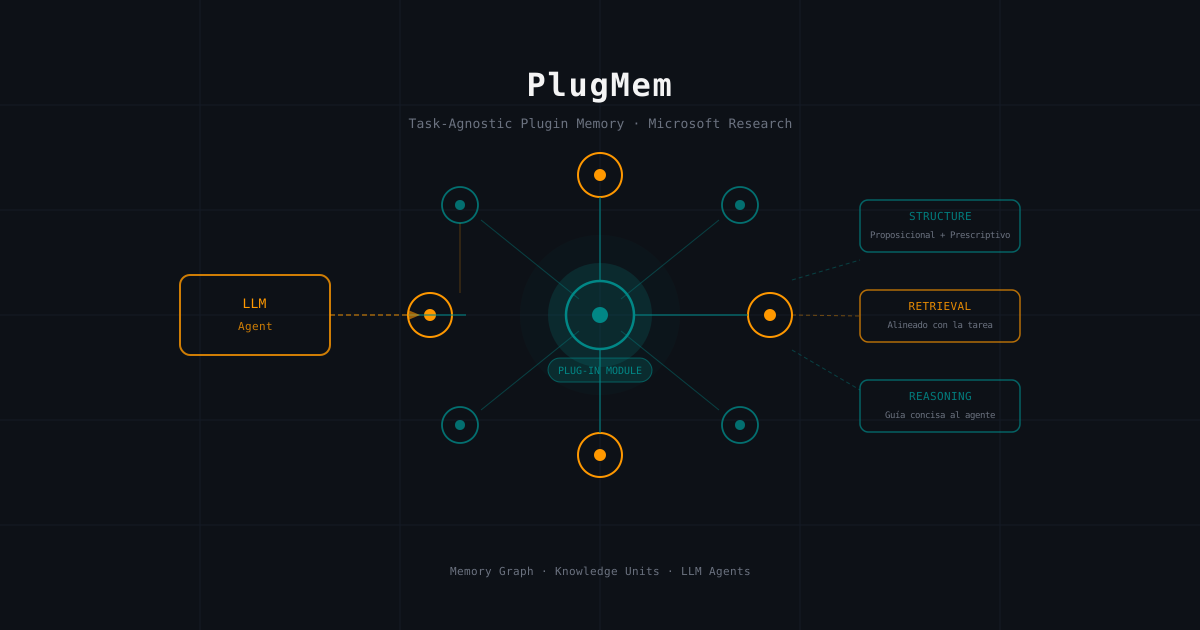
PlugMem: Microsoft Research's Task-Agnostic Memory Module That Every LLM Agent Needs
A technical deep-dive into PlugMem, Microsoft Research's plugin memory system that transforms raw LLM agent interactions into reusable structured knowledge. How its three-component architecture (Structure, Retrieval, and Reasoning) outperforms task-specific memory designs.
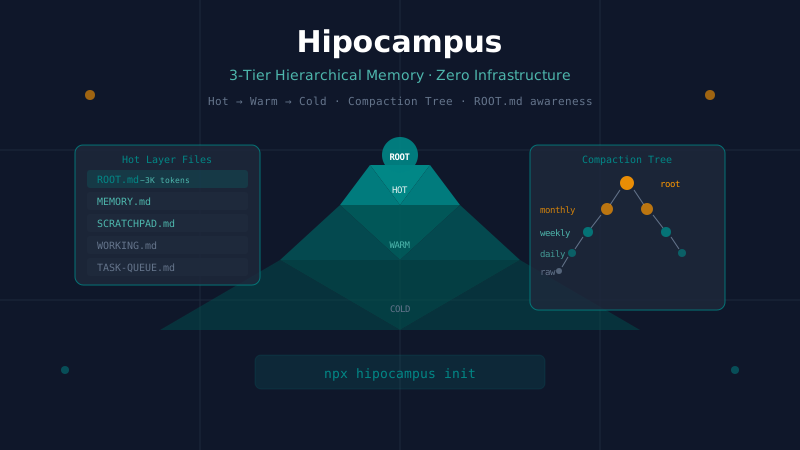
Hipocampus: Zero-Infrastructure Hierarchical Memory for AI Agents
A technical deep-dive into Hipocampus, a drop-in memory harness for AI agents that uses a 3-tier Hot/Warm/Cold architecture and a 5-level compaction tree. How ROOT.md enables constant-cost memory awareness and how it compares to hmem, Mem0, and Letta.
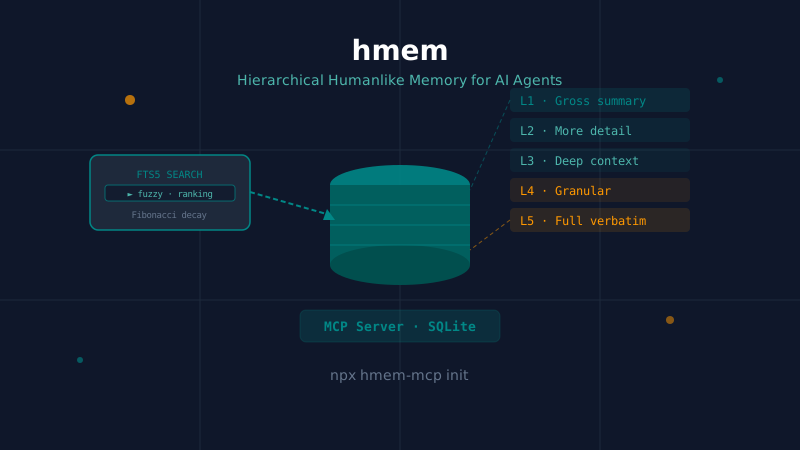
hmem: Hierarchical SQLite Memory for AI Agents That Actually Persists
A technical deep-dive into hmem (Humanlike Memory), an MCP server that models human memory in five lazy-loaded levels backed by SQLite + FTS5. How Fibonacci decay, logarithmic aging, and a curator agent solve the context window problem across sessions and machines.