
OpenViking: one context layer for multiple AI agents
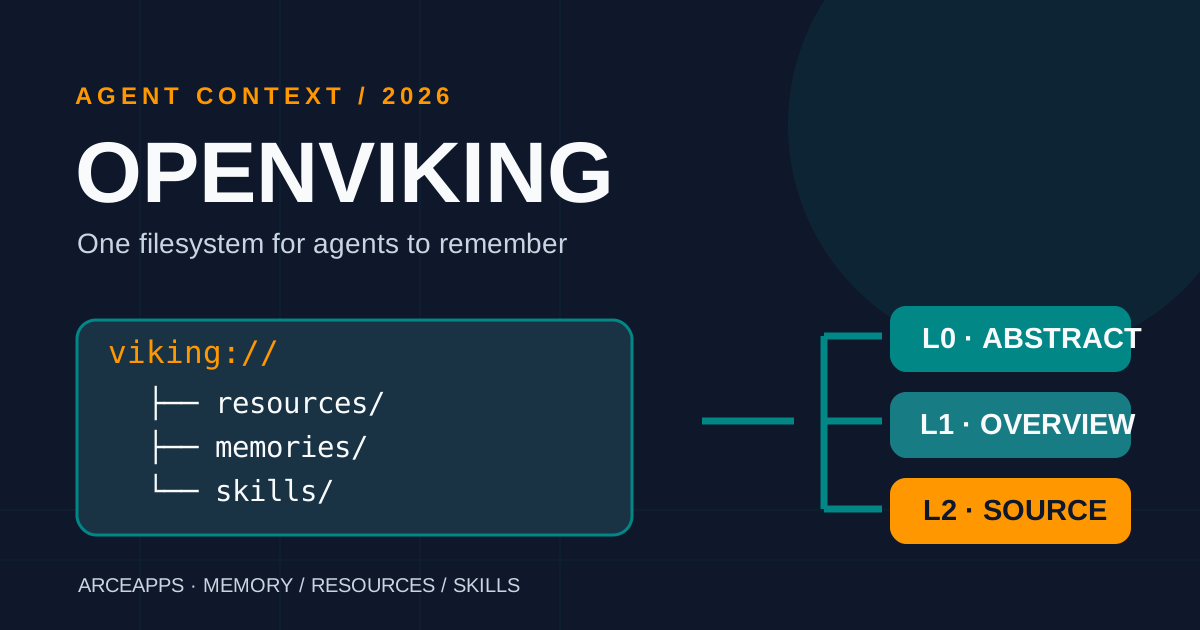
Table of Contents
An agent forgetting is not the whole memory problem
The most frustrating moment with an AI coding assistant often comes at the beginning of a new session. Yesterday it understood why a dependency was chosen, which architecture had been rejected and how the repository must be released. Today it starts asking the same questions. Sending the entire history back into context is not a satisfying fix. It increases processing costs, introduces irrelevant details and can make the crucial evidence harder to locate.
I have already explored Mem0 and Letta, persistent agent memory, cross-agent memory services and Graphicle. Those projects approach extraction, storage, code knowledge, retrieval and integration from different directions. OpenViking interests me because it aims to put resources, memories and skills behind one navigable context model, with a filesystem-like interface.
That is not quite the same as dumping Markdown files into a directory or asking a vector database for similar text. The official documentation describes viking:// addresses, filesystem-like operations, progressive L0/L1/L2 representations, resource ingestion and memory extraction from committed sessions. The architectural question is whether this organization gives an agent better evidence without filling its context window indiscriminately.
For a developer running several coding agents, the requirements are straightforward. Important decisions must survive sessions, remain traceable to their origins, respect access boundaries and become visibly stale when the project changes. “Search returns some plausible text” is not enough. We need a system that helps the agent find reliable context while keeping maintenance understandable.
Filesystem as an interface, not a promise about storage
OpenViking’s most accessible design choice is the filesystem analogy. People and agents can think in terms of paths, directories and documents. They can list a known location, inspect the structure and open a source when they need details. This is easier to reason about than a black-box retrieval endpoint that returns unexplained snippets.
But the analogy has a boundary. A viking:// URI is not simply an absolute local path, and the interface does not mean every backend component is a plain-file store. OpenViking also performs semantic processing, maintains search indexes and uses storage components configured by the operator. The path is an address within the context system.
The documentation distinguishes resources, which represent imported documents or code; memories, which preserve information from sessions or explicit additions; and skills, which contain reusable instructions and supporting materials. Those categories share access patterns without having to be confused conceptually.
This matters because a skill should not be treated as an ordinary fact. A remembered preference is different from a current API reference. Source documents and generated summaries have different levels of authority. A shared interface can make them easier to find, but a responsible agent still needs to know which kind of evidence it is reading.
The appealing part is that developers can keep the navigation model familiar while leaving indexing and summarization to the service. The risk is assuming the automation makes all underlying data trustworthy.
Separate shared resources from user and agent scopes
The official product model uses viking:// namespaces and scopes for different kinds of context. It can distinguish generally available resources from user-specific material and agent-oriented knowledge. This is more than tidy folder organization: it creates the opportunity to express ownership and access boundaries.
Imagine three items: public documentation for a library, a private architecture decision for one project, and a general code-review skill that may be reused by several agents. They are all context, but they should not necessarily have the same readers or writers. A single global search across all three may be convenient in a demo and dangerous in a real environment.
OpenViking documents multi-tenant operation, identity, resource access controls and encryption-related features. Documentation of a capability is not proof that a particular deployment enables it correctly. Operators must configure identities, credentials, networking and access rules according to their own threat model.
I would begin by assigning each memory or resource to the narrowest appropriate scope, then import it, and only afterward give agents access to retrieval tools. Reversing that order risks turning a knowledge service into a searchable collection of private files.
When evaluating shared memory, privacy questions belong near the beginning: can one agent search another user’s memories, can a tool write to a shared scope, and does a session import inherit the correct ownership? These are functional acceptance criteria, not optional polishing tasks.
L0, L1 and L2: reading progressively
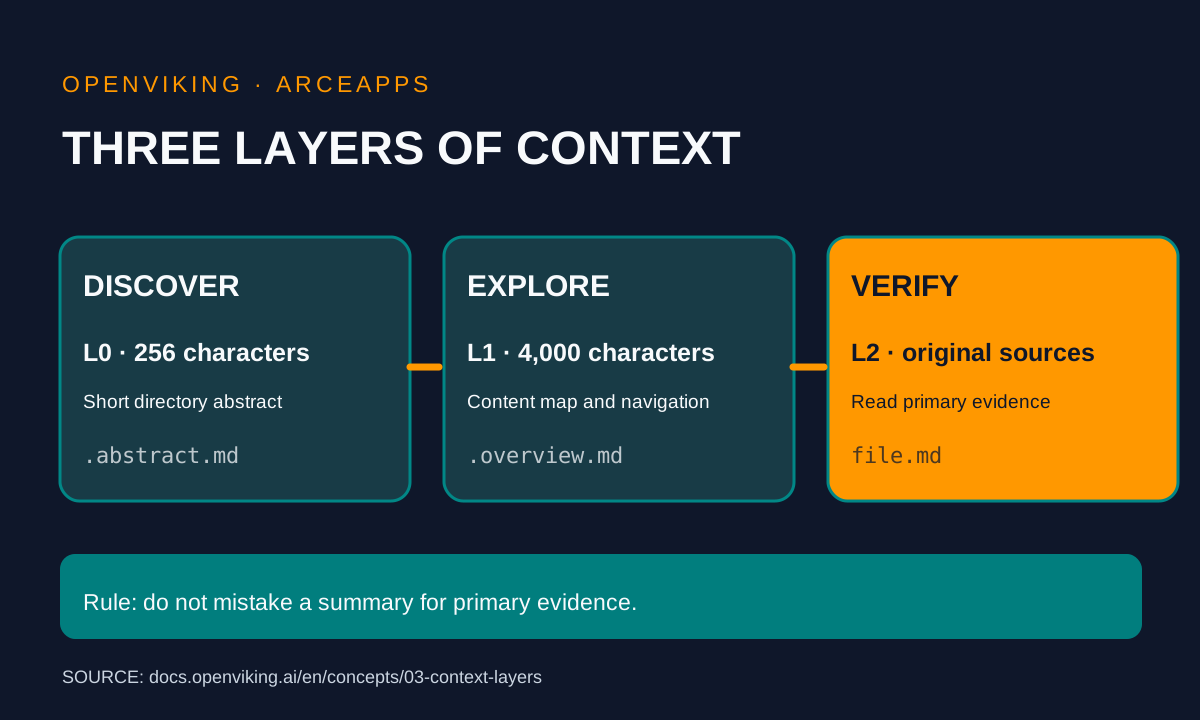
The central architectural idea is progressive context loading. Instead of automatically returning complete documents, OpenViking creates short representations for discovering relevant areas and longer views for navigating them. The underlying source remains available when accuracy requires a full read.
L0 is a concise abstract, generally stored as .abstract.md in a directory. It supports quick filtering and vector retrieval. The current technical documentation specifies a default generated-body budget of 256 characters. That is enough to signal relevance, not enough to treat an architectural claim as verified.
L1 is a directory overview, usually .overview.md, with a default generated-body budget of 4,000 characters. It can explain the purpose of a collection, identify useful child paths and help the agent decide what to inspect next. It remains a derivative representation and may omit conditions or exceptions.
L2 is the original source material, loaded on demand. It is the place to verify exact code, configuration, version-specific behavior and claims that were summarized in the other layers. L2 does not have the same uniform size budget as the generated directory summaries.
One nuance is easy to lose in marketing descriptions. The official documentation describes L0 and L1 as directory-level sidecars. It does not create an L0/L1 pair for every ordinary file. File summaries can contribute to the directory’s L1, but representing the system as a fixed three-file bundle for every document is inaccurate.
The distinction is important when designing a migration. You need to understand the directory hierarchy, not only the number of imported files.
Why hierarchical retrieval can reduce context waste
A coding agent does not always need the same depth of information. To find an architecture decision it may only need a directory description. To plan a change it may need an overview. To edit a function safely it needs the source, tests and relevant dependencies. L0/L1/L2 formalizes those different levels of attention.
Consider ten potentially relevant documents. A naive system might return long excerpts from all ten. A hierarchical system can retrieve abstracts, inspect a smaller set of overviews and finally open the most relevant sources. The potential token saving is intuitive, but a percentage cannot be claimed without measurements.
The hierarchy has its own costs. Abstracts and overviews must be produced and refreshed. An incorrect abstract can remove the right document from consideration. A summary that overlooks a crucial exception may cause a wrong decision. More retrieval steps can also increase latency even if the final context is shorter.
I would evaluate the entire task: evidence recovered, source correctness, prompt tokens, processing cost, latency and the final result. Measuring only that an abstract is shorter than its original document proves very little.
In my view, the strongest feature of progressive loading is conceptual rather than numerical. It forces the agent to distinguish finding a promising source from reading the evidence required to act. That is a useful discipline with or without OpenViking.
Ingestion is part of the product, not a preparation footnote
Search demos often begin with a clean, fully indexed dataset. Real projects begin with inconsistent documents, code repositories, duplicate notes and sources that keep changing. OpenViking describes an ingestion pipeline that parses content, builds a navigable tree, generates semantic representations and updates indexes.
The documentation covers importing documents, code, web resources and supported media. Some media understanding depends on compatible multimodal components. None of this means that every file format is parsed perfectly or that every imported fact remains correct indefinitely.
Freshness is one of the hardest issues. If the architecture document says a library is required but the repository removed it yesterday, precise retrieval is not enough. The system needs mechanisms for refresh, invalidation and provenance. OpenViking documents updates to parent summaries and resource processing, but an operator still needs to check the behavior in the exact installed version.
Another trap is assuming the ingest operation and semantic processing finish at exactly the same time. Some processing is queued or asynchronous. Before querying freshly imported content, I would inspect any available processing status and test both direct navigation and semantic search.
This is why installation success is a poor acceptance criterion. The meaningful question is whether changed knowledge becomes recoverable consistently, with the old version no longer presented as current truth.
Session memory: extraction is an editorial act
OpenViking can record sessions and extract memories when those sessions are committed or archived according to a policy. The documented process includes memory categorization, extraction, merging and deduplication, potentially involving model calls.
That makes an important distinction from document retrieval. A conversation is not a catalog of confirmed facts. It contains suggestions, mistakes, rejected options, experiments and corrections. Turning all of it into durable memory without keeping the status of each statement is dangerous.
Suppose an assistant suggests migrating a database and the developer says, “We might evaluate that next month.” An indiscriminate memory extractor could store “the team decided to migrate the database.” That memory is concise, searchable and false. Better embedding models will not repair information that was distorted during extraction.
For consequential engineering decisions, I favor an explicit review path: proposed memory, source session, provisional or confirmed status, and a way to correct or delete it. Corrections should eventually reach the relevant summaries and indexes. Do not assume that removing one visible file instantly erases every derivative representation.
This raises a governance question that is easy to ignore: who is allowed to turn a session into durable shared memory? The answer should be narrower than “any process that can chat with the agent.”
CLI, API, SDK and MCP are access paths, not identical experiences
OpenViking provides a CLI, APIs, SDKs and MCP integration options. Its official documentation shows a global npm install command for the CLI:
npm install -g @openviking/cliThat command is documented by the project; I am not claiming to have installed or tested it in the reader’s environment. Before adopting a release, check its runtime requirements, server configuration, authentication and supported operations.
MCP is useful because several agent clients can talk to a tool service through a shared protocol. But protocol compatibility does not guarantee feature parity. One integration may expose search and read operations while another handles session commits or memory writes. The capabilities must be inspected for the specific adapter and version.
There is a second boundary: sharing an OpenViking context service does not mean sharing a provider’s private internal memory. If a decision exists only inside an unexported ChatGPT or Claude memory store, another agent cannot retrieve it from OpenViking by magic. Shared context means information written into or imported into a common service and made accessible under appropriate permissions.
This distinction matters when building realistic workflows across Codex, Claude Code and other assistants. The shared system can be a common evidence store, not an omniscient synchronization layer.
How it differs from Mem0, Letta, Graphicle and Markdown
The question “Which memory framework is best?” usually hides a more useful question: best for which problem? Mem0 focuses on extracting and retrieving facts and supports configurable storage approaches. Letta develops an agent runtime with memory management. Graphicle links code structure, documentation, session material and memory to repository symbols. Plain Markdown offers excellent readability and control with almost no infrastructure.
OpenViking’s differentiator is its unified navigation of resources, memory and skills with layered retrieval. That can be valuable when multiple agents repeatedly need several kinds of context from the same knowledge base. The cost is operational complexity: ingestion, indexes, background processing, storage and authorization.
I would compare OpenViking to Graphicle for repository-grounded evidence. I would compare it to Mem0 for extracted facts from sessions. I would compare all of them to well-organized Markdown and text search when the project remains small. A simple filesystem solution should be included as a baseline, not dismissed for lacking an AI label.
These are analytical comparisons based on architecture, not benchmark results I ran myself. The tools overlap in features, and releases evolve. A meaningful recommendation requires actual representative tasks, fixed versions and a clear success definition.
The best choice might even be two complementary tools, provided their responsibilities are explicit and the data is not duplicated without a reason. More memory layers do not automatically mean better recall.
A small reproducible test for cross-agent memory
Before moving an entire repository’s knowledge base into a new service, I would design a focused experiment with three clients and a tiny document set. One client writes a confirmed architecture decision with provenance. A second client retrieves it during a different task. The third checks what happens when the decision is edited or removed.
The questions should include simple recall, multi-document reasoning and deliberately unanswerable cases. The last category matters because a memory system that always returns something can look helpful while driving hallucinations. For multi-hop tasks, inspect whether the retrieval contains all the evidence required, not merely a high-similarity snippet.
Record retrieval correctness, source provenance, final task outcome, context size, total latency, ingestion cost and maintenance operations. Then try a privacy test: ask one client to retrieve memory outside its scope. The correct outcome is denial or no result even if the index knows where the record is.
Repeat after a document update, a process interruption, and a restart. Persistence and reliability need recovery tests; their existence cannot be inferred from a marketing claim about memory.
This proposed experiment is small enough for a personal project but broad enough to detect important architectural weaknesses.
Concurrency, snapshots and crash recovery
Shared memory is also a storage system. Two agents can update the same record, an ingestion can stop halfway through, and a vector index can lag behind the source tree. Those failure modes may matter more than a small recall improvement.
OpenViking documents path locking, queue state, multi-write storage, crash recovery and Git-backed snapshots. I consider that a positive sign of engineering attention, but it is not evidence that every installation or failure mode is covered perfectly. The right test depends on the release and the deployed backend.
Snapshots deserve particular care. The roadmap notes that restoring file content does not automatically restore historical access-control lists or vector indexes. A content snapshot is not necessarily a complete service backup. Confusing the two creates dangerous recovery assumptions.
For a personal setup I would demand readable exports, a verified backup, a tested restore, and a way to return to a simple solution if the service becomes unmaintainable. Open source reduces some lock-in risks but does not eliminate dependence on a particular data model or index layout.
Reliability is not an abstract feature count. It is what happens when a write collides with another write, a process crashes and the service comes back.
Security, licensing and operating cost
The official repository identifies OpenViking as AGPL-3.0 licensed. That matters when considering redistribution or offering a modified service. “Open source” does not mean there are no licensing obligations. The applicable requirements depend on how the code is used and modified, so check the license rather than relying on a summary.
The actual operating cost also needs attention. Generating L0/L1 summaries, embeddings, session memories and merges may require model inference or local compute. OpenViking documents multiple provider options. Costs depend on data volume, update frequency, session count, model configuration and storage.
A local deployment is not automatically a private deployment. Embeddings or memory extraction might call external services depending on configuration. The server might expose an API, and an MCP endpoint may need authentication. Before connecting a private repository, inspect which components send data out and which identities can read each scope.
My basic safety checklist includes minimum-privilege credentials, restricted network exposure, storage backups, dependency updates, input limits, access-control tests and an explicit policy for personal or private data.
Only after those checks would I connect an agent empowered to edit code or publish files.
Would I adopt OpenViking for indie development?
My answer depends on the workflow. For one project, one assistant and a dozen stable decisions, Markdown under version control plus local search may still be the better engineering decision. Adding semantic queues, indexes, memory extraction and a persistent service could increase maintenance without producing enough value.
I would take OpenViking more seriously when several clients need the same auditable context, sources change frequently, and manually recovering decisions starts to consume meaningful time. Then a unified interface, progressive retrieval and shared governance may earn their complexity.
Even in that case I would begin with a small collection, not a complete migration. Prove that the agent retrieves the right evidence and respects permissions. Introduce backup and update tests. Measure the end-to-end task outcome. Only then expand.
The most transferable lesson is progressive reading. An agent can navigate using summaries but should open primary sources before making a precise technical decision. That is excellent practice even if OpenViking turns out not to be the right product for your environment.
I would not accept a claim that shared memory automatically eliminates contradictions, staleness or hallucinated decisions. Those problems require provenance, confirmation and review.
Lessons learned: context must remain inspectable
Five lessons stand out. A shared interface simplifies access but does not unify the meaning of every document. L0 and L1 are navigation aids, not replacements for source material. Session extraction needs to preserve the status of decisions. Shared memory must enforce permissions. And storage reliability has to be demonstrated through recovery tests.
The decision is not simply “OpenViking versus Mem0.” It is: what needs to be remembered, who should be able to see it, what evidence is sufficient to act, and how much infrastructure can we maintain?
Sometimes the answer will be a shared context service. Sometimes a clean directory tree and grep will win. The right system is the one that helps us resume meaningful work without re-explaining everything and without creating a new source of errors.
References
- OpenViking official repository, code, license and releases.
- OpenViking introduction, context types and sessions.
- L0/L1/L2 documentation, precise directory-summary behavior.
- OpenViking roadmap, implemented features and future directions.
- Project website, integration and processing overview.
- ArceApps background: Graphicle, Mem0 and Letta and cross-agent memory.
Closing thought. Agent memory should be helpful when needed, inspectable when wrong, and quiet when irrelevant. OpenViking makes a serious architectural proposal toward that goal. Whether it succeeds for you is a question for your own tasks, permissions and data.
You might also be interested in
AgentMemRec: treat agent memory like recommendations
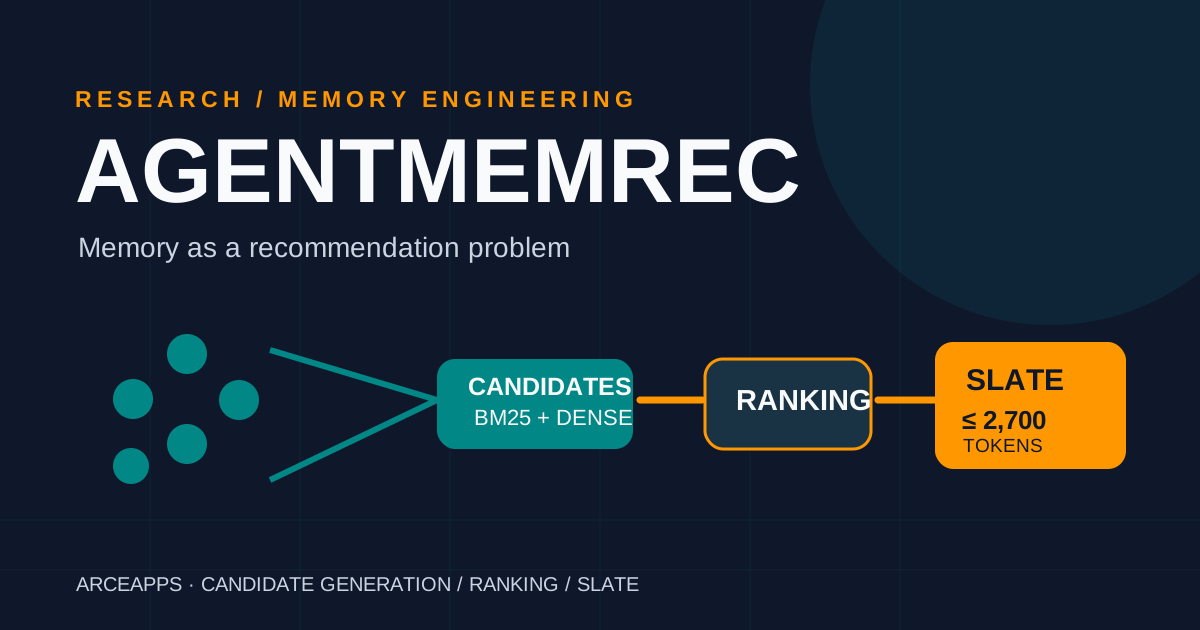
Analyze AgentMemRec's recommender approach to memory retrieval, combining BM25, learned ranking and token-bounded context without extra LLM selection calls.
Graphicle: Code Graph and Memory for AI Coding Agents
Explore how Graphicle combines a code graph, documentation and agent memory; examine its architecture, privacy, benchmarks and closest alternatives.
Agent Memory: what Mem0 and Letta benchmarks reveal
Compare reproducible benchmarks of Mem0, Letta, Graphiti and LangMem, including sample sizes, recall, latency, costs and methodological traps.