
Graphicle: Code Graph and Memory for AI Coding Agents
Table of Contents
Related reading: I have previously covered semantic code search tools, cross-agent MCP memory servers, and persistent memory for AI agents. This article connects two questions usually treated separately: how an agent understands the code, and how it remembers why that code exists.
There is a familiar moment in nearly every long coding-agent session. You ask the agent to change one function. It finds the file, then spends the next several minutes tracing its callers, its imports, the tests and the configuration that makes the behavior possible. You open a new session the following day, and much of that exploration begins again. Worse, the agent may revisit an architectural decision you settled weeks ago.
These are two related but distinct problems. One is structural: symbols, calls, dependencies, imports and impact. The other is historical: decisions, constraints, experiments and previous sessions. Ordinary search addresses some of the first. Conversation summaries address some of the second. Neither necessarily connects the decision to the code it concerns.
Graphicle is an attempt to bring both kinds of context into one place. It is an open-source Rust program that constructs a graph of a repository, indexes documents and captured agent sessions, lets humans approve proposed memories, and serves relevant excerpts with citations through command-line tools and MCP. The attraction is not that it magically understands an application. The attraction is that an agent can ask better questions of evidence that already has structure and provenance.
But that promise raises a harder question: does Graphicle actually improve a developer’s work compared with capable built-in search, a well-maintained AGENTS.md file and a modest collection of design notes? To answer that, we need to inspect how the project operates and read its published measurements without exaggerating them.
The missing context between code and decisions
A software project accumulates at least three distinct kinds of knowledge. Current code tells us what the system does today. Maintained documentation explains conventions, interfaces and intended behavior. Historical context explains decisions that were discussed and perhaps never written down, including ideas that were explicitly rejected.
A text-search command can locate the definition of a function or a log message. An LSP-based tool can navigate to a symbol. An engineering journal can tell us why a particular database was chosen. Yet none of these alone answers every question. The coding agent may find a comment that says a design is intentional, but not know whether that decision was superseded. A memory tool may confidently recall a function that no longer exists. A dependency graph may show calls without explaining the product constraint that created them.
Graphicle tries to provide a common retrieval surface over these sources. It maps code relationships, stores indexed text, captures supported agent sessions and associates reviewed memories with the relevant source context. When an agent requests help, Graphicle can return a limited set of excerpts, including file paths and lines, instead of dumping a huge bundle of files into the model context.
The important word here is limited. Building a large index is useful only if retrieval remains selective. Giving an LLM the entire history of a repository is not memory management; it is context overload with better packaging. A good system keeps evidence available without assuming every piece belongs in every prompt.
This idea also works without Graphicle. A stable documentation index, versioned decisions and a clearly written agent instruction file are excellent starting points. Graphicle becomes worth investigating when manually connecting that material to changing symbols is a recurring cost.
What Graphicle actually includes
The official repository describes a locally run, Apache-2.0-licensed program built in Rust. Its code-graph engine uses tree-sitter to parse program structure. Indexed memory and project sources are kept in SQLite. A command-line interface and local web application provide human access; an MCP server gives AI coding clients tools for retrieving context and exploring code relationships.
It is useful to separate the product into several responsibilities:
- Structural extraction: files, functions, classes, imports and calls become a graph of named nodes and relationships.
- Document indexing: Markdown and other supported document formats become sources available alongside code.
- Session capture: supported clients can contribute previous interactions, which then become another retrievable source.
- Reviewed memory: an agent may propose a durable memory, but a human approves it before it is treated as an accepted project memory.
- Cited retrieval: CLI and MCP tools return source excerpts within a token budget rather than expecting a model to read everything.
- Synchronization: changed files are refreshed on retrieval, with Git hooks helping keep the index current across ordinary repository operations.
- Inspection: the local browser interface allows you to explore the graph, sources and memory and review proposed notes.
There is an important origin story. Graphicle’s code-graph engine is a Rust port of Graphify’s engine, with attribution to Graphify and its contributors. The memory system, session capture and application are additional work. This is neither a completely independent graph algorithm nor simply a rename of Graphify. It is a different packaging and integration of related structural technology.
It is not a complete autonomous developer. The program does not independently decide which issue to implement or verify the correctness of a pull request. It does not replace unit tests or a human’s understanding of an architectural choice. It supplies the context with which an agent, and ultimately a developer, can make those choices.
That distinction is essential because well-cited misinformation is still misinformation. A stale document remains stale even when retrieved with perfect source references.
How the code graph helps with multi-hop questions
A repository is not a bag of isolated strings. Functions call functions, classes depend on interfaces, components import packages and schemas connect to consumers far away in the directory tree. Textual search is good at names and literals. It is less direct for questions involving paths through several relationships.
Parsing an abstract syntax tree gives a tool named program elements without calling an LLM to explain every file. A graph can then answer relational questions: what calls this symbol, which files depend on it, what path links two areas of the application and what might be affected if a definition changes? Graphicle exposes searches, neighbors, paths, symbol explanations, impact operations and a browser-based graph view.
The official example for impact exploration is concise:
graphicle graph extract . --code-only
graphicle graph affected "retry()"
The first command extracts the structure without the optional model-assisted enrichment step. The second explores the dependencies of a named symbol. The output should be treated as an impact-analysis starting point, not a formal proof that the system has discovered every consequence of a change.
Any static graph has limits. Dynamic dispatch, code generation, reflection, dependency injection, runtime configuration, SQL built from strings and network boundaries can hide relationships from a parser. Even in strongly typed code, a dependency may be behavioral rather than a visible call. The graph tells you what it could infer from its inputs and its rules.
Consider a Kotlin application. A user action may flow through a ViewModel, use case, repository interface and persistence adapter. The graph can help the agent locate likely consumers before changing an interface. In a TypeScript monorepo, it might reveal which packages refer to a shared function. In either case, after exploring the relationships, the developer still needs tests and build verification.
There are also questions where grep is absolutely the right tool. An uncommon error message, a feature flag, a translation key or an unfamiliar endpoint string might be found faster by exact search. We should not replace a small and excellent primitive with a sophisticated tool simply because the new tool has a better diagram.
Persistent memory with provenance
Graphicle’s second major capability is retaining project context across sessions. It indexes maintained documents, can capture completed turns from Claude Code and Codex, and supports proposed memories that wait for a human to review them in the local interface. That approval step is more interesting than it first appears.
Imagine ending a session with the conclusion: “For this local prototype, keep SQLite; a server-managed database would add maintenance without improving the current requirements.” A later agent should be able to recover that reasoning. It should also know whether it is an accepted decision, an informal conversation or a design suggestion that was never adopted.
A useful memory system must distinguish source material from approved interpretations. Raw sessions often contain mistakes, trial-and-error commands and abandoned approaches. Treating all of that as reliable instructions would make the agent less dependable with every additional conversation. Reviewing durable memories offers a point where the developer can reject or correct a conclusion before it becomes part of the reusable context.
Graphicle also documents associating memories with the code symbols they concern. When a linked function changes, the system can flag the corresponding memory as potentially stale. A change elsewhere in the same file will generally not invalidate it. This is an attractive answer to a subtle problem: an old decision may remain linguistically persuasive after the implementation it described has disappeared.
It is not perfect semantic change detection. A product requirement may become obsolete because of a customer decision, an external API or a dependency version, even if the linked function remains untouched. One decision may span many modules. A function can change internally without changing the underlying architectural rationale. Staleness flags are therefore review signals, not automated proofs that memory is right or wrong.
I would organize trust as a hierarchy. Current code and tests describe operating reality. Maintained documentation describes intended behavior. Reviewed decisions explain historical intent. Captured sessions are evidence of discussions and experiments, not necessarily rules. The tool helps connect those layers, but the hierarchy itself is an engineering practice.
Cited context is not the same as lower token use
One of the most common mistakes in discussions of code indexing is mixing together three different measurements: index size, retrieved-context size and end-to-end tokens spent by an agent on a task. Graphicle gives the caller a context budget, and its tools can produce a compact packet of relevant excerpts. That controls the amount returned by one retrieval. It does not, by itself, establish that a complete coding session becomes cheaper.
In a plausible workflow, the agent receives an issue and asks Graphicle where the related symbols and decisions live. The tool synchronizes changed files and returns a few excerpts with file paths, source lines and perhaps reviewed historical context. The agent reads this packet, requests further evidence if needed, then proposes an implementation. Each step can be checked against the source.
That has value even when token usage remains unchanged. Citations make it easier to challenge assertions, reproduce a lookup and open the underlying files. If an agent claims a validation takes place in a particular module, you can inspect the exact lines. If it quotes a decision, you can check whether that decision predates a breaking change.
The official CLI demonstrates this distinction:
graphicle ask "where is tax added to prices?"When no answer model is configured, graphicle ask shows the evidence rather than pretending that an LLM has answered. Configuring a supported provider can add generated prose. The retrieval and graph tools themselves do not need to call a model for their ordinary code-only operation.
This separation also makes failures easier to diagnose. If the cited result is irrelevant, investigate indexing and ranking. If the right passage appears but the agent reaches the wrong conclusion, investigate reasoning and instructions. Blaming every mistake on “bad memory” makes both systems harder to improve.
Installing it without surrendering control of the repo
The project’s quick start documents Homebrew, release archives and a shell installer. On a machine with Homebrew, the published path is:
brew install graphicle-ai/tap/graphicle
cd path/to/your-repository
graphicle setup
graphicle doctor
The convenience of setup is part of the selling point: it discovers supported clients, updates MCP configuration, adds integration hooks and may add a brief section to AGENTS.md. The project’s documentation says it backs up modified files and offers graphicle disconnect to undo its integration.
That is useful but deserves deliberate inspection. Hooks and agent instructions are part of a developer’s execution environment. An automatic installer touching them should not be treated like a passive library download. Before running it, record Git status, inspect the files that will change and keep a copy of existing MCP settings. I would avoid the noninteractive --yes flag for the first run in a valued repository.
The official shell-install command is another option, but I prefer reviewing a downloaded script before executing it, or using a verified package. The README describes Windows x86-64 support as a preview without code signing at the time reviewed. That should inform any decision to use the tool in a sensitive Windows workflow.
A controlled first trial looks like this. Start from a disposable clone. Connect one agent, open graphicle open and inspect the resulting code and document sources. Ask a question with a known answer. Change a small function and inspect the reported impact. Check synchronization after the change. Finally run graphicle disconnect and compare the configuration with the initial state. These are suggested evaluation steps, not tests I conducted for this article.
If you work across multiple repositories, Graphicle’s workspace recall interface, including graphicle context --workspace, offers another potential benefit. But a wider search scope must come with clear boundaries: not every decision from one project is relevant or safe to expose in another.
MCP clients, sessions and operational boundaries
Graphicle lists Claude Code, Codex, Cursor, VS Code, Claude Desktop and other MCP clients as integration targets. The depth is not identical. The setup documentation describes session capture for Claude Code and Codex, while other MCP clients can use graph and memory tools without necessarily receiving those session hooks.
An MCP connection does not make every piece of software on the machine equally trusted. The index can contain private code and documentation. The connected coding agent may run a remote model, in which case retrieved excerpts can leave the machine through the model provider. A local-first index does not imply a fully local reasoning pipeline.
The repository states that the web app and HTTP/MCP endpoints bind to 127.0.0.1 by default, with a SQLite-based local store, no account requirement and no telemetry. It also documents exceptions to the no-network claim. A command may check GitHub for new releases daily; remote model calls or configured connectors use the network; GitHub CLI operations can contact GitHub; and full graph extraction may use an LLM to process documents and images. The release check can be disabled with GRAPHICLE_NO_UPDATE_NOTIFIER=1.
The project says ordinary synchronization honors .gitignore and skips conventional secret files and credentials. Session capture includes redaction rules and private delimiters. Those are good safeguards, but they are not a guarantee that no sensitive value can ever enter an index or a retrieval result. A secret pasted into a Markdown note, CI log or unusual filename needs independent care.
For a private project, I would audit the files included in the initial sync, understand the retention and deletion controls, and confirm which client transports retrieved content to which model. The published deletion mechanism includes receipts for removing remembered material, but erasing something from Graphicle does not revoke data already sent elsewhere.
One further boundary is worth repeating: --code-only graph extraction and a full, model-enriched extraction have different privacy and cost profiles. A README headline saying “no API key required” describes the core experience, not every optional workflow. That is not a contradiction, but it is an important operational distinction.
Reading the benchmarks as an engineer
Graphicle’s maintainers publish a relatively detailed benchmark methodology. I appreciate this more than a large speedup claim without an accompanying method. The downside is that the headline numbers are easy to strip of essential context.
In one comparison covering 13 codebases and 39 measurements, the 0.1.1 memory engine in a pre-release Graphicle build completed measured graph extraction and update operations 3.0 to 22.7 times faster than Graphify 0.9.91 under the documented conditions. The generated graphs were similar but not exactly identical; node and edge counts differed slightly. That matters because a parser producing a different graph is not necessarily performing exactly equivalent work.
The memory measurements also favor Graphicle in those tests, subject to specific builds and measurement conventions. They are informative but should not be treated as immutable hardware requirements for future versions. If your limiting factor is RAM, the honest approach is to reproduce the measurement on your actual repository and current versions, including startup, initial indexing and repeated lookups.
The agent tests tell a more complicated story. On 100 SWE-bench Verified tasks, ordinary Claude Code and the Graphicle-equipped configuration each found all files changed by the solution in 95 cases. Graphify’s setup found them in 94. In that particular study, the agent never invoked Graphicle’s tools, and the Graphicle configuration used 16% more tokens than plain Claude Code. That result cannot establish whether a better tool-use policy would help, but it certainly does not establish the commonly claimed automatic token savings.
On a 30-question showcase corpus from Graphify, Graphicle’s evaluated settings retrieved a larger share of facts than Graphify, but the difference from plain Claude Code did not meet the stated statistical criterion. Median tokens per answer were approximately 69.2k for Graphicle and 60.8k for plain Claude Code, without a proven difference between those two systems. Graphicle outperformed Graphify on some measured outcomes, but the evidence does not prove broad superiority over standard agent search.
The maintainers also describe offline file-ranking results for Graphicle 0.1.3 and faster context-query latency in Graphicle 0.1.8 compared with 0.1.7 on a Kubernetes corpus. Those are valuable engineering observations, especially for identifying where bottlenecks were improved. They are not substitutes for evaluating whether an agent finishes real work more accurately or with fewer tokens. The project explicitly notes that prolonged, accumulated cross-session memory use has not yet been tested comprehensively.
My conclusion from the measurements is therefore narrower than the marketing proposition. Graphicle has credible published evidence of fast structural indexing against the compared Graphify releases. Its integrated memory design is worth testing. Claims that it will reliably save agent tokens or improve task outcomes across projects remain open.
A practical evaluation plan for your own codebase
The right benchmark is not “Can it index a repository?” but “Does it answer questions I routinely lose time on?” I would choose three kinds of task: locating an implementation, understanding the impact of a change and recovering a historical design decision. Each should have a known, verifiable answer.
For example, start with a retry path, a shared interface and a documented decision about persistence. Ask the same coding agent to solve each question with and without Graphicle, keeping the repository revision, model and instructions as consistent as possible. Record whether it names the correct files, how many irrelevant files it reads, its total time and overall token usage. Note specifically whether it invokes the MCP tools.
Next, create a controlled change that should make a stored decision stale. Did the system recover the original decision? Did it identify the changed symbol? Did the agent recognize that the old rationale needed review instead of presenting it as current truth? This is a more meaningful memory test than simply asking whether yesterday’s chat can be quoted.
Finally, evaluate ongoing cost. Measure initial indexing, re-indexing after a few edits, memory usage on a genuinely large repository, the amount of configuration introduced and the ease of rolling back. Verify language support against your real code, rather than a short toy example. Examine a few graph edges by hand; a small number of misleading relationships can waste more time than a slower but predictable search method.
I would also run tests that favor the baseline: searching a unique log message and locating a simple string literal. If Graphicle only wins tests selected to flatter graph traversal, it tells me nothing about whether the everyday workflow improves. A fair trial lets simple tools win where they are already excellent.
Relationship to SDD, docs and a second brain
This is the part of Graphicle’s design I find most thought-provoking. Spec-driven development is not primarily about generating more documentation. Its value comes from expressing requirements and decisions clearly enough that later changes can be checked against them. A concise plan and a short record of an architectural trade-off should remain useful even when the original AI assistant disappears.
I would not let an opaque memory database become the only durable home of important decisions. Keep stable knowledge in versioned Markdown or another portable source of truth. Use Graphicle to discover, connect and cite that knowledge. Treat captured sessions as a source of candidate learnings rather than a permanent stream of instructions.
A documentation index can answer where a decision lives. A code graph can show what calls the implementation. A reviewed memory can explain why the implementation exists. Combined, those capabilities support a workflow in which an agent checks the current code, reads the intended constraint and tests the change rather than merely generating plausible code.
The same principle applies to a personal knowledge base. A second brain needs ownership of the actual notes, consistent naming and a maintenance routine. Automated retrieval makes it easier to consult that material; it does not guarantee that the material is current. A stale wiki indexed perfectly is still a stale wiki.
Working across multiple personal projects makes scoping equally important. A shared workspace can reduce repetitive orientation, but project-specific decisions should remain project-specific. The best cross-project memory finds the right context without accidentally borrowing assumptions from a different application.
Risks, trade-offs and signs of maturity
As of October 26, 2026, Graphicle is an actively evolving 0.1.x project. Its published documentation discusses pre-release measurements, significant performance changes between versions and preview Windows packaging. There is real engineering momentum, but also a reason not to regard its behavior as permanently settled.
The automatic setup experience creates responsibility. Changing hooks, MCP configuration and agent instructions can conflict with an existing carefully tuned workflow. Incremental graph maintenance must handle renames, generated files, changes in ignored paths and large repositories. Security-oriented exclusions and redaction need to be verified with the actual material you use.
Resource usage may vary substantially across releases and workload types. The maintainers’ own comparisons show meaningful optimization between versions, including context-query time and memory. I would keep the first deployment reversible, pin or record the version under test and measure more than one representative repository.
There is also an epistemic risk: the better a tool looks at citing sources, the easier it is for an agent to sound overconfident. A retrieved decision is historical evidence, not a direct command to apply it to every future case. Tooling should support human judgment, not give it a polished excuse to disappear.
Before making this a permanent part of my workflow, I would want four answers: does it reliably retrieve decisions I care about, can I undo all integration changes, do repository boundaries remain clear, and does it measurably improve my task outcomes compared with existing search? If not, Graphicle may still be a useful occasional inspection tool rather than a default always-on dependency.
Final comparison: Graphicle vs popular alternatives
There is no single category called “AI coding context tools.” Some products build code graphs, some provide semantic symbol operations, some remember interactions and others build temporal knowledge graphs for custom agent applications. The following comparison is deliberately organized by the job each tool is designed to perform, rather than pretending that star counts or a single speed benchmark rank them on one universal scale.
| Tool | Primary purpose | Main strength | Important limitation |
|---|---|---|---|
| Graphicle | Code graph, documents and reviewed agent memory | Integrated local context with citations and staleness signals | Not a replacement for tests or maintained documentation |
| Graphify | Structural graphs of code and other sources | The original code-graph lineage and a focused graph workflow | Its OSS graph engine is not Graphicle’s integrated reviewed-memory experience |
| Serena | Semantic navigation and editing via MCP | Symbol-level inspection, editing and refactoring | Not primarily a historical decision-memory store |
| claude-mem | Session persistence for Claude Code | Automatically capturing and summarizing development activity | Not primarily a static code-dependency graph |
| Graphiti | Temporal knowledge graphs for agent applications | Tracking evolving facts, provenance and historical validity | Requires application-level integration, not a turnkey code navigator |
| CodeGraph / CocoIndex Code | Code indexing and retrieval; CodeGraph also stores memory and documents | Graph exploration, semantic search and IDE integration | Memory approval and staleness workflows differ from Graphicle’s approach |
Graphicle or Graphify?
This is the closest architectural comparison. Graphicle explicitly ports and credits Graphify’s graph engine and then builds a broader local experience around it. If you already have Graphify and only need accurate call and import relationships, changing tools might add migration work without solving a new problem. If you want code analysis and reviewed session memory behind one MCP server, Graphicle has a distinct operational proposition.
There is a nuance around product scope: comparing Graphicle with Graphify OSS does not automatically describe the features of Graphify’s hosted commercial offering. The deployment model matters just as much as the function list.
Graphicle or Serena?
Serena is more like an IDE’s semantic operations presented to a coding agent. It emphasizes symbol-level retrieval, editing and refactoring, often making it a strong choice when the agent needs to act precisely on existing definitions. Graphicle emphasizes repository structure and connecting it to historical context. Their strengths can complement each other, but running two MCP servers also introduces extra tools and cognitive overhead for the agent. I’d test whether both are actually invoked before keeping both.
Graphicle or claude-mem?
If the pain is primarily that Claude Code forgets what happened between sessions, claude-mem targets that problem directly. It captures observations and generates reusable summaries for later sessions. Graphicle offers a wider concept: session memory connected to a code graph and accessible through broader MCP integrations. The crucial evaluation criterion is not the number of saved notes. It is whether remembered information can be inspected, corrected, discarded and recognized as stale.
Graphicle or Graphiti?
Graphiti solves a substantially different problem. It is a framework for building temporal context graphs that represent changing entities, facts and relationships with historical provenance. That is compelling when memory is a feature of the product you are building, such as a custom assistant with evolving domain knowledge. It is not primarily a drop-in map of a code repository. Graphicle is the more ready-made option for local coding-agent context; Graphiti is the more general building block for a custom temporal memory architecture.
What about CodeGraph and CocoIndex Code?
Our earlier code-search comparison examined these specialized approaches. They remain relevant if the actual problem is finding definitions, callers and related passages efficiently. CodeGraph itself also offers persistent memories and document indexing, so its scope overlaps with Graphicle’s; treating it as a search-only product would be inaccurate. CocoIndex Code focuses on semantic code search, with local or external embeddings depending on its installation. Choosing a graph-plus-memory tool for a problem that fast symbol search already solves is unnecessary complexity. Conversely, insisting that a search index must manage historical decisions forces it beyond its natural purpose.
Which would I choose?
For a local, multi-session workflow where I need to reconnect code, documentation and reviewed decisions, I would trial Graphicle in a disposable clone. For structural exploration I already handle well with Graphify, I would not migrate without a measured reason. For precise symbol editing and refactoring, I would start with Serena. For Claude Code session continuity alone, I would evaluate claude-mem. For a new agent product whose temporal memory is part of its architecture, I would study Graphiti.
The simplest conclusion is also the strongest one: the best context system is the one that helps you make a verifiable decision with the least additional work. Graphicle’s architecture makes a serious attempt at that goal. The next step is not to trust the prettiest graph or the largest speedup, but to compare real tasks with the ordinary tools we already have.
References and further reading
- Graphicle: source, architecture, installation and limits.
- Graphicle: benchmark methodology and published results.
- Graphicle: configuration and operational limits.
- Graphicle: agent integration.
- Graphify: original graph-engine project.
- Serena: semantic code navigation and editing.
- claude-mem: memory across coding sessions.
- Graphiti: temporal knowledge graph framework.
- CodeGraph: graph navigation, memory and MCP tools.
- CocoIndex Code: indexed code search.
- Model Context Protocol: official documentation.
This article draws on public project documentation and maintainer-published tests as reviewed on October 26, 2026. I did not install Graphicle or independently reproduce its benchmarks to write it. If you test it on a real repository, I am most interested in whether it helps preserve decisions and avoid repeated exploration—not merely in how quickly it builds an index.
You might also be interested in
The Persistent Memory Stack I Actually Use...
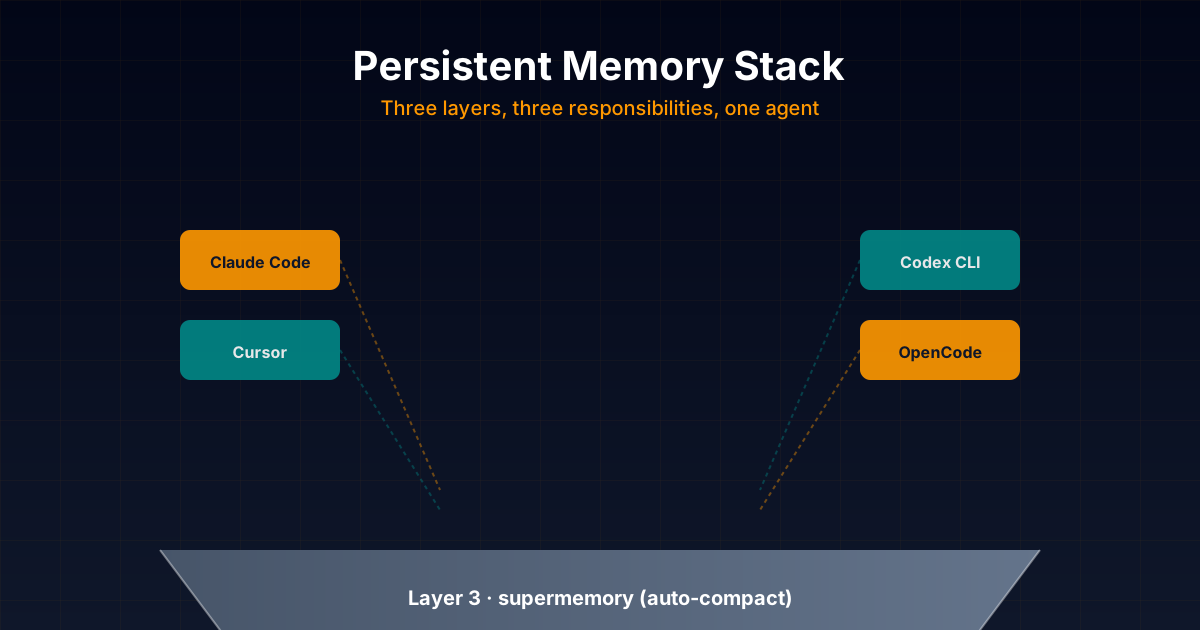
Honest technical deep dive into the persistent memory stack I combine daily in my projects: opencode-supermemory for auto-compact, basic-memory as main memory with Markdown + graph, and forgetful as procedural skills layer. With real configuration examples for Claude Code, Codex,
Native OpenCode Plugins for Persistent
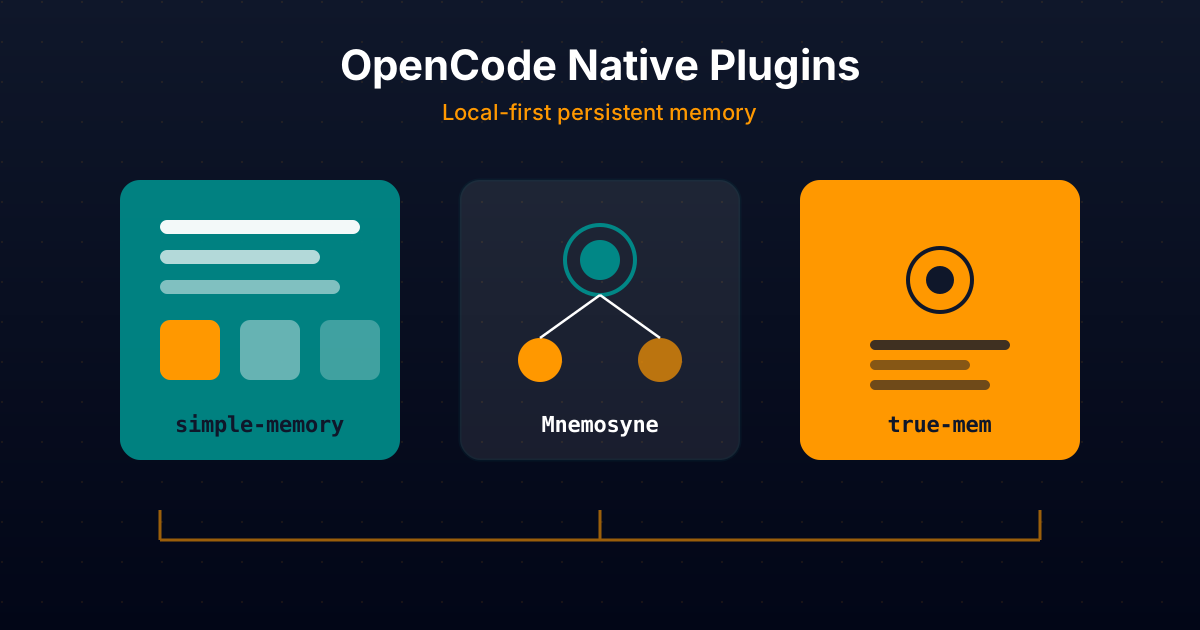
Comparative technical analysis of three native OpenCode plugins to give your AI agent persistent local memory: simple-memory (logfmt), Mnemosyne (offline Go binary), and true-mem (cognitive psychology).
Cross-Agent MCP Servers for Persistent
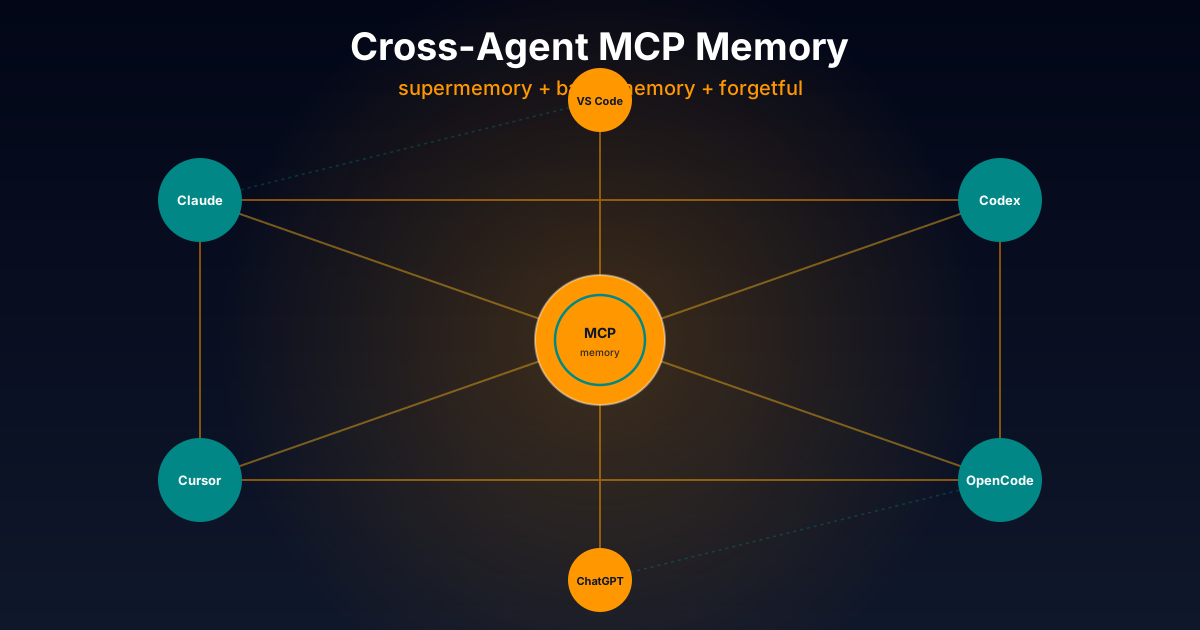
Exhaustive technical comparison of three cross-platform MCP servers to give AI agents persistent memory: opencode-supermemory (cloud), basic-memory (Markdown + graph), and forgetful (atomic Zettelkasten). Works with Claude Code, Codex, Cursor and more.