
Table of Contents
A memory that never reaches context is not useful
For years we have discussed agent memory primarily as a storage problem. Save notes, extract facts, create graphs, summarize sessions and perhaps the assistant will stop forgetting what it learned. But every request involves another decision that is often more important: which of all those stored memories should actually enter the language model’s limited context?
An agent may have retained the right architectural decision and still act as if it never existed. It might retrieve an obsolete note about the same library. It might find the first half of a story but not the later correction that changes the answer. None of these failures necessarily means the information was lost from storage. They indicate a failure in evidence selection.
The preprint Agent Memory as Recommendation, submitted by Xinyu Zhang and Weiwei Sun on 26 October 2026, proposes looking at this problem through recommender-system engineering. Rather than treating long-term memory solely as a search index, it models each query as a request for a compact selection of items competing for a fixed context budget.
This is not another introductory guide to Mem0. It follows my earlier persistent memory overview, Mem0 and Letta architecture and discussions of hierarchical memory, but asks a different question: how can an agent select the entire set of evidence necessary to answer without spending a long sequence of generative model calls deciding what to read?
The paper offers a formal model, a concrete retrieval pipeline, ablations and benchmark results. It is interesting precisely because those parts can be examined separately instead of being hidden inside a new product name.
From searching documents to recommending a set
A conventional recommendation system has a large catalog, a particular user’s request, candidate generation, ranking and a final collection of items shown on a screen. An agent memory system faces a similar situation. The catalog is the conversation history, the request is the question, the items are stored turns or records, and the final collection is the context given to the answering model.
The authors call that collection a slate. The value of a slate depends on the set as a whole, not merely on each item’s individual relevance. Suppose an old conversation says a pottery class meets on Tuesdays, while a later message says it has moved to Thursdays. Answering “What day is it now?” requires the relevant old and new evidence and the ability to interpret their temporal relationship.
This illustrates why ranking individual snippets solely by semantic similarity may fail. A highly similar sentence can repeat information already known. A less similar sentence may contain the correction that completely changes the answer. The true objective is not just finding something relevant; it is covering the evidence required for the task.
The context budget makes selection unavoidable. The paper describes LongMemEval-M histories with roughly 500 sessions and about 1.5 million historical tokens, while the answering model receives only around 2,700 retrieved tokens in the tested protocol. A design that depends on simply putting the whole history into context cannot solve that particular problem.
The challenge gets harder when the facts are scattered across sessions or when the history includes contradictions and revisions. The desired output is a compact but sufficiently complete context, not necessarily the ten passages with the highest standalone similarity.
Four stages, one common architecture
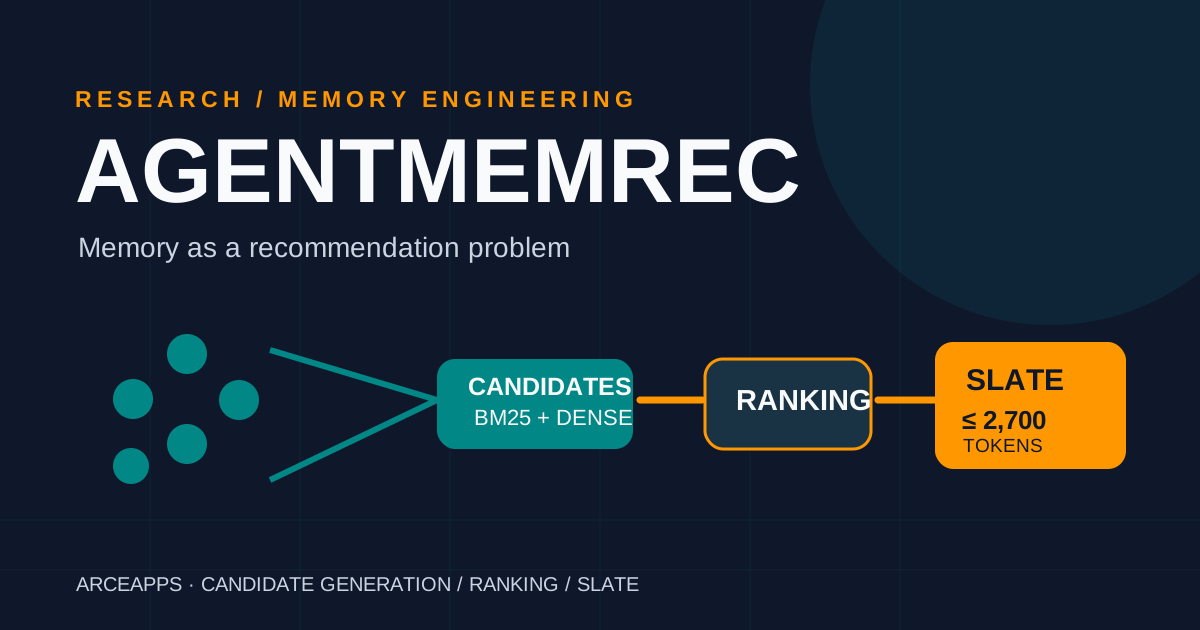
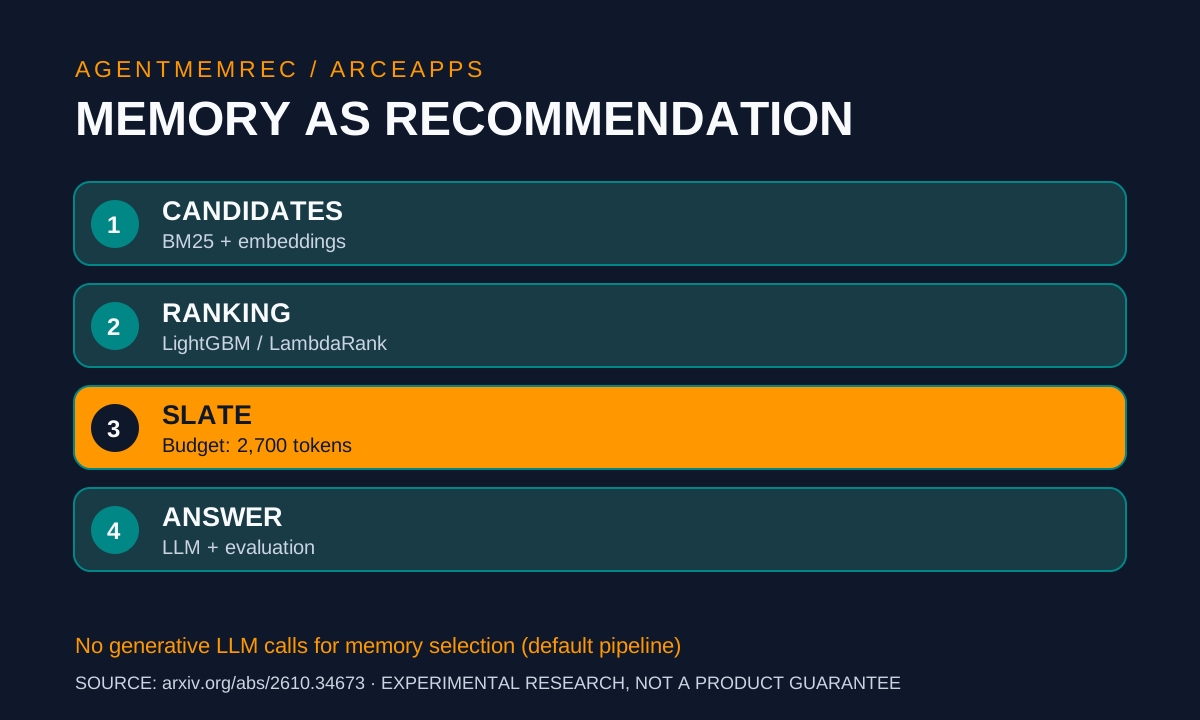
The paper represents memory designs as a cascade of four operations. A write-time mapping transforms the history into units. Candidate generation retrieves a smaller pool. A ranker orders those candidates. Finally, a slate builder assembles an actual context under a token budget.
This language can describe a surprising range of systems. Some spend generative model calls writing linked notes or summaries. Some store original turns. Others navigate knowledge graphs or use a model to rerank retrieved passages. They differ in design, but each must eventually decide which evidence survives into the prompt.
The benefit of this formulation is that it asks where computation is spent and what it improves. A sophisticated memory builder might create thousands of structured facts. If candidate generation then loses one of two essential sessions, that write-time sophistication does not help the current question.
AgentMemRec uses original turns as its primary memory units and avoids calls to a generative LLM in the default write-time and selection pipeline. That is a narrower and more accurate claim than “it uses no AI.” It still uses embeddings, a cross-encoder and a learned ranker. The answering model remains an LLM.
Separating those details helps compare costs honestly. Moving work away from generative inference can be useful, but it does not make processing or deployment free.
Pool completeness and ranking completeness
The authors distinguish the probability that candidate generation includes all required evidence from the probability that ranking and slate assembly preserve that evidence once the pool contains it. These probabilities give a diagnostic view of the process.
If an essential item never enters the candidate pool, no reranker can restore it. If the pool contains all relevant turns but ranking pushes one below the context budget, the final slate can still fail. Widening the pool and improving the ranking address different bottlenecks.
Under the paper’s cascade definitions, final slate completeness factorizes into pool completeness multiplied by conditional ranking completeness. Answer accuracy can then be expressed in terms of how often the slate is complete and how well the answering model performs with complete or incomplete evidence.
That does not mean a recall percentage is magically identical to answer accuracy. It provides a structure for understanding why some systems perform better and which stages are responsible for the difference.
A wider pool can raise evidence coverage while introducing more distractors. A stronger ranker may overcome those distractors, but it can also be more expensive. Therefore the right pool size must be evaluated together with the ranking method and token budget.
This is a more useful diagnosis than the generic advice to retrieve more documents whenever a RAG pipeline makes a mistake.
Candidate generation: BM25, dense retrieval and fusion
The default AgentMemRec candidate generator uses two complementary retrieval channels. The lexical channel ranks turns with BM25, which preserves the usefulness of exact terms, identifiers and names. The dense channel uses bge-m3 embeddings and cosine similarity, improving retrieval when the wording of a memory differs from the current question.
The channels are combined with Reciprocal Rank Fusion, with k=60 in the reported setup. This is a practical way to avoid relying entirely on either exact lexical overlap or semantic similarity. A version number can be critical even when its embedding is not especially distinctive; a conceptual paraphrase can be essential even without sharing exact words.
The main pipeline keeps a candidate pool of up to 128 turns. The authors selected that size using development data and its effect on final slate completeness. In their tests, a 128-turn pool performed better than a 64-turn alternative on the relevant selection measure.
There is nothing magical about the number 128. More candidates cost additional ranking work and may introduce hard negatives. A different domain, history distribution or model could favor another size. The correct approach is to reproduce the experiment on representative questions before adopting the parameter.
The broader principle is valuable: candidate generation should maximize the chance that every needed fact remains available while controlling the cost and difficulty of the next stage.
Learning to rank without generative scoring calls
Instead of prompting a language model to judge each candidate, AgentMemRec uses LightGBM with a LambdaRank objective, a familiar family of techniques from search and recommender systems. The ranker is trained from labeled evidence about which turns matter for which questions.
The paper lists ten features for each question-turn pair. Five capture relevance: dense cosine similarity, transformed global ranks from dense and BM25 retrieval, position in the fused pool, and a cross-encoder score from bge-reranker-v2-m3. Five describe the turn’s context: speaker role, relative position within the session, age, length and overlapping entities or keys.
This is one reason the approach differs from a simplistic vector search. It considers more than semantic similarity. A user’s correction may matter because of who said it, when it was said and where it appeared in a session.
The main ranker was trained on gold annotations from 152 development questions, creating 19,456 labeled question-turn pairs. That supervision is a central part of the design. You cannot assume the same quality will appear in an unrelated domain without appropriate training data or transfer testing.
The cross-encoder also performs neural computation. “Zero LLM selection calls” should never be mistaken for zero ranking cost. The distinction is between many calls to a generative model and a more specialized ranking pipeline that can be measured and optimized.
Building the slate under a real token budget
After ranking, AgentMemRec walks the candidates in order and adds each turn whose rendered size fits the remaining budget. If a turn does not fit, the builder skips it and continues. It accounts for session headers when calculating how many tokens the rendered context will consume.
The primary experiment uses 2,700 tokens and tests nearby budgets from 2,400 to 2,700. Rather than selecting a question-specific cutoff in the ranked list, the builder attempts to fill the available space with useful candidates.
This strategy is supported by a theoretical result in the paper. Under conditions where adding items does not reduce the value of the slate, filling the budget cannot be worse than keeping a shorter prefix that fits. The qualification is important: extra text can sometimes mislead, distract or contradict.
A production system should therefore test hard negatives, obsolete facts and potentially malicious content. Filling every remaining token blindly is not a security policy. The paper itself examines circumstances where item-wise relevance and monotonicity assumptions become questionable.
The essential insight is that a good ranked list is not yet a good context. The final assembly step must preserve evidence and keep temporal or source relationships understandable to the answering model.
LongMemEval results: strong, but bounded
The study evaluates LongMemEval-S with roughly 50 sessions per history and LongMemEval-M with roughly 500. Its primary multi-session analysis considers questions with evidence in at least two sessions, with 209 test questions for each variant under the described split.
On LongMemEval-S, the paper reports AgentMemRec accuracies of 80.7% with Qwen and 89.4% with DeepSeek. In the same table, Adaptive-k scores 69.1/76.6, and T-Mem 70.3/73.2 under the tested setups. On LongMemEval-M, AgentMemRec scores 70.0/81.3 versus 59.3/62.1 for DynamicRAG-8B.
These are results reported by the authors, not measurements I have reproduced. They support the abstract’s summary of gains around 10 to 31 percentage points over memory systems and context selectors in particular LongMemEval-S comparisons. They do not establish a universal ranking across all possible memory workloads.
The study also compares against an LLM reranker that makes 64 model calls per question. AgentMemRec is generally at parity under the paper’s statistical definition, with a gain in one harder setting. That is more nuanced than saying it always beats the expensive alternative.
The authors use repeated decoding under nearby context budgets, paired bootstrap analysis and a specified non-inferiority margin. These details strengthen the methodology, but it remains a new preprint requiring independent scrutiny and reproduction.
It would be misleading to advertise the top number without the dataset, answer model, split, context budget and comparison protocol.
Why complete evidence matters so much
In the paper’s analysis, the AgentMemRec slate includes all annotated evidence for about 94% of the relevant cases, while some turn-based alternatives are closer to 50%. When both systems receive complete evidence, several comparisons show no statistically significant answer-quality difference.
That observation points toward a very practical bottleneck. A capable answering model cannot reliably infer a fact that the memory selector leaves out. Improving candidate recall and ordering can matter more than creating ever more sophisticated memory artifacts.
The authors report that widening the pool improves evidence coverage, and that the learned ranker substantially improves conditional completeness over the original retrieval order. Those experiments make the architecture easier to analyze than a single opaque end-to-end score.
Still, completeness is not a guarantee of correctness. A model may receive the right sources and mishandle a relative date, confuse provisional and approved decisions, or make a logic error. Coding agents also need to identify the correct files and pass tests.
Retrieval benchmarks are therefore informative components of agent evaluation, not substitutes for functional verification of an entire coding workflow.
LoCoMo, temporal memory and optional records
The paper also evaluates LoCoMo. Its base pipeline performs better than the reported Mem0 and Zep configurations in that setting without generative LLM calls during write-time memory construction. The authors then study an optional enrichment that uses a generative model to extract dated, typed records citing original turns.
The enriched variant is not a zero-LLM-write pipeline anymore. Keeping this distinction explicit prevents a common form of benchmark inflation in which the cheapest architecture and the most accurate variant are described as if they were identical.
Dated records can improve the interpretation of relative-time statements. They can also introduce errors when the system resolves a date incorrectly. The paper reports benefits on some temporal subsets and regressions on others. That is exactly the kind of mixed result I want to see disclosed.
For project memory, the lesson is that time and decision status matter. A memory about a planned migration should not become a record of a completed migration merely because it is easy to summarize.
I would rather preserve explicit provenance and review important decisions than silently infer their status from conversational fragments.
What “3.2 times lower cost” actually means
The headline cost comparison concerns serving a memory selector against a reference reranker making 64 LLM calls. The paper defines a particular measurement on A100 GPU time and a specified hourly price. In one reported setup, selection uses roughly 280 versus 891 GPU-milliseconds per request, yielding an approximately 3.2-fold difference in that cost model.
This is a concrete experimental comparison, not a promise that every cloud invoice will fall by the same factor. Hardware, batching, utilization, model versions, network overhead and provider pricing can change the outcome.
The system still needs embeddings, a cross-encoder and a ranking model. These are not free. The default write-time pipeline may avoid generative calls, but it also retains and indexes turn-level material. Storage and maintenance belong in the total cost.
I would calculate separate budgets for initial ingestion, incremental updates, index size, retrieval latency, selection computation and final answer generation. Then I would evaluate cost per correct answer on my own workload, not simply per model call.
A system may spend less on selection yet perform worse on code tasks requiring precise source relationships. Total usefulness is the denominator that matters.
Assumptions, failure modes and transfer to other domains
The theoretical reduction to item-wise ranking depends on explicit assumptions about evidence independence and the relationship between slate completeness and reward. Real memories can be redundant, complementary, contradictory or temporally sensitive. Two facts may only make sense together.
The authors examine where these assumptions become strained, particularly for evidence scattered across three or more sessions and near-miss distractors. Their analysis is useful because it acknowledges that selecting individually relevant items is not always enough to maximize set-level utility.
The learned ranker is also trained on a particular labeled dataset. Transfer to code repositories, mixed-language developer notes or personal knowledge stores is an empirical question. Domain-specific labels may be expensive to create. A model that learns conversational patterns could fail when important evidence appears in stack traces or configuration files.
The paper includes extensive tables and ablation studies, but it was submitted in October 2026 as a preprint. It has not thereby become an independently certified production architecture.
The responsible position is to treat the approach as a promising, testable engineering hypothesis and examine it on the actual tasks and privacy constraints that matter.
A coding-memory evaluation I would run
I would build a small dataset where a developer chooses an architecture, revises it, rejects an alternative and later confirms a replacement. The histories would include library versions, file paths, dates and explicit decision statuses, plus unrelated conversations that create distractors.
The baseline would be dated plain-text records with keyword search. I would then combine BM25 and dense retrieval, measure candidate-pool coverage, add ranking and assemble a slate under a fixed token budget. Evaluation would distinguish pool completeness, final slate completeness, answer correctness and total operating cost.
I would include unanswerable questions and access-control boundaries. If the developer never approved a migration, the correct answer is that no confirmed decision exists. If a relevant memory belongs to another project or user, it should not appear even when semantically close.
I would not expect to reproduce the paper’s 80.7% on unrelated tasks. The useful finding would be whether the pipeline reduces real mistakes compared with simpler baselines, and at what maintenance cost.
This is a proposed experimental protocol, not a claim that I have already implemented and measured it.
How it relates to Mem0, Letta and existing memory stacks
AgentMemRec is not necessarily a universal replacement for Mem0, Letta or graph-based memory. One application needs automatic extraction and updating of facts. Another needs an agent runtime managing context. A third needs code symbols and dependencies. AgentMemRec mainly addresses read-time selection.
That focus opens possible combinations. A fact extractor could create additional candidate units, a code index could provide references, and a learned ranker could choose which evidence enters context. Those are architectural possibilities, not integrations established by the paper for every listed product.
The strongest takeaway is that storing more information does not fix weak retrieval. Before adding another summarizer, graph or database, inspect the evidence your agent actually received and whether all necessary pieces survived the selection pipeline.
For an indie workflow, where maintenance time matters as much as token cost, that may be the most valuable lesson of the research.
Conclusion: useful memory arrives at the right moment
AgentMemRec shifts the focus from accumulating memories to selecting a sufficient evidence set. Its combination of lexical and semantic retrieval, supervised ranking and budgeted slate construction shows, in the authors’ experiments, that specialized selection can compete with approaches that spend many more generative model calls.
The reported results are encouraging within their conditions: LongMemEval and LoCoMo workloads, defined answering models and splits, reference hardware and a trained ranker. They are not a production guarantee.
The question I will ask when evaluating agent memory from now on is: when the agent answers incorrectly, was the fact never stored, excluded from the pool, lost in ranking, or present but misinterpreted? Distinguishing those failures is a practical way to make memory engineering less mysterious.
References
- Zhang and Sun, Agent Memory as Recommendation (2026), original preprint.
- Full HTML paper, methods and tables.
- LongMemEval, long-term memory evaluation.
- LoCoMo, conversational memory benchmark.
- LightGBM, ranking implementation.
- Mem0, Graphiti, Letta, related architectures.
- ArceApps background: Mem0 and Letta, persistent memory, and hierarchical memory.
Closing thought. An agent need not remember absolutely everything. It needs all the pieces that matter, delivered in time to avoid making the wrong decision.
You might also be interested in

Agents of Chaos: 7 Critical AI Agent Security Flaws
Analysis of the 'Agents of Chaos' paper (arXiv:2602.20021): 7 critical vulnerabilities found in two weeks of red-teaming autonomous AI agents with persistent memory, email, and shell access.

The Architecture of Persistent AI Agent
A deep technical analysis of how AI agents persist, consolidate and retrieve information autonomously. From OpenClaw and QMD to Mem0, Cognee and neurobiological memory models.

Graphicle: Code Graph and Memory for AI Coding Agents
Explore how Graphicle combines a code graph, documentation and agent memory; examine its architecture, privacy, benchmarks and closest alternatives.