
Reasoning Models: From o1 to R1

Table of Contents
🧠 The Era of “Thinking” Models
We’ve moved from “Next Token Prediction” (GPT-3) to “Reasoning First” (o1, R1). These models pause to think (CoT) before answering.
OpenAI o1
The first widely available reasoning model.
- Strength: Unmatched in math, physics, and complex coding logic.
- Limitation: Slow, expensive, and censored.
DeepSeek R1
The open-weight challenger.
- Strength: Almost as good as o1, but free/cheap and runnable locally (quantized).
- Limitation: More hallucinations in niche topics.
⛓️ Chain of Thought (CoT)
The secret sauce is CoT. The model generates intermediate reasoning steps that are hidden (o1) or exposed (R1).
Why it matters for Developers
- Debugging: You can see why the model chose a specific algorithm.
- Complex Logic: Better at understanding convoluted business rules than standard LLMs.
- Refactoring: Can plan a multi-file refactor before touching code.
🚀 Practical Application: Coding Agents
We are integrating R1 into our dev workflow for:
- Code Review: Detecting subtle race conditions.
- Test Generation: Creating comprehensive edge-case tests.
- Documentation: Explaining “why” a piece of legacy code exists.
🏁 Conclusion
Reasoning models are not just faster; they are qualitatively different. They are junior engineers, not just autocomplete tools.
You might also be interested in
Reasoning Models (o1, R1): Why Prompt Engineering is Dying
The arrival of OpenAI o1 and DeepSeek R1 marks the end of complex 'Prompt Engineering'. Understand how reasoning models (System 2) work and when to use them.

DeepSeek R1: The Coding Review
A developer's take on DeepSeek R1 for coding tasks. From impressive reasoning to common hallucinations. Is it ready for production code?
Lean Task-First Development: Beads, LeanSpec, and Taskmaster in Practice
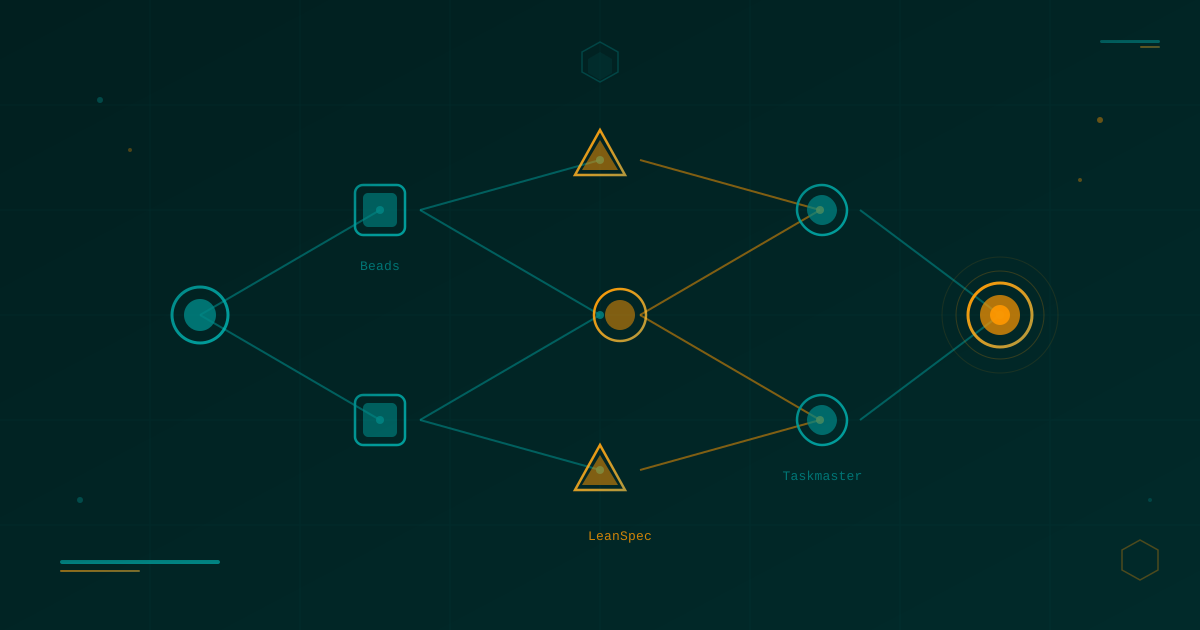
A deep dive into three tools that solve context rot and keep AI coding agents focused: Beads (git-native DAG issue tracker), LeanSpec (minimal spec-driven workflow), and Taskmaster (PRD-to-task orchestration). Real commands, real workflows, real indie dev perspective.