
Agents.md Standard: Blueprint for AI-Ready Projects

Table of Contents
📜 The Problem: Context Amnesia
Every time you start a new chat with an AI (Copilot, ChatGPT, Claude), it knows nothing about your project’s specific rules.
- “Use Hilt, not Koin.”
- “All ViewModels must extend
BaseViewModel.” - “Target SDK is 34.”
You repeat these instructions ad nauseam. This is inefficient and error-prone.
💡 The Solution: AGENTS.md
We propose a standard file, AGENTS.md, placed at the root of your repository. This file is written specifically for AI agents, not humans (though humans benefit too).
It serves as a “System Prompt Injection” for your codebase.
Structure of AGENTS.md
- Project Overview: High-level summary.
- Architecture: Layering, patterns (MVVM/MVI), directory structure.
- Tech Stack: Libraries, versions, constraints.
- Coding Conventions: Naming, formatting, prohibited patterns.
- Testing Strategy: Libraries, coverage goals.
- Common Tasks: “Few-shot” examples of how to implement common features.
📱 Example: Android Project
# Android Project - Agents Guide

## Overview
A modern task management app built with Jetpack Compose.

## Architecture
- **Clean Architecture**: `data` -> `domain` -> `presentation`.
- **UI**: Single Activity, Compose Navigation.
- **State**: `StateFlow` + `UiState` sealed hierarchy.

## Tech Stack
- **DI**: Hilt
- **Async**: Coroutines + Flow
- **Network**: Retrofit
- **DB**: Room

## Coding Rules
- Use `val` by default.
- ViewModels expose `StateFlow<UiState>`.
- Composables: Accept `modifier: Modifier` as the first optional param.
- **NO**: `LiveData`, `AsyncTask`, `Synthetics`.

## Testing
- Unit: JUnit5 + Mockk
- UI: Compose Test Rule
🚀 How to Use It
- Create the File: Add
AGENTS.mdto your root. - Reference It: When asking an AI to generate code, say:
“Generate a Login Screen following the guidelines in AGENTS.md.”
- Automate It: Configure tools like Cursor or Copilot to always index this file.
📈 Benefits
- Consistency: AI generates code that looks like your code.
- Speed: No need to prompt-engineer every request.
- Onboarding: New devs (humans) can read it to understand the “soul” of the project.
🔮 The Future
We envision IDEs automatically detecting AGENTS.md and pre-loading it into the context window of every AI interaction. It’s a small file that makes a massive difference in AI-assisted development.
You might also be interested in
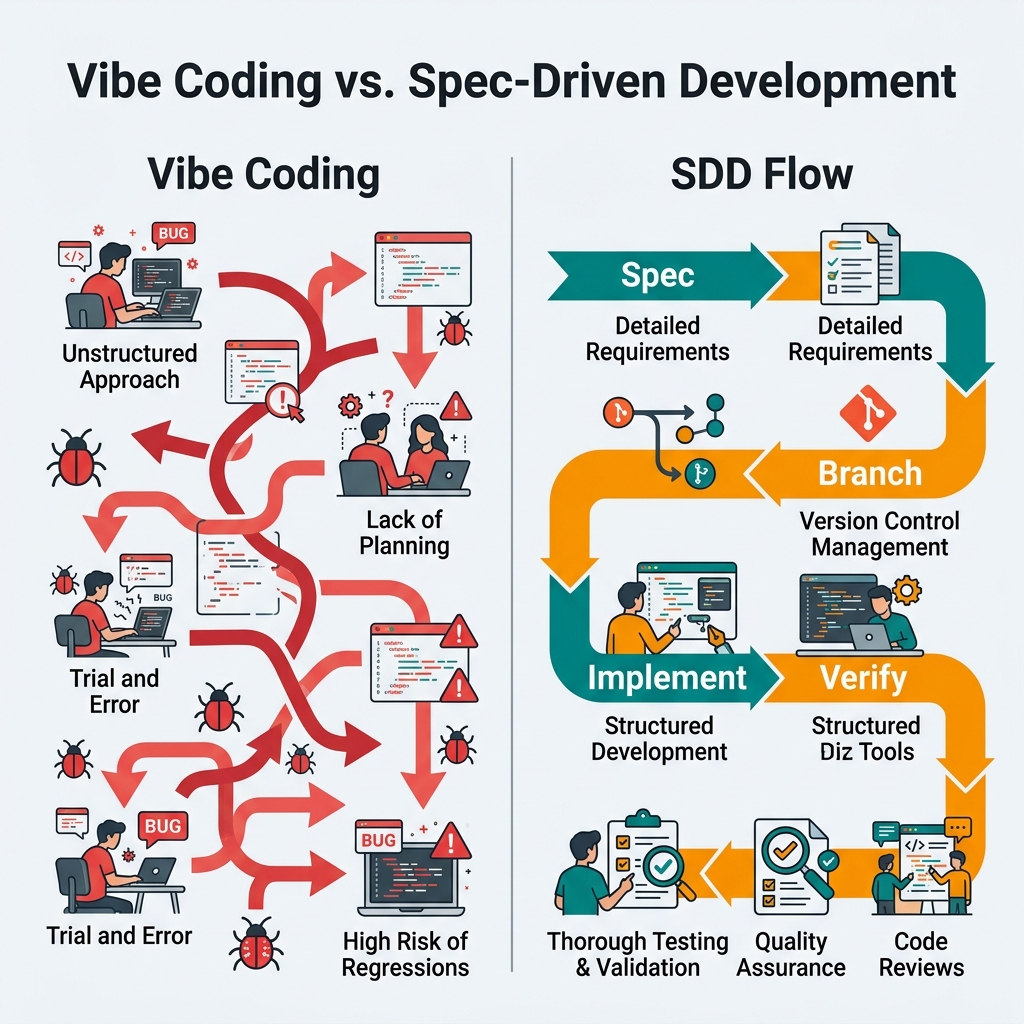
Spec-Driven Development with Agentic
A senior engineer's guide to SDD for agentic AI: from vibe coding to structured, reproducible development using GitHub Spec Kit, BMAD Method, OpenSpec, SPARC, and more.
The Persistent Memory Stack I Actually Use...
Honest technical deep dive into the persistent memory stack I combine daily in my projects: opencode-supermemory for auto-compact, basic-memory as main memory with Markdown + graph, and forgetful as procedural skills layer. With real configuration examples for Claude Code, Codex,
Loop Engineering
Discover how Loop Engineering is replacing traditional prompting. Learn to design autonomous systems for mobile development with Kotlin and Android, managing risks and optimizing resources.