
Alternative Paradigms and Emerging Methodo...
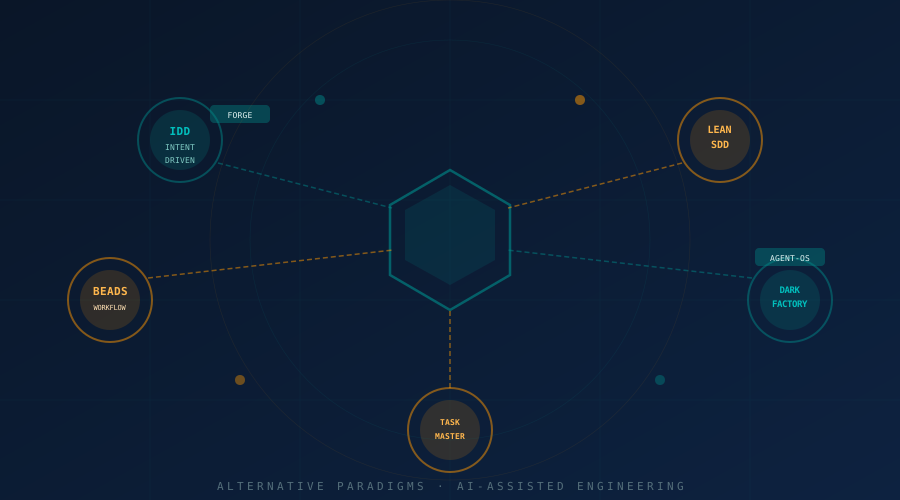
Table of Contents
Related reading: Spec-Driven Development with Agentic AI · Autonomous AI Agents in Android Development · Building AI Agent Skills for Development
🧭 The Cracks in the Conventional Paradigm
Agile was a genuine revolution when it arrived. It dismantled the rigid waterfall, put the working software above exhaustive documentation, and brought teams closer to delivery reality. For two decades it worked well enough. But Agile was designed for human teams writing code manually, where the bottleneck was always the cognitive bandwidth of the programmer.
That assumption has collapsed.
Today, a sufficiently good AI agent can produce in minutes what a senior developer would spend half a day on. The bottleneck has shifted from implementation to intent: the ability to express clearly what needs to be built, why, and under what constraints. And yet most teams still organize their work around sprints, daily standups, story points, and ticket grooming — rituals designed to manage human implementation capacity that no longer represents the critical path.
This is the structural tension that is driving a new generation of software engineering methodologies. They are not marginal experiments. They are responses to a genuine paradigm shift in where value and risk live in the development cycle. This article maps the most interesting of these emerging approaches, their underlying logic, their tooling, and the tradeoffs you should understand before adopting them.
The methodologies covered here are not mutually exclusive. In practice, teams often combine elements from several of them. Think of this as a landscape survey, not a prescription.
🎯 Intent-Driven Development (IDD)
Core idea: shift the primary artifact of software development from the implementation (code, tickets, sprints) to a precisely articulated intent — a description of the outcome, the constraints, and the acceptance criteria, from which an AI agent derives the implementation.
IDD is arguably the most fundamental rethinking of how software should be specified in the AI era. Its central claim is simple: what matters is not how something is built but what it should do. AI agents are increasingly competent at the “how”; the lasting human contribution is clarity about the “what” and “why.”
The FORGE Framework
The most mature implementation of IDD principles is the FORGE Framework by Scott Feltham, designed as a structured process for teams working with agentic AI. FORGE breaks the development cycle into five phases:
-
Focus — Define the intent precisely. What problem are we solving? Who is the user? What does success look like? This is captured in machine-readable format: structured prompts, YAML-based intent files, or lightweight Markdown documents with strict frontmatter.
-
Organize — Translate intent into an architectural plan. Break the problem into bounded units. At this stage, AI helps produce C4 diagrams, component lists, API contracts, and interface sketches from the intent document.
-
Refine — Write acceptance criteria. For each deliverable, specify the observable, verifiable conditions that determine whether intent has been satisfied. These become the automated validation layer the AI references when evaluating its own output.
-
Generate — AI produces implementation artifacts: code, tests, documentation, deployment configurations. The agent operates within the intent and refinement artifacts as its only source of truth.
-
Evaluate — Human review focuses not on line-by-line code inspection but on intent alignment: does the delivered artifact satisfy the acceptance criteria? If not, the loop restarts at Refine.
FORGE is not a silver bullet. It demands rigorous discipline at the Focus and Refine stages — the phases where human judgment cannot be delegated. Teams that rush through intent definition consistently report divergence between what the AI built and what was actually needed. The quality of the output is bounded by the quality of the intent document.
IDD vs. Agile/Scrum
The most commonly asked question is how IDD relates to Agile. The honest answer is that IDD can replace Agile ceremonies or coexist with them depending on team culture, but it challenges some core Agile assumptions:
- User stories in Agile are proxies for intent. IDD makes intent the primary artifact, not a proxy inside a story template.
- Sprint planning exists to allocate human capacity. In IDD, capacity allocation is largely managed by the AI orchestrator, which decomposes intent into parallelizable tasks.
- Definition of Done in Agile is a team convention. In IDD, it is encoded in the acceptance criteria of the intent document and can be validated programmatically.
Early adopters report 40–70% reductions in delivery time for well-specified features, with the main investment shifting to the quality and precision of intent documentation.
📐 Lean Specification-Driven Development (Lean SDD)
If classic SDD is the cathedral (thorough, structured, expensive to build), Lean SDD is the bazaar (lightweight, adaptive, context-aware). The distinguishing characteristic is an explicit design constraint: specs must be small enough to fit in context.
The codervisor/lean-spec open-source project formalizes this as a methodology with specific tooling. The philosophy emerges from a real problem: traditional SDD specs grow large enough that LLMs can no longer reliably process them in a single context window. Lean SDD enforces a hard limit — typically under 300 lines or 2,000 tokens — that keeps every specification artifact immediately consumable by an AI agent without chunking, summarization, or retrieval tricks.
Living Documents and Status Tracking
Lean SDD specs are not written once and archived. They are living documents with explicit lifecycle states: planned, in-progress, complete, archived. The LeanSpec toolchain provides:
- A CLI for creating, listing, and transitioning specs
- A VS Code extension for inline spec viewing and status updates
- A GitHub Actions workflow for automated spec validation on every PR
- An MCP server (Model Context Protocol) that gives AI agents direct access to the specs directory without manual context injection
Each spec lives in specs/[number]-[slug].md with YAML frontmatter:
---
id: 042
title: "User authentication flow"
status: in-progress
depends-on: [039, 040]
ai-context: true
---
The ai-context: true flag signals to the MCP server that this spec should be automatically injected into any AI interaction touching the related codebase area.
The Context Economy Principle
The insight that distinguishes Lean SDD from heavyweight SDD is what the project calls context economy: treating LLM context windows as a scarce resource to be managed deliberately. Every token wasted on stale documentation, architectural decisions that don’t affect the current task, or background information the agent doesn’t need is a token not available for the actual implementation problem.
This is why Lean SDD specs are aggressively trimmed. The spec for a feature contains only what an agent needs to implement that specific feature: the interface contract, the acceptance criteria, the affected components, and the hard constraints. Nothing else.
For solo indie developers working with AI coding assistants, Lean SDD is often the most practical starting point: low overhead, immediately useful, and composable with any existing workflow.
🔗 The BEADS Workflow: Dependency-Graph Task Management
BEADS addresses a different problem: context continuity across sessions. When you close your IDE, the AI agent loses all context about what was done, what remains, and what depends on what. The next session starts from zero. For small features this is manageable. For projects spanning weeks or months with complex inter-feature dependencies, it is a significant source of drift and rework.
BEADS replaces the traditional flat task list (TASKS.md, a GitHub Project board, or a Jira backlog) with a directed acyclic graph (DAG) of issues stored as version-controlled files. The key data structures are:
.beads/issues.jsonl— each line is a JSON object representing a task with fields for status, priority, assigned agent, and dependency list.beads/beads.db— a local SQLite index for fast query: “what tasks are unblocked right now?”, “what is the critical path to release?”.beads/config.yaml— project-level configuration including default agent assignments and escalation rules
The workflow integrates naturally with specification-driven approaches. A spec in Lean SDD format can generate a set of BEADS issues automatically; each issue becomes an executable unit of work for an AI agent.
Practical Impact
The productivity gain from BEADS comes from two places:
-
Agents can self-direct. At the start of a session, an agent queries the BEADS graph to find the highest-priority unblocked task, picks it up, implements it, marks it done, and surfaces the next unblocked tasks. No human prompt needed to establish direction.
-
Context handoffs are lossless. When you return to a project after a week, you don’t need to reconstruct state from memory or messy commit histories. The BEADS graph is the ground truth of project state.
For teams combining BEADS with a specification framework like Lean SDD or Forge, the combination effectively creates a self-directing development pipeline where human involvement concentrates at intent definition and acceptance review, not task management or implementation direction.
🖥️ Agent OS: Infrastructure for Autonomous Agents
The agent-os project from SmartComputer AI takes a more radical position: if AI agents are going to be doing most of the work, they need their own operating environment — not a conversation window attached to an IDE, but a persistent, sandboxed runtime with managed memory, tools, skills, and a task queue.
Agent OS provides:
- Persistent agent memory — agents retain knowledge across sessions, building context over time like a team member who has worked on the project before
- Skill registry — reusable capabilities (run tests, open a PR, query an API, write documentation) that agents invoke by name
- Task queue — incoming work is queued, prioritized, and routed to agents with the appropriate skills
- Audit log — every action taken by every agent is recorded with timestamp, inputs, outputs, and result
The conceptual shift Agent OS represents is moving from AI as a tool you invoke to AI as a running service you manage. The agent is always on, always monitoring, always processing the task queue. You interact with it by adding tasks and reviewing results, not by opening a chat window.
This model is most relevant for teams managing multiple repositories, with continuous integration workflows generating a constant stream of tasks (failing tests, opened PRs, security alerts, dependency updates) that benefit from automated triage and first-pass resolution.
🏭 The Dark Factory: Lights-Out Software Development
The “dark factory” concept comes from manufacturing. In a sufficiently automated factory, the machines can run in complete darkness — no humans present, no lights needed. The analogy to software development is deliberately provocative: what would a “lights-out” software development operation look like?
In the current state of the art, true lights-out development remains aspirational for all but the most routine maintenance tasks. But the trajectory is clear, and understanding it is valuable for anyone positioning their skills and processes for the next five years.
A dark factory software operation would require:
- Requirements ingestion — natural language requirements are parsed and formalized automatically, without human interpretation
- Autonomous design — architectural decisions are made by agents operating within pre-defined constraint sets (performance budgets, security profiles, coding standards)
- AI-to-AI code review — multiple specialized agents review each other’s output: one for correctness, one for security, one for style, one for performance
- Self-healing CI/CD — failing tests trigger automated debugging cycles; the agent diagnoses, patches, verifies, and merges, escalating to human review only for novel or high-risk failure modes
- Continuous refactoring — background agents identify and address technical debt according to architectural rules, without waiting for planned refactoring cycles
The fspec project from Sengac is one attempt to formalize the machine-readable specification layer needed for dark factory operation. quint-code from m0n0x41d explores type-theoretic verification approaches that make automated correctness checking more tractable. aispec from cbora defines a common interface language for AI agents interacting with codebases, enabling agent interoperability across different platforms and LLM providers.
None of these is production-ready at scale today. But they represent the engineering work being done to make lights-out development possible, and they are worth tracking if you are building the infrastructure for AI-native development teams.
🎛️ Task Orchestration: Claude Task Master and the PRD-to-Task Pipeline
The most practically impactful tool in this landscape for individual developers and small teams is claude-task-master by Eyal Toledano. It has over 25,000 GitHub stars and is widely used in AI-native development workflows for a simple reason: it solves the most immediate pain point of working with AI on non-trivial projects.
The problem it addresses: LLM context windows are large enough to suggest they can handle entire projects, but they consistently perform better when given focused, bounded tasks with clear inputs and outputs. The classic failure mode is giving an AI agent a large, ambiguous goal and getting back a confident but incorrect or incomplete result.
Claude Task Master’s workflow:
- Write a PRD (Product Requirements Document) — a natural language description of the feature or project
- Parse the PRD — the tool uses an LLM to decompose it into a structured task graph with estimated complexity, explicit dependencies, and success criteria for each task
- Orchestrate execution — tasks are routed to agents in dependency order; parallel tasks execute concurrently
- Validate completion — each task has a checker that verifies the output against the acceptance criteria before marking it done
- Escalate exceptions — tasks that fail validation after a configured number of retries are escalated to human review
The reported reduction in AI coding errors when using this focused-task approach is significant — some teams report up to 90% fewer hallucinations and context errors compared to whole-project prompting. The reason is straightforward: smaller context means less opportunity for the model to drift from the original requirements, and explicit acceptance criteria give the model a concrete target to optimize for rather than a vague goal to approximate.
📊 Choosing Your Paradigm: A Practical Comparison
These methodologies are not interchangeable. They address different problems and suit different team contexts:
| Methodology | Primary Problem Solved | Best For | Key Trade-off |
|---|---|---|---|
| IDD / FORGE | Intent ambiguity | Teams with clear product vision | Requires disciplined intent authoring |
| Lean SDD | Context window management | Solo devs, small teams | Spec maintenance overhead |
| BEADS | Cross-session continuity | Long projects, multiple agents | Setup complexity |
| Agent OS | Agent infrastructure | AI-native teams, multiple repos | Infrastructure cost |
| Claude Task Master | Task decomposition | Any team, immediate value | PRD quality ceiling |
| Dark Factory (fspec/aispec) | Full automation | Future target state | Not production-ready |
For most indie developers and small teams right now, the highest-leverage entry point is the combination of Lean SDD (for specification quality) + Claude Task Master (for task orchestration). These two tools together address the two most common failure modes of AI-assisted development: context drift from poor specifications and context overload from under-decomposed tasks.
Teams with mature AI workflows and multiple agents running in parallel will find BEADS and Agent OS increasingly valuable as the complexity of coordinating agents grows beyond what informal conventions can handle.
🔭 The Future: Composable Methodology Stacks
The most likely trajectory for these methodologies is not convergence on a single dominant approach but composability: teams assembling methodology stacks that match their specific context, scale, and risk tolerance.
The tooling is moving in this direction. The Model Context Protocol (MCP) is emerging as a common integration layer that allows different tools — Lean SDD’s spec server, BEADS’ task graph, Agent OS’s skill registry — to share context with AI agents without bespoke integrations. As MCP adoption grows, the barriers to combining these approaches will drop significantly.
What remains constant across all of them is the underlying shift: human engineers are moving from implementation workers to intent architects. The competitive advantage will increasingly belong to those who can articulate precisely what needs to exist, why it matters, and under what constraints — and who can structure the automated machinery to reliably produce it.
The paradigm shift is real. The specific tools that win are still being decided. But the direction of travel is clear enough to start investing in the skills and practices that will matter most.
📚 References
-
FORGE Framework — Feltham, S. Intent-Driven Development: Express intent clearly, let AI handle complexity. scottfeltham.github.io/forge-framework
-
Intent-Driven Development 2026 — Kodenerds. Intent-driven development 2026: The AI-era methodology that delivers 3x velocity. kodenerds.com/intent-driven-development-2026
-
IDD at Keyhole Software — Keyhole Software. Intent-Driven Development: A Modern SDLC for AI-Accelerated Teams. keyholesoftware.com
-
LeanSpec — Codervisor. Lightweight, flexible Spec-Driven Development for AI-powered teams. github.com/codervisor/lean-spec
-
Lean Spec Documentation — lean-spec.dev
-
BEADS Issue Tracker — Better Stack. Beads: A Git-Friendly Issue Tracker for AI Coding Agents. betterstack.com/community/guides/ai/beads-issue-tracker-ai-agents
-
Building Apps with AI and BEADS — Koustubh. Building Apps with AI: How beads Changed My Development Workflow. dev.to
-
Agent OS — SmartComputer AI. Agent OS: An operating system for autonomous AI agents. github.com/smartcomputer-ai/agent-os
-
Claude Task Master — Toledano, E. An AI-powered task management system for software development. github.com/eyaltoledano/claude-task-master
-
Claude Task Master in Practice — Tessl. How claude-task-master “Reduced 90% Errors for My Cursor.” tessl.io/blog/claude-task-master
-
fspec — Sengac. Functional specification framework for AI-native development. github.com/sengac/fspec
-
quint-code — m0n0x41d. Type-theoretic approach to verifiable code specifications. github.com/m0n0x41d/quint-code
-
aispec — Cbora. Common interface specification for AI agent interactions with codebases. github.com/cbora/aispec
-
Spec-Driven Development: 2025 Practice — Thoughtworks. Spec-driven development: Unpacking one of 2025’s key new AI-assisted engineering practices. thoughtworks.com
-
State of AI-Assisted Software Development — Google. State of AI-assisted Software Development 2025. services.google.com
You might also be interested in
Agentic Engineering Methodologies: Superpowers vs OpenSpec
A deep dive comparison of two distinct approaches to AI software development: the skill-based methodology of Superpowers and the artifact-guided workflow of OpenSpec.
SDD Frameworks Deep Dive: GitHub Spec Kit,...
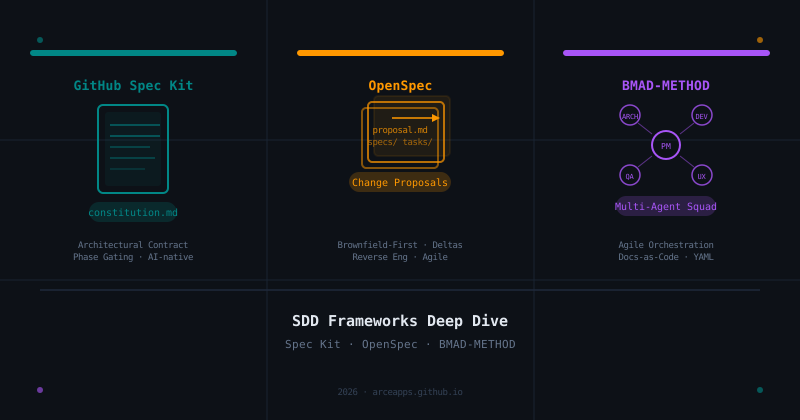
A thorough analysis of the three leading Spec-Driven Development frameworks: the architectural contracts of GitHub Spec Kit, the change-proposal agility of OpenSpec, and the multi-agent orchestration of BMAD-METHOD.
The Persistent Memory Stack I Actually Use...
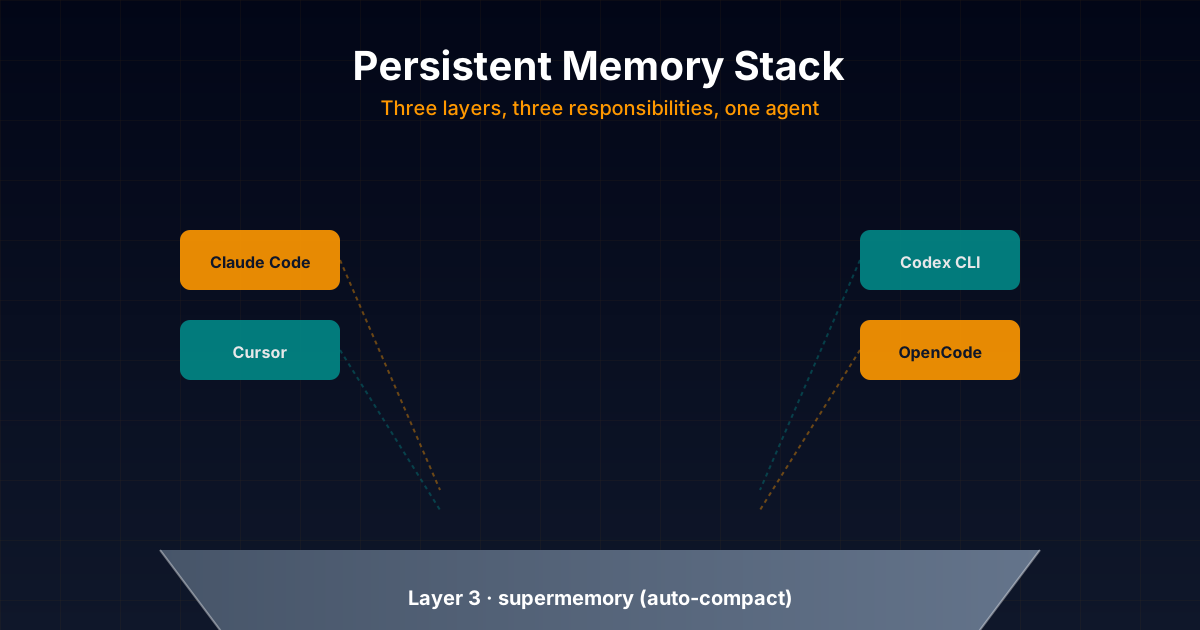
Honest technical deep dive into the persistent memory stack I combine daily in my projects: opencode-supermemory for auto-compact, basic-memory as main memory with Markdown + graph, and forgetful as procedural skills layer. With real configuration examples for Claude Code, Codex,