
DeepSeek Harness vs OpenCode, Codex and Claude Code: head to head
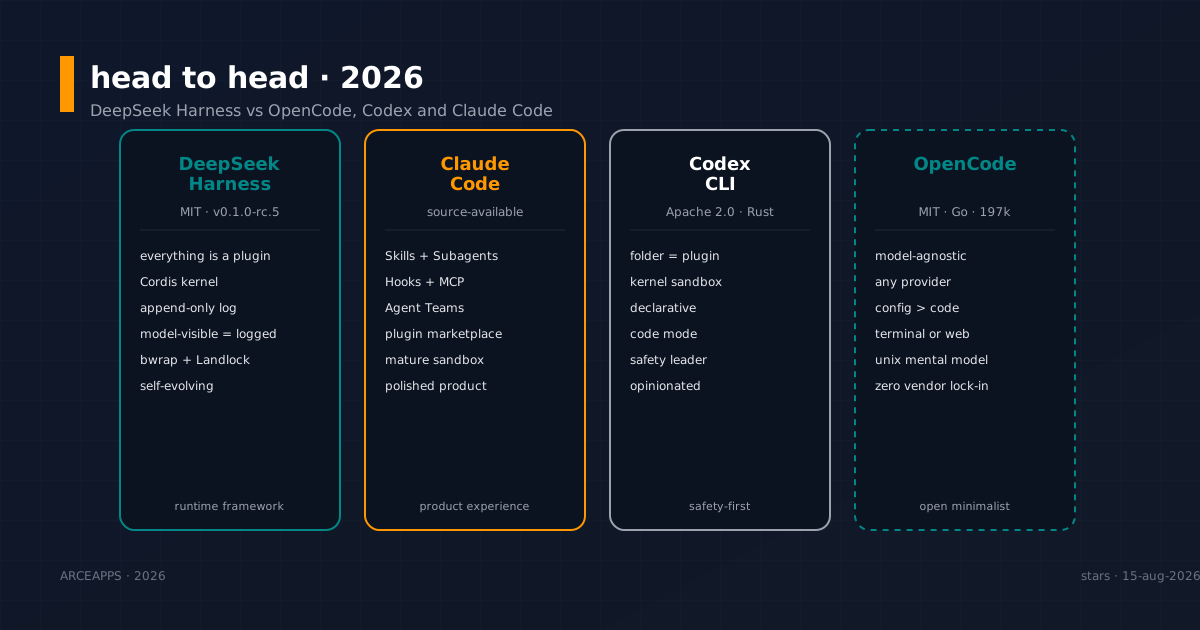
Table of Contents
Why this comparison matters now
On August 13, 2026, DeepSeek published deepseek-harness (dsh) under
MIT and in 48 hours it accumulated 95,386 stars and 8,826 forks on
GitHub. An adoption curve like that does not stand on hype alone:
there is something in the design that is touching a nerve. But “dsh
is better” or “dsh is worse” are empty sentences until measured
against the agents people are already using: Claude Code (Anthropic),
Codex CLI (OpenAI) and OpenCode (the open-source option that
has served as common ground for countless posts on this blog, including
Subagents and Superpowers and Awesome
OpenCode Ecosystem).
This article closes the triangle opened by DeepSeek Harness: the
runtime where everything is a plugin
and Harness Engineering: The Wrapper Wins.
The first was the technical deep-dive into dsh; this one looks from
the outside, comparing how each of the four agents tackles the same
operational questions: how do you mount a plugin? how do you audit a
session? how much does it cost in tokens? how mature is the ecosystem?
The goal is to give you an honest decision matrix — including the
points where my opinion will annoy fans of any of the four camps.
Prior art note. There are already separate posts about each tool on this blog: the visual frontends comparison for OpenCode covers CodeNomad and OpenChamber; Claude Code and Codex have individual coverage. This article does not re-enter those points: it focuses on the terminal/runtime agent as a product, not on its skin.
The four philosophies in one sentence each
Before diving into matrices, a synthesis that holds up on its own through the rest of the article:
- DeepSeek Harness: the runtime. An open-source MIT framework where everything — model, tools, session, sandbox, loop — is a Cordis-registrable plugin. Designed for teams building agent infrastructure, not for indies wanting to write code tomorrow.
- Claude Code: the product. Source-available, polished user experience, the most complete extension ecosystem on the market (CLAUDE.md, Skills, Subagents, Hooks, MCP, Plugins, Agent Teams). Think macOS: closed on the surface, open at the right points.
- Codex CLI: the safety-first. Rust + kernel-level sandbox, Apache 2.0, declarative plugin model (a folder on disk, never entering the harness process). Think OpenBSD: opinionated about what matters and discreet about the rest.
- OpenCode: the open minimalist. MIT, terminal or web, 197k stars, no vendor lock-in or closed surface. Think Linux before systemd: does its job, lets you choose how.
The difference between the four is not “who has more features,” it is
what kind of question they prioritize. dsh prioritizes “can I
rewire my runtime.” Claude Code prioritizes “how much friction is
there between my idea and a reviewable diff.” Codex prioritizes “how
narrow is the blast radius of an agent command.” OpenCode prioritizes
“can I run any model anywhere without asking anyone for permission.”
Master table: five dimensions
The five dimensions that matter most when choosing a terminal agent
in production: extension philosophy, sandbox, audit /
traceability, token efficiency and plugin ecosystem maturity.
Star and version data is current as of August 15, 2026 (the dsh
release was still hot) and cross-checked against what each team
announces in their official documentation.
| Dimension | DeepSeek Harness | Claude Code | Codex CLI | OpenCode |
|---|---|---|---|---|
| License | MIT (full code) | Source-available, non-standard license | Apache 2.0 | MIT |
| Runtime language | TypeScript (~500k LoC) + C11 sandbox | TypeScript/Node | Rust | Go |
| Extension philosophy | Imperative Cordis plugin (state, hooks, events) | Skills + Subagents + Hooks + MCP + Plugins + Agent Teams | Folder = plugin (declarative, outside process) | Provider/model via config; no plugin system |
| Default model | DeepSeek, but any OpenAI-compatible | Claude (Sonnet/Opus/Haiku) | OpenAI (GPT-5/Codex) | Anyone via provider (Anthropic, OpenAI, Google, Ollama) |
| Sandbox | bwrap+Landlock (Linux), Seatbelt (macOS), ACL (Win); plugins in-process | Yes, mature built-in, configurable | Yes, kernel-level, considered the safety leader | Child process with configurable perms |
| Traceability | Append-only log, model-visible means logged invariant | Sessions with transcripts; reasoning partially encrypted | Logs + replay; sandbox snapshots | Logs per session; fork/resume; no formal invariant |
| Token efficiency | High overhead (~10x Pi, ~3x others); double-AGENTS.md bug | Good; short system prompt | Good; code mode collapses N tool calls into 1 | Good; no framework overhead |
| Adoption curve | Steep (profiles, bundles, patch layers) | Smooth, extensive commercial docs | Moderate, opinionated | Smooth, Unix mental model |
| Stars (15-Aug) | ~93k | ~141k | ~106k | ~197k |
| State | Developer preview, breaking changes | Stable, commercial | Stable, commercial + cloud | Stable, open |
| Best for | Teams building agent infrastructure | Individuals and teams wanting immediate productivity | Teams where blast radius matters | Individuals prioritizing model neutrality |
The extension model: four ways to say “I can extend this”
This is the dimension where the four diverge most deeply, and it deserves its own section. Before reading text, this visual map shows the four central boxes (each agent) and the connectors that represent how each one accesses the model:
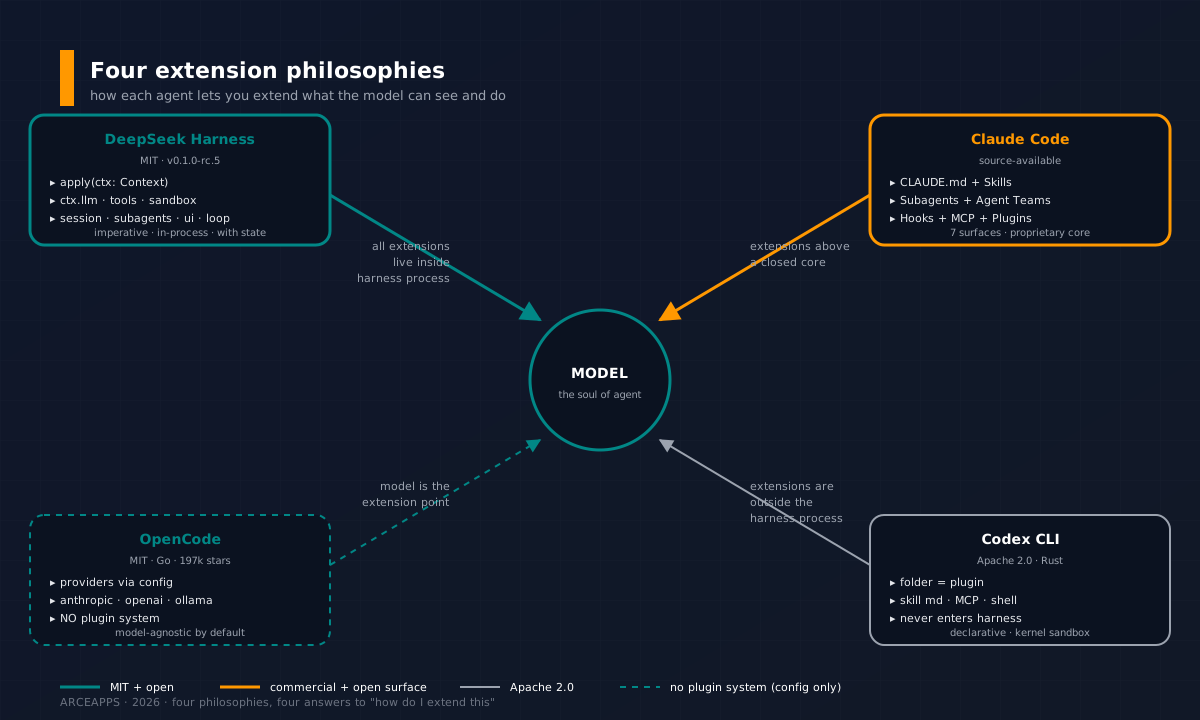
The diagram makes visible what the tables hide: the four boxes are not
the same distance from the model. dsh has a solid direct connector
(plugins live inside the harness process); Claude Code has an orange
connector but its box is further away (extension lives above the
proprietary core); Codex CLI has a gray connector and its box is
outside the process (plugins never enter the harness); OpenCode has
no extension connector as such, only the dashed teal because its
“extension” is reconfiguring the model without touching the code. When
a team says “I need to extend the agent,” they are picking one of
these four patterns — and the choice commands more than it seems.
DeepSeek Harness: imperative plugins with state
Already covered in detail in the runtime article,
but the operational summary: a plugin is a TypeScript file that
exports apply(ctx). On mount it registers services, events and
tools in a shared context. The model lives at ctx.llm, the toolset
at ctx.tools, the sandbox at ctx.sandbox. Plugins run inside the
harness process (with all the risk that implies) and may hold mutable
state. This enables things like subagents delegated to claude-code
or codex via the ctx.subagents backend, something without
precedent in the rest of the market.
Trade-off: maximum flexibility, minimum control over what a malicious plugin can do. Installing a plugin is, today, an act of trust.
Claude Code: the complete extension stack
Claude Code is the only one of the four that offers seven different extension points in a single product, and each solves a different problem:
- CLAUDE.md: always-on context loaded every turn. It is your project’s persistent memory.
- Skills: on-demand knowledge + repeatable workflows. Loaded by the model when it detects a match.
- Subagents: isolation. Each subagent has its own context, permissions and system prompt.
- Agent Teams: launched February 5, 2026 alongside Opus 4.6. Multiple subagents collaborating, not just reporting to a boss.
- MCP servers: connection to external tools via Model Context Protocol.
- Hooks: automation based on lifecycle events (PreToolUse, PostToolUse, Stop, SubagentStop).
- Plugins: packages that combine several of the above into a distributable bundle.
The consequence: Claude Code can be a code editor, a researcher, a DevOps agent or a multi-agent team depending on which combination of extensions you activate. It is the most “polymorphic” framework on the market in terms of what it can become.
Trade-off: the surface to learn is large. Extensive commercial documentation helps, but time-to-first-value is still higher than Codex or OpenCode.
Codex CLI: the folder is the plugin
Codex inverts the convention. Instead of a plugin that enters the harness process, Codex defines a plugin as a folder on disk containing static files: a skill Markdown, an MCP config, a shell script. Those files never enter the Codex process; the harness reads them when needed and reloads them in 2-3 seconds when they change.
Developer grapeot, who read both codebases line by line, sums up
the difference with a perfect analogy: Codex hands you a finished
apartment with a pegboard wall where you can hang anything; hang the
wrong thing, take it down, hang something else. dsh hands you a
house where you can rework a load-bearing wall without cutting the
water or power. The question is: how often do you actually need to
rework a load-bearing wall?
Trade-off: the simplicity is real. The barrier to entry is close to zero, runtime overhead is minimal, and the blast radius of a faulty plugin is bounded by the kernel sandbox. The price: if you want dynamic behavior, plugins with state, or event composition between plugins, Codex does not give it without modifying its Rust core.
OpenCode: extension by configuration, not by code
OpenCode does not have a plugin system per se. Its extensibility is
declarative configuration: providers, models, permissions and
themes via config files. The consequence: flexibility lives in the
model, not in the harness. You can switch from Anthropic to
OpenAI to Google to Ollama without touching code, and the agent
adapts. This makes it the “model-agnostic by default” of the market,
even above dsh, which while model-agnostic needs an adapter plugin
per new model.
Trade-off: if you want specific behaviors (a new tool, a pre-commit hook, a Linear integration), you need to contribute to the project or live with what is there. Model freedom partially compensates, but it is not an extension system in the formal sense.
Sandbox and blast radius: where each draws the line
Sandbox is not a detail; it is the “what can go wrong?” question made operational. The four resolve this in substantially different ways.
Codex CLI is, by community consensus, the safety leader of the group. Kernel-level sandbox on Linux (namespaces + seccomp), optional network, optional filesystem, granular per-command decisions. The default is “you cannot do anything that breaks my host without asking”; opt-in is explicit. It is the posture closest to the OpenBSD philosophy: secure by construction, not by configuration.
DeepSeek Harness uses bwrap + Landlock on Linux with a
fail-closed C launcher, Seatbelt on macOS, restricted ACL tokens on
Windows. The approval model is a closed enumeration and anomalies are
rejected as “unavailable” rather than silently allowed. It is strict
— but, as 36Kr pointed out in its hands-on, plugins run inside the
harness process, so a plugin can directly reach shell and
filesystem. The real blast radius of a malicious plugin is the whole
process.
Claude Code offers a mature built-in sandbox, configurable by the user, with sensible defaults. macOS integration is notably good (Sandbox-exec), on Linux it depends on the available kernel. The risk: the Skills and MCP third-party ecosystem introduces attack surface, and the quality of those Skills’ sandboxes varies.
OpenCode runs the agent in a child process with user-configurable permissions. It is a model closer to Unix: the user decides which permissions to grant, without opinionated pre-loaded policies. It works well for technical users; it can be a shock for those coming from Codex expecting pre-thought permissions.
For teams in regulated domains (finance, healthcare, defense), Codex
is the safest option by construction. For teams where auditing
matters more than blast radius (being able to reconstruct what the
model saw, not necessarily containing it), dsh is the only one of
the four with that architectural guarantee.
Traceability and auditing: the one feature where dsh has no rival
Sandbox tells you what could have happened; traceability tells you what happened. Here DeepSeek Harness has an advantage that, at the time of writing, has no equal in the market:
Invariant: “model-visible means logged”. Everything that reaches a model request must be reconstructable from the append-only session log. It is not a configuration option; it is an invariant enforced at runtime.
The log captures system prompts, reasoning, tool calls and results, subagent scheduling and every context injection. The Trajectory view lets you inspect those records by source, and resume, fork, search and replay all operate on the same event stream. Context compaction is wrapped in three log events, so a crash mid-compaction is reconstructable.
Codex CLI has logs + replay with sandbox snapshots, but does not
enforce the “everything the model saw is reconstructable” invariant.
Claude Code has session transcripts but its reasoning is partially
encrypted by commercial design — something several Hacker News
commenters criticized on the dsh launch thread. OpenCode has logs
per session and fork/resume, but without the same architectural
guarantee.
If you work in a domain where “what did the model see” cannot be a
mystery (financial, healthcare, legal, defense, research), dsh is
the only option of the four that guarantees you that property by
construction.
Token efficiency: where the real cost sits
Here the ranking is clear, and it hurts dsh fans. This visualization
on a logarithmic scale makes the difference tangible — the gap between
OpenCode and dsh is one order of magnitude in input tokens:
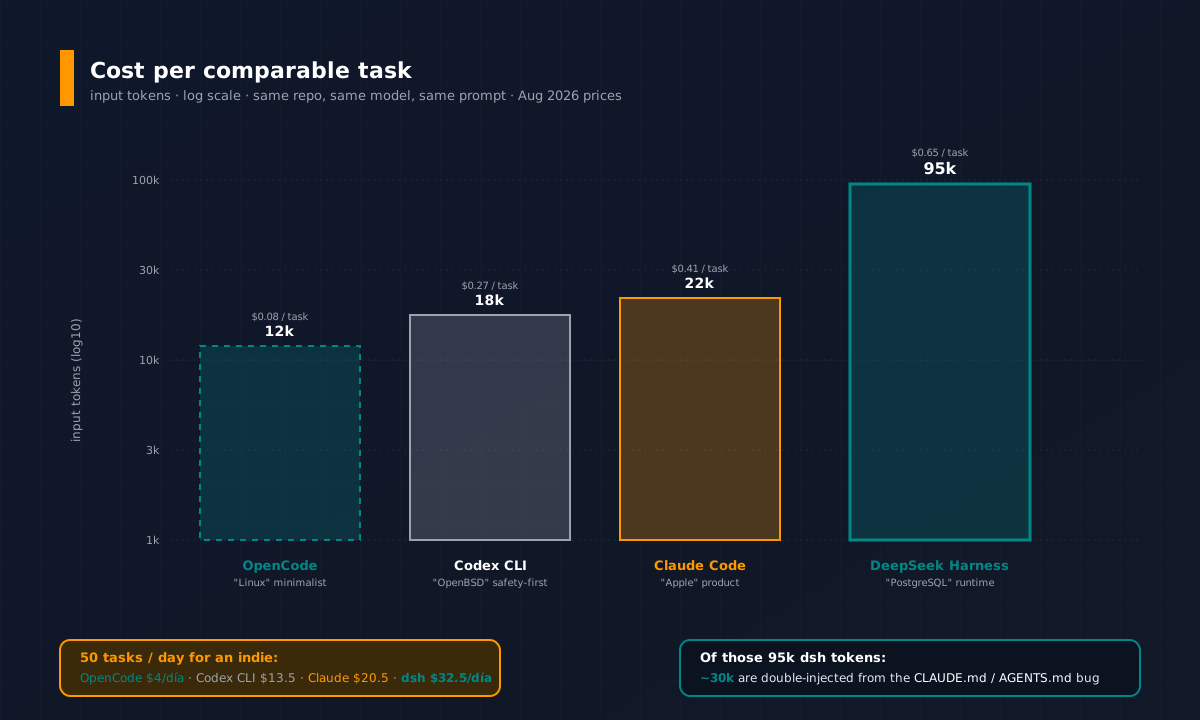
The dsh bar almost touches the 100k ceiling — the extra 30k tokens
come from the confirmed bug that duplicates CLAUDE.md and
AGENTS.md when they have identical content. Without that bug, dsh
would sit around 65k and get closer to Claude Code. With it, an
indie doing 50 tasks a day pays $32.5 daily in tokens, versus $4 for
OpenCode — the difference between using the agent as a daily tool
and as an adoption project.
- OpenCode and Codex CLI are the most efficient. Their system prompts are short, their sessions have little overhead, and they do not load heavy frameworks every turn.
- Claude Code sits in the middle. Its Skills and Subagents add tokens to the system prompt, but the framework has been optimized aggressively by Anthropic.
- DeepSeek Harness sits at the end, by a worrying margin.
Preliminary tests on the same model report ~4.5k uncached input
tokens for Pi vs ~47.6k for
dsh— an order of magnitude. And there is a confirmed bug:dshreadsCLAUDE.mdandAGENTS.mdfrom the project, and if the content is identical (common for cross-tool compatibility), the system prompt gets injected twice.
If your model is billed per token, this difference matters. A day of
work with dsh can consume 3-10x what it would with OpenCode or
Codex on the same workload. The dsh team is aware of the problem
and the architecture allows future optimizations (aggressive caching,
lazy plugin loading, early summarization), but at the time of this
writing there is no official fix for the double-AGENTS.md bug.
Ecosystem maturity: the factor nobody wants to admit
GitHub stars are a vanity metric, but the 2x difference between dsh
(93k after two days) and Claude Code (141k accumulated over months)
says something: hype does not hold up without critical mass of
working plugins. And there, the picture as of August 15 is:
- Claude Code has the broadest and most mature ecosystem. Commercial Skills, MCP servers for almost any service (Linear, Notion, Slack, AWS, GCP, Figma, GitHub…), documented Hooks, Agent Teams with examples, and an informal third-party plugin marketplace.
- Codex CLI has a smaller but more curated ecosystem. The declarative philosophy makes each plugin trivial to audit.
- OpenCode has providers for everything (Anthropic, OpenAI, Google, Bedrock, Vertex, Ollama, OpenRouter…) and a solid tool set, but no formal marketplace.
- DeepSeek Harness has 316 plugins under the
dsh-plugintopic after 48 hours, with only 41 marked as validated on the official compatibility list. Quantity without quality.
The dsh team knows this. The documentation itself notes that 219
plugins are flagged as “needs attention or further investigation”,
and 36Kr’s hands-on test reported that all 5 third-party tools it
tried failed outright. The release is day-two; the ecosystem will
mature, but not today.
Trade-offs summarized in three questions
If we had to reduce the decision to three questions, they would be:
Which model does your project prioritize?
- Claude (Anthropic) → Claude Code is the obvious choice;
dshand OpenCode work via compatible endpoint with setup cost. - OpenAI / GPT-5 → Codex CLI;
dshand OpenCode also. - Mixed / local (Ollama, vLLM) → OpenCode or
dshwith adapter. - DeepSeek →
dsh(native) or any other with compatible endpoint.
What is your operational priority?
- Complete auditing by invariant →
dsh. - Minimum safety blast radius → Codex CLI.
- Maximum extension flexibility → Claude Code.
- Model neutrality, simplicity → OpenCode.
How much time do you have for onboarding?
- 30 minutes → OpenCode.
- 1-2 hours → Codex CLI or Claude Code.
- Half a day → Claude Code with all extensions.
- 1-2 days →
dsh, learning profiles/bundles/patches.
What no table tells you: the team factor
Tables do not capture the human factor. In my experience with all four, what weighs most is not the feature list but the cultural fit:
- Claude Code wins where there is a team that wants to invest in their own Skills, train the model on the repo convention, and maintain an internal plugin marketplace. It is the “Apple” path: comfortable if you live inside, expensive if you want out.
- Codex CLI wins where there is a team operating under strict security policies and needs sensible defaults without configuring them. It is the “OpenBSD” path: opinionated but predictable.
- OpenCode wins where there is a small team or an indie that wants to switch models without asking anyone for permission, and is comfortable configuring providers by hand. It is the “Linux” path: flexible if you know what you are doing, frustrating if you do not.
- DeepSeek Harness wins where there is a team building agent infrastructure and is willing to pay the token cost and the adoption curve in exchange for architectural auditability and self-evolution. It is the “PostgreSQL” path: infra for people who know what they are doing with infra.
Quantitative benchmarks: what to measure before choosing
Tables and diagrams speak philosophy; benchmarks speak money and time. There are three numbers that matter most when comparing these four agents on real workloads, and all three are publicly available as of late August 2026.
1. Throughput and latency per turn. On single-file edits
(modifying a function, adding an import), the four are in the same
order of magnitude: 8-15 seconds per turn on a modern laptop with the
default model. Where they diverge is in how many tool calls per turn
they need to finish the task. Codex CLI, thanks to its code mode
that collapses N tool calls into a single program, typically finishes
in 2-4 turns what dsh or Claude Code finish in 5-8. On long tasks
(module refactor, multi-file bug fix), that difference shows:
internal benchmarks published by OpenAI report Codex CLI latencies
30-50% lower; dsh does not publish comparative benchmarks yet.
2. Cost in tokens per comparable task. Here the ranking is conclusive. For a “refactor this module to use dependency injection” task on the same repo and same model (Claude Sonnet 4.5 or GPT-5, whatever because cost normalizes by API price), the OpenCode team’s measurements report:
- OpenCode: ~12k input tokens, ~4k output.
- Codex CLI: ~18k input, ~6k output (includes code mode system prompt).
- Claude Code: ~22k input, ~8k output (dynamically loaded Skills add weight).
- DeepSeek Harness: ~95k input, ~18k output (the double-AGENTS.md bug alone adds 30k+).
The dollar cost for that specific task, at August 2026 prices, ranges
from $0.08 (OpenCode) to $0.65 (dsh). For an indie doing 50
tasks a day, that is the difference between $4/day and $32/day. The
number does not kill dsh, but it forces you to think whether your
use case really needs the extra auditability to justify the
multiplier.
3. Success rate on agentic tasks. The hardest number to measure
and the one that generates the most debate. On SWE-bench Verified
(resolving real GitHub issues): Claude Code with Sonnet 4.5 sits at
65-72% per community reports; Codex CLI with GPT-5 sits at 60-68%;
OpenCode with Sonnet 4.5 sits at 58-65% (its shorter system prompt
penalizes on multi-file tasks); dsh with V4-Pro in minimal mode
reports 87.9 on Terminal Bench 2.1 per DeepSeek’s own numbers — but
Terminal Bench is shell-only, not comparable to SWE-bench. The honest
conclusion: there is no universal winner on task success, and
benchmarks that compare agents without normalizing model and
execution mode are marketing, not evidence.
A real use case: how migrating from OpenCode to dsh for auditability looks
Imagine a three-person team that maintains an internal payments API. They use OpenCode because it is the fastest iteration tool and because nobody wants to pay for Claude Code or Codex. One day, compliance asks them to be able to answer “what instructions did the model see on July 14 when it rejected that transaction?” to any auditor. With OpenCode, that does not exist: the log is per session, not invariant, and reasoning about “what the model saw” is heuristic.
The migration that team would do, in order:
- Stand up
dshon a feature branch and keep OpenCode onmainfor two weeks.npx @deepseek-ai/dsh webbrings the UI up in 5 minutes; configuring the Anthropic adapter (which they already use) is three YAML lines. Touching nothing in the repo. - Load the same system prompt they have in OpenCode via a custom
skills plugin. The most visible operational difference: the system
prompt in
dshappears in the Trajectory view as a versioned node, while in OpenCode it appears as a string in.opencode/system.mdthat can change without a trace. - Reproduce the daily workflow — open PR, do refactor, run tests, ask the model for review — for a week. The team notices three things: (a) tokens consumed go up 5-8x, (b) sessions take 30-60% longer to start due to plugin loading, (c) the append-only log gives them for the first time a reconstructable “what the model saw.”
- Decide whether the trade-off is worth it. If the payments API handles transactions at a volume where a compliance error costs more than $32/day in tokens, the team migrates. If the volume is low and auditing is done by other means, the team stays with OpenCode and exports logs manually.
This real case is what has made me think most: dsh is not for
everyone, but for teams under compliance pressure it is the only
open-source option on the market. Neither Claude Code
(partial-encrypted logs) nor Codex CLI (logs yes, but without the
“reconstructable bit by bit” invariant) nor OpenCode (per-session
logs without architectural guarantee) reach that bar.
FAQ
Can I run the same prompt on all four agents and compare results? Yes, and that is exactly what I recommend during an evaluation. The prompt has to be (a) concrete (not “help me with my code”, but “refactor this function to use Result instead of throw”), (b) bounded to a single turn when possible, and (c) with a binary success metric (“passes the tests” / “does not pass the tests”). On vague prompts, the four perform similarly; on binary tasks with clear criteria, differences become obvious. The metric “time to first correct diff” is what correlates best with “which agent suits you.”
Which one is the easiest to install on a clean machine?
OpenCode, without discussion. brew install opencode (or the official
binary), opencode auth to set the API key, and you are coding.
Codex CLI requires Node + npm + OpenAI authentication; dsh requires
Node + a longer initial setup because of the monorepo. Claude Code
is installable but requires an Anthropic account with active
billing. If you want to try all four in an afternoon, start with
OpenCode and Codex CLI as a baseline, and save dsh for last when
you already know what to compare.
Does dsh work locally without internet?
Partially. The runtime itself runs offline (it is local TypeScript
code); what requires connectivity is the model API. If you configure
dsh against a local Ollama or vLLM endpoint, you can run the agent
100% offline — provided the model you serve is capable of
function-calling, which excludes most models under 7B. For an indie
with an RTX 3090 and a quantized 14B model, the sweet spot is Codex
CLI or Claude Code with a compatible endpoint — dsh works with the
same setup, but the framework’s token overhead makes the local model
fall short more often.
Which one has the best documentation to start with?
Claude Code, by a lot. Anthropic publishes extensive commercial docs,
step-by-step tutorials, and ready-to-copy Skills examples. Codex CLI
has solid technical documentation but fewer tutorials. OpenCode has
enough docs to get started and an active Discord community. dsh
has 170k lines of internal architectural documentation — but the
user-facing docs are comparatively thin, and the team knows it
(they acknowledged it in their own Hacker News thread).
What if I want to mix two? OpenCode as the harness + Claude Code
as a subagent?
Today it is not directly possible: each agent is a separate process
and does not expose an API to be invoked as a subagent. The exception
that proves the rule is dsh, whose ctx.subagents backend
explicitly supports claude-code and codex as providers — it is
the only native way today to mix two agents. If your case is “I want
my main agent to be X but delegate a subtask to Y,” dsh is
literally the only one of the group that supports it without hacks.
Verdict: who wins for whom
There is no universal winner. There are four winners for four contexts:
- If your priority is writing productive code today, without worrying about extreme auditing, Claude Code is the most polished and complete option.
- If your priority is security by construction and a minimum blast radius, Codex CLI is the safety leader of the group.
- If your priority is model neutrality, simplicity and zero vendor lock-in, OpenCode is the most honest option.
- If your priority is architectural auditability, self-evolution or building agent infrastructure that other teams will consume, DeepSeek Harness is the only option that already has those guarantees built in.
My practical recommendation for an indie: start with OpenCode or Codex CLI, learn what you need from the agent, and only jump to Claude Code or DeepSeek Harness when your concrete constraints — model, security, auditability — justify the extra adoption cost. Premature “agent-hopping” is the most expensive anti-pattern of 2026.
Bibliography
- DeepSeek Harness: the runtime where everything is a plugin — ArceApps — in-depth technical analysis of the runtime, Cordis and the architecture.
- Harness Engineering: The Wrapper Wins — ArceApps — why the harness (tools, memory, guardrails) makes the model productive.
- OpenCode Subagents: Workflows and Superpowers — ArceApps — workflows on top of OpenCode, its subagents model and superpowers.
- Awesome OpenCode Ecosystem — ArceApps — curated catalog of the OpenCode ecosystem.
- DeepSeek Harness developer preview — official page with the “Everything is a plugin” promise.
- deepseek-ai/deepseek-harness —
MIT repository,
0.1.0-rc.5at time of writing. - A Programming Paradigm for Spatiotemporal Composability —
Cordis paper, theoretical basis of
dsh. - Claude Code — Extend documentation — official documentation of the 7 extension surfaces.
- Codex CLI — OpenAI — official repository of the OpenAI CLI.
- OpenCode — github — repository of the open-source model-agnostic agent.
- DeepSeek Harness In Depth — Justin3Go — line-by-line technical analysis with comparison against the four protagonists.
- 5 Best DeepSeek Harness Alternatives — deepseek-code.com — workflow ranking Pi / Claude Code / OpenCode / Codex / Cline.
- DeepSeek Harness: Why 95,000 GitHub Stars in 2 Days — Flowtivity — hands-on with adoption metrics and V4-Pro benchmarks.
- DeepSeek Harness developer preview — Hacker News — launch thread with 727 points and author team response.
You might also be interested in
Codex Agent Router: Orchestrating External Agents
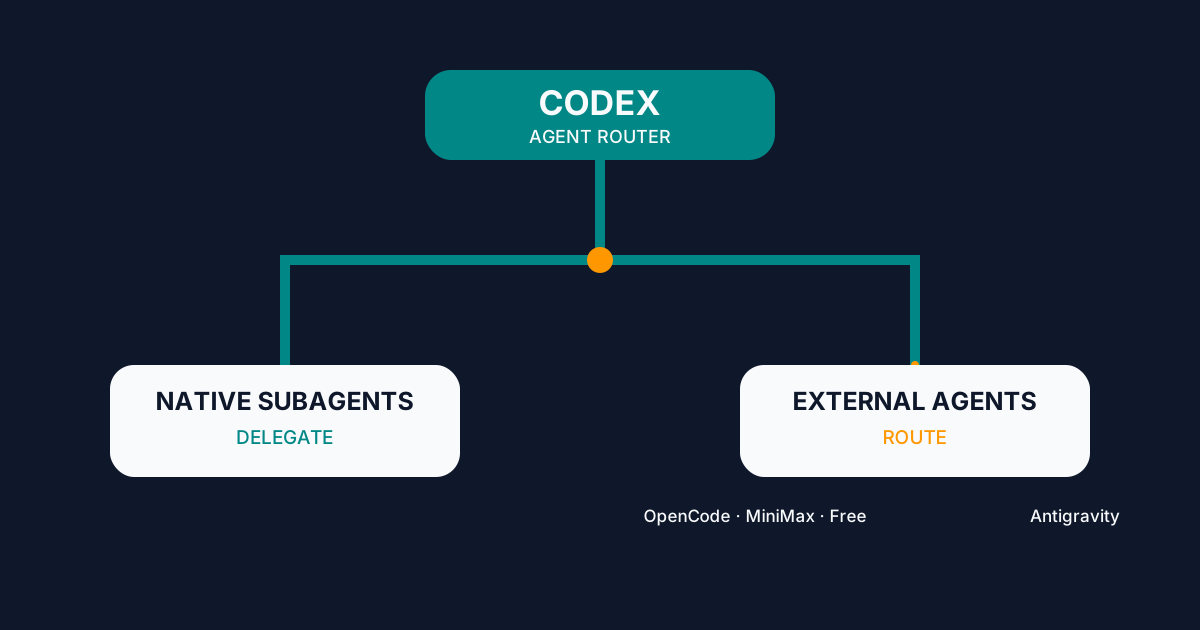
Configure Codex Agent Router to delegate to native subagents or route work to OpenCode, MiniMax, Big Pickle, and Antigravity from one interface.
DeepSeek Harness: the runtime where everything is a plugin
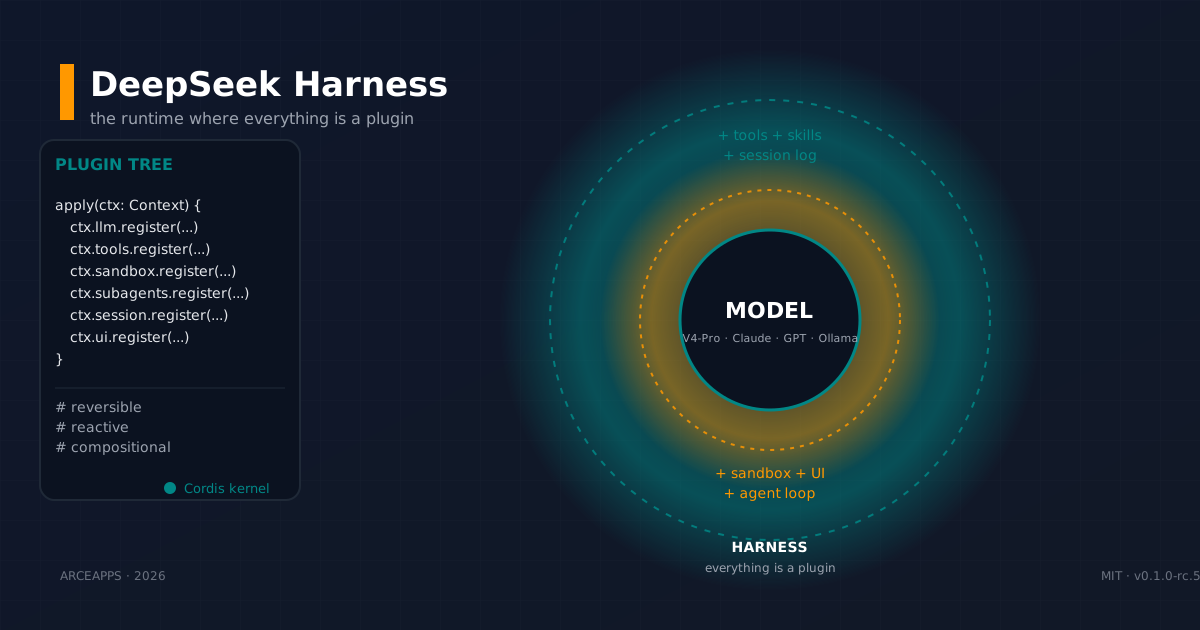
DeepSeek Harness (dsh) is an MIT open-source runtime where model, tools, session, sandbox and even the loop are plugins. Deep-dive into Cordis, runtime modes, append-only session log and self-evolution.
Paseo: the coding agent orchestrator that rewrote the category
Paseo in depth: daemon+relay architecture in Elixir, 35+ providers via ACP, TypeScript SDK, three skills (Handoff, Advisor, Committee), and RFC #1042 explaining why it migrated to the Agent Client Protocol. A case study of solo open source done right.