
Deep Dive into 'Grill Me': The Socratic Grilling Revolution in Claude Code
Table of Contents
Introduction: The End of Compliant AI Agents
In the era of AI-assisted development, we have grown accustomed to a dangerous dynamic: the “Yes Man” syndrome. You present a vague idea for a software architecture, and the LLM immediately responds with enthusiasm: “That’s a fantastic idea! Here is the code.” This sycophancy, inherent in language models optimized by RLHF (Reinforcement Learning from Human Feedback) to please the user, often leads to the generation of hundreds of lines of code based on flawed assumptions, unconsidered dependencies, and fundamentally broken designs.
This is where “Grill Me” enters the stage. It is a revolutionary skill for Claude Code created by Matt Pocock that has gone viral, accumulating over 13,000 stars on GitHub. The premise is as simple as it is brilliant: instead of allowing the AI to code blindly (what the community calls irresponsible specs-to-code), the /grill-me command forces the agent to stop, adopt the persona of a rigorous senior engineer, and bombard you with critical questions about your plan.
This article is a deep dive into how this skill works, why it is saving thousands of hours of refactoring, and how you can integrate it into your daily workflow to elevate the quality of your software engineering.
What is Grill-Me and How Does it Really Work?
The /grill-me command is not dark magic; it is prompt engineering taken to its maximal pragmatic expression. It is a skill (a behavioral extension for agents like Claude Code) that temporarily alters the agent’s “System Prompt” or core instructions.
When you invoke this command, you are telling the AI: “Do not write code. Do not agree with me. Instead, analyze my proposal and find all the plot holes, failure modes, hidden dependencies, and trade-offs I haven’t considered.”
The Internal Mechanics
The iterative process works as follows:
- Proposal Presentation: The developer states an idea (e.g., “I want to migrate our database to PostgreSQL and use Redis for caching”).
- The Grilling: The agent responds with a series of pointed questions. What about eventual consistency? How will we handle Redis failover? Have we considered the infrastructure cost?
- Branch Resolution: The agent forces you to resolve every branch of this decision tree. It won’t let you proceed until a solid “shared understanding” is reached.
- Clarification of Assumptions: It makes all technical and business assumptions explicit.
The Variant: /grill-with-docs
While /grill-me is phenomenal for quick brainstorming sessions, the /grill-with-docs variant takes things to the next level for long-term projects. It works exactly the same way but with an added superpower: it uses your project’s existing documentation as additional context and, as decisions are made during the grilling, it updates a glossary and the project documentation.
This ensures that architectural decisions are not lost in the chat history but instead become persistent artifacts (like ADRs - Architecture Decision Records) that will guide the agent’s future interactions.
Use Cases: When and Why to Use It
The versatility of this skill is the reason for its massive popularity. Here we analyze the five main use cases.
1. Before Starting a Project (Forcing Requirement Analysis)
Developers often fall into the trap of “Vibe Coding” or programming by instinct. This is fine for weekend prototypes but disastrous for production systems. Using /grill-me before even running npm init forces you to think about non-functional requirements: scalability, security, accessibility, and maintainability.
2. Critical Technical Decisions (Architecture, DB, Frameworks)
Imagine debating whether to use a monolithic framework or microservices. A standard agent would give you a generic list of pros and cons. The agent under /grill-me will look at your specific context and ask painful questions: “Given that your team consists of only 3 people, how do you plan to handle the operational overhead of orchestrating 15 microservices?“
3. Validating Specs-to-Code (Finding Holes Before Writing)
The ideal modern flow is Spec-Driven Development (SDD). However, a human-written spec often has holes. The agent will evaluate your SPEC.md file and find edge cases: “The spec says the user will be redirected after login, but it doesn’t mention what to do if the token expires during the redirection.” This saves hours of future debugging.
4. Pair-Programming: The “Clarifying Questions” Phase
In traditional human Pair Programming, the most important phase is not when solutions are typed, but when the navigator asks clarifying questions to the driver. Traditional AI skips this step. /grill-me reinstates this necessary and valuable friction in the AI ecosystem.
5. Brainstorming Sessions and Knowledge Extraction
A fascinating emerging pattern documented by developers (as mentioned in Mejba’s practical tutorial) is using the folder structure brainstorms/YYYY-MM-DD-topic.md. A complete grilling session is executed, and the entire Q&A is saved there to reconstruct the technical reasoning months later.
A Practical Example: The RAG System Case
Let’s look at a typical use case that went viral in the community (r/vibecoding). A developer recounted how he was about to build a complex RAG (Retrieval-Augmented Generation) system. His initial prompt was going to be: “Build a RAG system using Pinecone and LangChain for our support documents”.
Before hitting enter, he decided to run /grill-me. The agent asked him 14 questions he hadn’t considered:
- What is the chunking strategy for the documents?
- How will we handle updating documents in the vector store when the original changes (upserts)?
- What embeddings model will we use and why?
- Have we considered the context window token limit when retrieving multiple chunks?
- Is there Role-Based Access Control (RBAC)? Meaning, can a user query a document they shouldn’t be able to see?
The developer confessed that answering questions 2 and 5 would have required rewriting the entire architecture two weeks later if he had started coding immediately. The “Grill Me” skill literally saved the sprint.
The Viral Impact and the Community (Vibe Coding)
The reception in places like r/vibecoding has been overwhelming. The consensus is clear: “Viral ‘Grill Me’ Claude skill proves specs-to-code is vibe-saving”. The idea that stopping to think saves the project’s “vibe” resonates strongly with the widespread fatigue toward AI-generated spaghetti code.
Furthermore, its presence is so notable that prestigious future events, such as the AI Engineer Unconference Sydney 2026, already have panels dedicated to “Grill-Me” as the definitive case study on how a prompt skill that interviews the developer before coding shifts the human-machine interaction paradigm.
Distribution and Ecosystem
The skill has rapidly expanded beyond its original repo:
- LobeHub: An adapted version for easy installation and support for Codex and ChatGPT.
- MCP Market: Available via
npx skillfish add vechain/vechain-ai-skills grill-me. - AI UX Playground: An iteration focused on the career agent.
- AI DevKit: Included as part of the repeatable workflow alongside skills like “are we sure?”.
Stress, Threats, and Adversarial Prompting
The success of /grill-me rests on deep concepts of AI safety and efficacy. According to guides like the Prompt Engineering Guide on Adversarial Prompting, forcing an LLM to adopt an adversarial stance against the user’s own input is one of the best ways to extract deep reasoning.
In an LLM stress-testing context (LLM Stress Testing 2026), tools like this not only validate the code but also test the robustness of the CI/CD pipeline by ensuring that the specifications generated before the commit are free of “Threats in LLM-Powered AI Agents Workflows,” such as hallucinating non-existent APIs or assuming ideal states (Happy Path bias).
Technical Deep Dive: The Socratic Pattern in Complex Systems
To understand the true scope of “Grill Me,” it is essential to analyze its application in engineering domains that demand fault tolerance. Consider the development of distributed systems and microservice architectures, where component interactions are non-trivial and the risk of cascading effects is high.
Reducing Cyclomatic Complexity through Questioning
When an engineering team presents a plan to decouple a monolith, the general intuition is to fragment domains into entity-based microservices. However, this naive approach often ignores transactional boundaries. A standard LLM might quickly generate templates for the new services. An LLM under the influence of /grill-me, on the other hand, will interrogate you about the “Saga pattern” or two-phase commit (2PC).
How will a distributed transaction be reverted if the payment service fails after the inventory service has already deducted the stock? By forcing this question before writing code, “Grill Me” induces developers to explicitly model compensation scenarios. This mental exercise, documented asynchronously, substantially reduces the cyclomatic complexity of future implementations because error handlers become first-class citizens of the design, not hasty additions.
The Challenge of State Synchronization in Reactive User Interfaces
Another domain where “Grill Me” excels is in the development of complex, reactive user interfaces (e.g., Redux-based architectures or StateFlow in Android).
Suppose a developer proposes a new local caching layer to accelerate the loading of a news feed. The agent’s Socratic questions would point directly to race conditions: “If the user navigates to another screen while the cache is hydrating from the network, do we cancel the network operation or allow it to continue in the background? If it continues, how do we guarantee it doesn’t overwrite more recent data when the user returns to the original screen?”
These are the questions a Senior Software Architect would ask in a design meeting. The democratization of this level of rigor through a terminal command is the true achievement of Matt Pocock’s skill.
Practical Implementation: Integrating “Grill Me” into Your Repository
Adopting “Grill Me” requires more than simply running a command; it demands an adaptation of the entire team’s workflow. Here we present a maturity model for its integration.
Phase 1: Individual Adoption and Persistent Brainstorming
In the initial phase, developers use /grill-me in an ad-hoc manner on their own terminals before starting tasks of medium to high complexity. The key to success here is persistence. We recommend creating a ./design/brainstorms/ directory where the complete log of the adversarial conversation is saved.
This Markdown file is not just a block of text; it is the architectural justification. When a Code Reviewer asks six months later “why Redis was chosen instead of Memcached,” the detailed, AI-validated answer is found in the brainstorming log.
Phase 2: Automation in Spec Generation
Once the team feels comfortable with the adversarial interrogation, the next step is to connect the output of /grill-me with the generation of formal specifications. In the SDD (Spec-Driven Development) ecosystem, this is achieved by channeling the “Shared Understanding” reached during the session directly into the creation of a structured SPEC.md file.
Complementary tools in Matt Pocock’s ecosystem, like /to-prd (To Product Requirements Document), automate this transition. The agent, which has just exhaustively interrogated the proposal, is now the ideal candidate to draft the specification, ensuring that none of the discussed edge cases are left out of the final document.
Phase 3: Integration into the Continuous Integration (CI/CD) Pipeline
In forward-thinking organizations, the principles of “Grill Me” are being adapted to integrate directly into CI/CD flows. Although the original /grill-me command is designed for interactive terminal use, its underlying logic of “critical evaluation” can be instantiated in autonomous agents that review Pull Requests (PRs).
Imagine a GitHub Actions workflow that triggers a Socratic sub-agent. This agent analyzes the diff of the proposed code against the project’s architecture document and posts comments—not to blindly approve, but to interrogate the author about possible regressions and unproven assumptions introduced in the PR. This is the pinnacle of “Shift-Left” in AI-driven software quality assurance.
Risk Mitigation and Tool “Failure Modes”
Like any powerful software engineering tool, /grill-me has failure modes that teams must understand and mitigate.
Analysis Paralysis
The most prominent risk is falling into an infinite loop of interrogation. A language model configured to find flaws will always find a theoretical vulnerability if pushed hard enough, no matter how absurd the probability of occurrence (e.g., “What if a cosmic ray flips a bit in the database server’s RAM?”).
Developers must exercise pragmatic judgment. It is essential to know when to tell the agent: “I have documented that risk, but we have decided to accept it for this MVP iteration.” The goal is not the perfect, infallible architecture, but the conscious, deliberate architecture.
Confirmation Bias in Poor Documentation
The effectiveness of the /grill-with-docs variant depends entirely on the quality of the existing documentation (the provided context). If the base architecture document (ARCHITECTURE.md) is generic or outdated, the Socratic agent will not have a solid frame of reference to question the developer’s proposal. Evaluating documentation quality becomes a prerequisite for successful adversarial interrogation at the project level.
The Paradigm of “Interrogation-Centric Engineering”
In summary, the popularity of “Grill Me” is not a passing fad in the ephemeral world of AI tools. It is a symptomatic response to a structural problem in how we have been building AI-assisted software. By centering the workflow on questioning rather than generation, we are reclaiming the essence of software engineering: structured and rigorous problem-solving.
Lines of code are cheap and abundant in 2026. Clarity of thought, resilient design, and deep domain understanding are the truly scarce resources. By integrating tools that actively foster these qualities, we ensure that the AI revolution elevates the fundamental quality of our software, rather than simply accelerating our capacity to produce technical debt.
Organizational Consequences: Beyond the Code
The adoption of “Grill Me” affects not only the technical quality of the code but also profoundly transforms team dynamics. When the agent takes on the role of the “tough” reviewer, it frees human engineers from this interpersonal burden. Peer code reviews can become tense when architectural decisions are questioned. “Grill Me” acts as an objective buffer.
Furthermore, it facilitates the onboarding of new engineers. By recording the interrogation sessions, a new team member can read exactly what issues were considered before choosing a specific database or design pattern. This builds an institutional memory that is resistant to staff turnover, a critical challenge in modern software engineering.
In conclusion, the true value of Socratic Grilling lies not in writing code faster, but in writing the right code. In a landscape where speed often takes precedence over solidity, tools like this are the necessary counterweight to ensure that artificial intelligence is used as an amplifier of our technical rigor, not as a shortcut to architectural failure.
The Role of Developer Experience (DX) in AI Integration
Developer Experience (DX) is increasingly recognized as a key differentiator for high-performing engineering organizations. The introduction of tools like /grill-me initially seems contrary to the standard DX goal of removing friction. However, this is “good friction.” By catching errors early and building a robust shared language, the downstream DX is immensely improved. Developers spend less time deciphering legacy code and more time building robust features. The Socratic agent essentially becomes a mentor, guiding engineers toward better design patterns and practices through rigorous questioning.
Building the Future of Software Engineering
As we look toward the horizon of software development, the integration of Socratic methods into our daily tools is not just a passing trend; it’s a fundamental shift in how we approach problem-solving. The AI Engineer Unconference Sydney 2026 highlighted that the next generation of developers will not be measured by how fast they can prompt an AI to write code, but by how effectively they can direct, constrain, and collaborate with AI agents to architect resilient systems.
The “Grill Me” skill is a precursor to a more interactive, dialogue-driven development environment where the AI acts as a sounding board, a critic, and a partner. This shift will require a new set of skills from developers: the ability to articulate complex ideas clearly, to defend architectural choices with sound reasoning, and to embrace constructive criticism from non-human entities. By embracing this change, we can ensure that the software we build tomorrow is not only faster to develop but fundamentally better, more secure, and more maintainable than ever before.
Conclusion
Matt Pocock’s “Grill Me” skill is much more than a simple terminal command. It represents a maturation in how we interact with Artificial Intelligence. We have moved from seeing AI as a magic code vending machine to recognizing it as a rigorous validation partner.
The next time you have a “brilliant idea” to refactor that microservice or add a new abstraction layer, do yourself a favor: do not start writing code. Open your terminal, type /grill-me, and prepare to sweat defending your proposal. Your future self will thank you.
Resources, Links, and Credits
This article was built based on the analysis of the following fundamental sources. We highly encourage our readers to explore them:
- mattpocock/skills (GitHub): The original repository with over 13K stars.
- My ‘Grill Me’ Skill Went Viral (AI Hero): Author Matt Pocock’s post explaining the context and pattern behind his creation.
- Grill Me Skill for Claude Code: Extract Your Knowledge: An excellent practical tutorial by Mejba on knowledge extraction.
- grill-me on LobeHub: Adaptation for other AI ecosystems.
- Awesome Skills: Directory and format description.
- r/vibecoding - Viral ‘Grill Me’ Claude skill…: Reddit thread featuring the RAG system case study.
- Adversarial Prompting (Prompting Guide): Theoretical basis for stress-testing.
Read more on our blog about complementary methodologies like Spec-Driven Development and the Socratic Method for Prompts in Kotlin.
You might also be interested in
'Grill Me' vs Socratic Method vs Spec-Driven Development: Evaluating the Next Wave of AI Development
An architectural analysis of how the 'Grill Me' skill fits into the historical tension between honoring the specification and constantly challenging it through adversarial prompts.
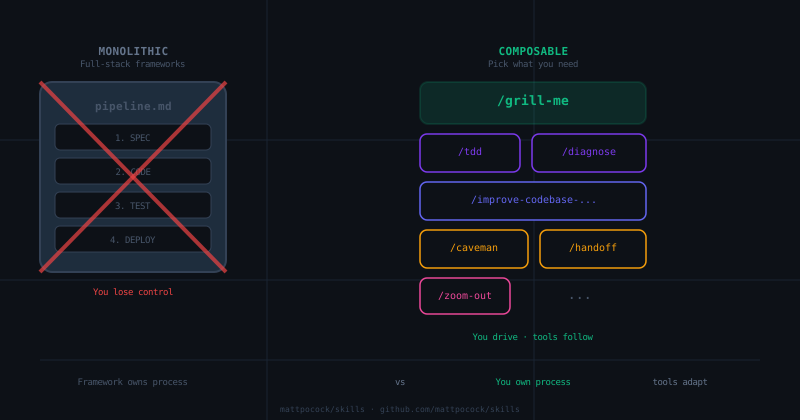
Mattpocock/skills: The Composable Alternative to Full-Stack SDD Frameworks
Why Matt Pocock's skills are small, composable, and opinionated — and how they compare to Spec Kit, OpenSpec, and BMAD for AI-assisted Android development.
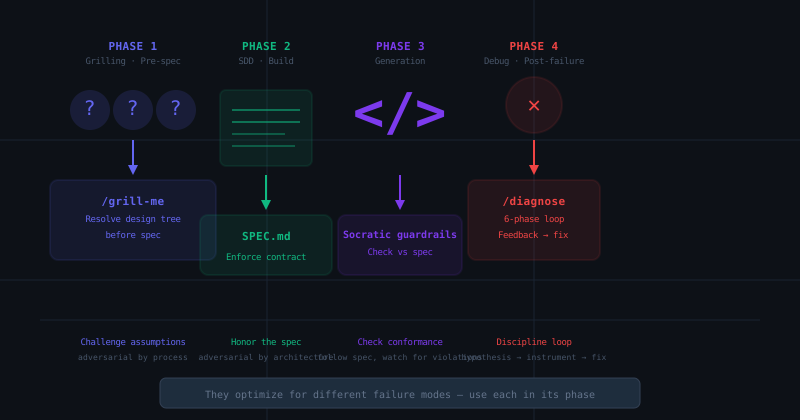
Socratic Grilling Meets Spec-Driven Development: Can They Actually Coexist?
Matt Pocock's /grill-me skill forces adversarial alignment before coding. SDD frameworks enforce architectural contracts. We test whether these two philosophies can actually work together in a single workflow — and where they genuinely conflict.