
'Grill Me' vs Socratic Method vs Spec-Driven Development: Evaluating the Next Wave of AI Development
Table of Contents
Introduction: The Tension in the Generative Code Ecosystem
As the ecosystem of AI agents matures, we find ourselves at a fundamental philosophical crossroads regarding how humans and machines should collaborate in software engineering. On one hand, we have the paradigm of Spec-Driven Development (SDD), which dictates that the Specification (the SPEC.md) is a sacred, immutable document; the agent’s job is to implement it with absolute fidelity. On the other hand, we have Socratic Prompting, which argues that the model must constantly challenge our assumptions, adopting an adversarial stance to break the inherent “sycophancy” of LLMs.
This tension creates a paradox for developers. If you apply the “challenge everything” mindset of the Socratic method during the build phase, you never ship anything because every line of code is debated. If you apply the “the spec is sacred” mindset of SDD from day one, you end up faithfully coding flawed architectures.
In this article, we will comprehensively analyze how the recent viral phenomenon “Grill Me” (a skill created by Matt Pocock for Claude Code, boasting over 13,000 stars on GitHub) resolves this apparent conflict. We will explore how this tool positions itself not as a replacement for SDD, but as the missing piece of the puzzle: the critical bridge between ambiguous ideation and strict specification.
1. Understanding the Players on the Board
Before analyzing the integration, we must clearly define the three conflicting paradigms and what problem each attempts to solve.
Spec-Driven Development (Pure SDD)
Frameworks like Spec Kit and OpenSpec advocate for a linear, deterministic workflow. You write a detailed document (the SPEC.md), and the agent generates code in strict conformity.
- Strength: Prevents “drift,” where the implementation slowly diverges from the original intent over time.
- Weakness: Assumes the human knows exactly what they want and has considered all failure modes. Suffers heavily from “Garbage In, Garbage Out.”
The Socratic Method (Adversarial Prompting)
In our previous articles on the Socratic Method, we explored how to reconfigure system prompts so that LLMs ruthlessly evaluate our code instead of blindly praising us.
- Strength: Breaks sycophancy. Detects memory leaks, concurrency issues (like in Kotlin Coroutines), and architectural flaws that a human might overlook.
- Weakness: It is exhausting and can lead to “debate fatigue.” It is hard to scale to a deterministic CI/CD pipeline because its responses are inherently critical and expansive.
The “Grill Me” Skill (The mattpocock/skills Approach)
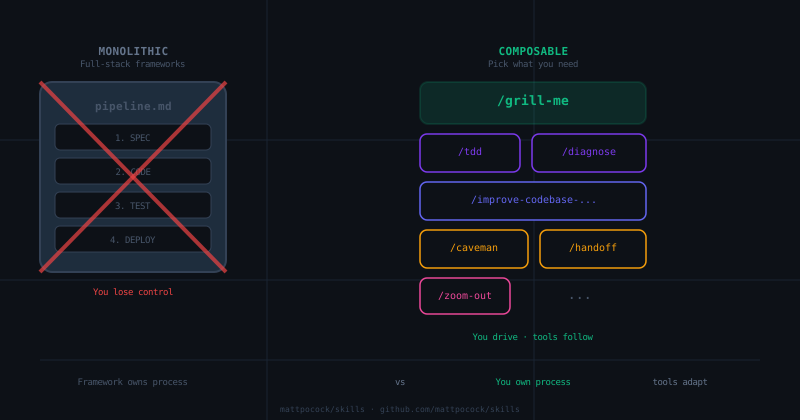
Matt Pocock’s Skills approach is not a Full-Stack methodology or a rigid framework; it is a “toolbox over pipeline” philosophy. At its core is the /grill-me command (and its persistent variant /grill-with-docs).
- The Mechanism: Before generating any code, you force the agent to systematically interrogate you about your technical plan.
- The Goal: To reach a “Shared Understanding” by resolving dependencies and edge cases before writing the first specification or line of code.
2. The Resolution of Conflict: Clear Phases
The greatest conceptual breakthrough that “Grill Me” brings to the community (and the reason it has resonated so deeply in forums like r/vibecoding under the banner of “specs-to-code is vibe-saving”) is the clear separation of software lifecycle phases in the age of agents.
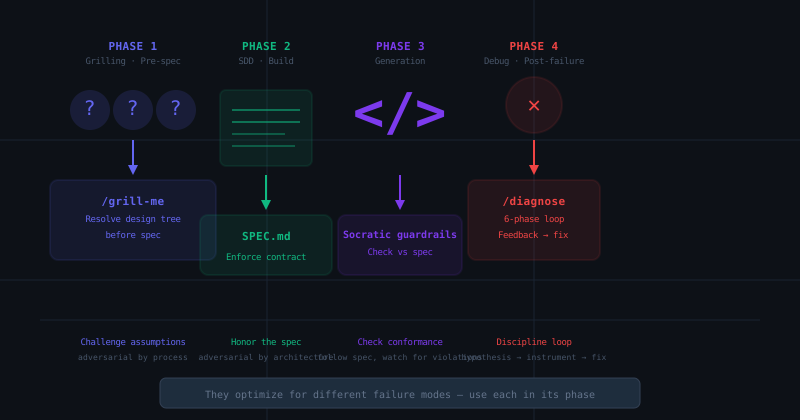
The conflict between Socratic Prompting and SDD only exists if you try to use both techniques simultaneously. The solution is a “Phase-Aware” workflow:
Phase 1: Pre-Spec (The Domain of Grill-Me)
This is where /grill-me shines. You have an idea (e.g., “Let’s build an offline-first architecture for Android using Room and Ktor”). You run the skill. The agent attacks you: “How do we resolve a conflict when the local state diverges from the remote server?”. There is no code here. There is only the clarification of ideas and the building of a shared Glossary (GLOSSARY.md). The outcome of this “adversarial questioning” phase is the solid knowledge base for your SPEC.md.
Phase 2: Build (The Domain of SDD and TDD)
Once the interrogation ends and the SPEC.md is locked, “Grill Me” turns off. Now the discipline of SDD takes over. The agent uses skills like /tdd (Test-Driven Development) to implement the code iteratively. In this phase, “the spec is sacred.” Architecture is not debated; it is implemented.
Phase 3: Post-Failure (The Domain of /diagnose)
If something breaks, you don’t go back to debating the spec. You use Socratic resolution tools like the /diagnose skill, which forces the agent to: (1) reproduce the bug, (2) generate multiple falsifiable hypotheses, and (3) test each one in isolation by changing a single variable at a time.
3. The Glossary: The Hidden Superpower of /grill-with-docs
A profoundly undervalued aspect of Matt Pocock’s suite is the concept of “Shared Language.”
In traditional software engineering (and particularly in Domain-Driven Design), establishing a Ubiquitous Language is the hardest step. When we use /grill-with-docs, the agent doesn’t just interrogate you; it documents the resolutions directly in the project’s context.
By establishing that “Active User” means “a user who has logged in within the last 24 hours,” the agent will never waste tokens assuming wrong definitions in the future. This drastically reduces hallucinations in LLMs—a core problem in managing agents at scale. Unlike SDD, where a human must meticulously draft this glossary beforehand, in the “Grill Me” workflow, high-quality documentation emerges naturally from the friction of the interrogation.
4. Industry Evidence and Future Events
This is not a niche concept. On the preparatory agenda for the AI Engineer Unconference Sydney 2026, the pattern established by /grill-me is positioned as a primary highlight. Experts argue that an agent’s ability to interview its creator marks the transition from “code auto-completion tools” (like the early days of GitHub Copilot) to “autonomous engineering partners.”
Furthermore, recent research on threats in AI agent workflows (Threats in LLM-Powered AI Agents Workflows, arXiv:2506.23260v2) corroborates this approach. The study notes that the largest risk vector in autonomous agents is acting on incomplete information. Forcing an adversarial questioning loop before granting execution permissions is the most effective Risk Mitigation measure documented to date.
5. Case Study: Socratic Integration in an Offline-First Architecture
Let’s take a real-world example, particularly relevant in modern mobile and web development.
The Problem: Implementing an offline-first data sync for a production application.
- Workflow A (Without Grill-Me - Naive SDD): The developer writes a quick SPEC.md stating that data must be saved locally and synced when the network returns. The agent implements this literally, using a simple network queue. Result: The application silently crashes when the server returns an HTTP 409 (Conflict) error because the specification never accounted for conflict resolution.
- Workflow B (With Socratic Integration + Grill-Me + SDD):
The developer pitches the idea.
/grill-mesteps in and asks: “What Merge Strategy will we use for LWW (Last-Write-Wins) versus Server-Wins conflicts?” and “How is the UI notified if a background sync fails asynchronously?”. The developer is forced to design these solutions. The result is captured in the SPEC.md. Then, during the Build phase, the agent rigidly adheres to this robust specification. Result: A resilient, enterprise-grade offline-first implementation from day 1.
In Workflow B, the model’s “sycophancy” could not hide architectural flaws. The “grilling” phase exposed them before they were committed to the codebase.
6. Limitations and When to Avoid “Grill Me”
Despite our enthusiasm, we must be rigorously honest about when this tool is not appropriate. As discussed in our SDD framework comparison (SDD Frameworks Comparison):
- Lack of Initial Vision: The skill is not going to tell you “what” to build. It is an interrogation about the “how.” If you lack a fundamental product vision, the agent will simply iterate on generalities without arriving at anything useful.
- Highly Regulated Teams: In heavily regulated environments (like finance or healthcare), “Grill Me” is useful, but it cannot replace the formal SDD flow of an architectural review board. The output of the interrogation must be formalized into an auditable document that passes through a traditional approval flow.
- Onboarding Cost: Learning to use 15 different skills (from
/tddto/improve-codebase-architecture) requires time. If a team prefers mandatory guardrails and guided flows, a deterministic framework like Spec Kit or BMAD (where agents direct phases automatically) might be more appropriate than Matt Pocock’s “free toolbox” approach.
In-Depth Review of Architecture
The intersection of adversarial tools with traditional paradigms forces us to rethink the very nature of the Software Development Life Cycle (SDLC). Over the past two years, we have witnessed the CI/CD pipeline fill up with static validators, code analyzers, and linters. However, all of these operate on the code after it has been written.
The “Shift-Left” Movement in Decision Making
In the world of cybersecurity, the concept of “Shift-Left” refers to moving security testing to the earliest phases of development. /grill-me applies this exact same principle, but to software architecture. Instead of discovering that our database sharding strategy is deficient during a stress test in staging (which is incredibly costly to rectify), the adversarial agent forces us to mentally model the failure and document the preventive solution in the Pre-Spec phase.
This preventative approach is what many in the community (as widely discussed in r/vibecoding threads) refer to as “Specs-to-code is vibe-saving.” The “vibe” of a software project is often ruined not by small bugs, but by the accumulation of technical debt born from unquestioned architectural decisions.
Multi-Agent Orchestration and the Hybrid Workflow
Let’s imagine a truly advanced development ecosystem. A Junior Developer (Human) proposes a new feature. Instead of sending it directly to a Senior for review, they use an Interrogation Agent (/grill-me).
- Iteration 1: The Agent finds three flawed logical assumptions and two theoretical security vulnerabilities based on recent papers regarding threats in LLM agents.
- Resolution: The Junior researches, adjusts the design, and resolves the agent’s questions.
- Spec Generation: Using
/to-prd(another skill from the Matt Pocock ecosystem), the Q&A session is distilled into a Product Requirements Document (PRD) and a formal technical SPEC. - SDD Implementation: A Coding Agent takes the locked SPEC and, using
/tdd, generates code that meets predefined tests. - Post-Hoc Validation: Finally, a Diagnostic Agent (
/diagnose) acts as a quality gatekeeper in case the automated tests fail.
In this paradigm, artificial intelligence acts not as a mere magical transcriber, but emulates the hierarchical structure and peer review rigor of a mature engineering team.
Theoretical Deep Dive: Hegelian Dialectic in Prompting
It is fascinating to note how this structure mirrors classical philosophical concepts, specifically the Hegelian Dialectic:
- Thesis: The developer’s initial proposal (often naive or incomplete).
- Antithesis: The agent’s adversarial interrogation (
/grill-me), which exposes contradictions, hidden assumptions, and failure modes. - Synthesis: The “Shared Understanding” captured in a robust GLOSSARY.md or SPEC.md.
Pure Socratic method often gets stuck in the Antithesis phase, endlessly searching for weaknesses. Pure SDD falsely assumes the Thesis is perfect. The greatness of the modular tools approach like “Grill Me” is that it actively facilitates the step into Synthesis.
Specific Tools and Automation of Socratic Grilling
Although the /grill-me command originated in the Claude Code ecosystem, the pattern it has established is inspiring the creation of dedicated tools and automated workflows. Engineering teams are building CLI utilities and IDE plugins that integrate “Socratic Grilling” natively.
For instance, an IDE plugin could detect when a developer is drafting a new architecture file and, in the background, simulate an interrogation session, highlighting questionable decisions as if they were syntax errors or code linters. This proactive approach ensures that critical assumptions are addressed even before the code is shared with the team.
The Impact on Sprint Estimation and Planning
An often-overlooked secondary benefit of applying “Socratic Grilling” in the Pre-Spec phase is the radical improvement in the accuracy of agile estimations. Story points often go astray due to hidden unknowns. By forcing a thorough exploration of edge cases, dependencies, and failure modes before the user story enters the sprint, teams can size the work with much greater confidence. The /grill-me session essentially converts “unknown unknowns” into “known unknowns,” mitigating the risk of massive schedule overruns.
In summary, the evolution from submissive coding assistants to critical peers represents a fundamental milestone. Tools like “Grill Me” are not simply productivity “hacks”; they are the crystallization of sound engineering practices in an accessible and repeatable format, ensuring that AI-driven software development maintains the rigor necessary to build the critical systems of the future.
Refining the Art of the Prompt
The skill behind “Grill Me” is essentially a masterpiece of prompt engineering. It demonstrates that the key to unlocking the true potential of LLMs is not just asking them to do tasks, but carefully setting the stage and defining the constraints of their behavior. Future developers will spend less time memorizing syntax and more time mastering the art of creating robust system prompts that guide AI agents to act as effective, domain-specific collaborators.
The Importance of Context in Socratic Dialogue
One aspect that cannot be understated is the role of context in making Socratic Grilling effective. When an AI interrogates a developer without sufficient context about the project’s constraints, existing infrastructure, or business goals, the questions can quickly become irrelevant or pedantic. The true brilliance of the /grill-with-docs variant is that it grounds the adversarial stance in the reality of the codebase. By dynamically feeding relevant documentation into the context window, the AI’s questions transition from generic (“How do you handle security?”) to highly specific (“Given that we use OAuth2, how do we handle token refresh failures on slow mobile networks?”). This contextual grounding is what ultimately makes the tool indispensable for serious software engineering, bridging the gap between theoretical best practices and practical implementation realities.
Conclusion: The Verdict on Coexistence
Socratic prompting and SDD can and must coexist. Their relationship is not mutually exclusive, but symbiotic. “Grill Me” is the missing link that allows us to harness the deductive and critical capabilities of LLMs without sacrificing the discipline and traceability of Spec-Driven Development.
If you are the kind of developer who appreciates classical software engineering principles (as described in books like The Pragmatic Programmer or A Philosophy of Software Design), the mattpocock/skills toolset will feel like a natural extension of your brain. It forces deliberate and careful design steps every single day.
At ArceApps, we have integrated this hybrid flow into the construction of our sub-agents, and the results are clear: less time debugging spaghetti architecture, higher quality documentation, and a much richer shared language between engineers and our synthetic peers. The era of the “Yes Man” is over. The era of agentic rigor has just begun.
References and Related Reading
- mattpocock/skills GitHub Repository: The epicenter of this methodology.
- Socratic Method Prompts: Breaking AI Sycophancy: Anatomy of a high-performance Socratic prompt.
- SDD Frameworks Comparison: A deep dive into Spec Kit, OpenSpec, and BMAD.
- Socratic Agents Part 2: SDD and Sycophancy: The historical relationship between adversarial prompting and Spec-Driven Development.
- Adversarial Prompting in LLMs: Prompt engineering guide on stress-testing.
- LLM Stress Testing 2026: load, adversarial, CI pipeline: Industry perspectives on the evolution of continuous integration with AI agents.
You might also be interested in
Socratic Grilling Meets Spec-Driven Development: Can They Actually Coexist?
Matt Pocock's /grill-me skill forces adversarial alignment before coding. SDD frameworks enforce architectural contracts. We test whether these two philosophies can actually work together in a single workflow — and where they genuinely conflict.
Deep Dive into 'Grill Me': The Socratic Grilling Revolution in Claude Code
Discover how Matt Pocock's viral skill is transforming AI-assisted development by forcing agents to ruthlessly question your design before writing a single line of code.
Mattpocock/skills: The Composable Alternative to Full-Stack SDD Frameworks
Why Matt Pocock's skills are small, composable, and opinionated — and how they compare to Spec Kit, OpenSpec, and BMAD for AI-assisted Android development.