
The Socratic Agent Series (Part 1): Induction, Entropy, and the Math Behind AI Doubt
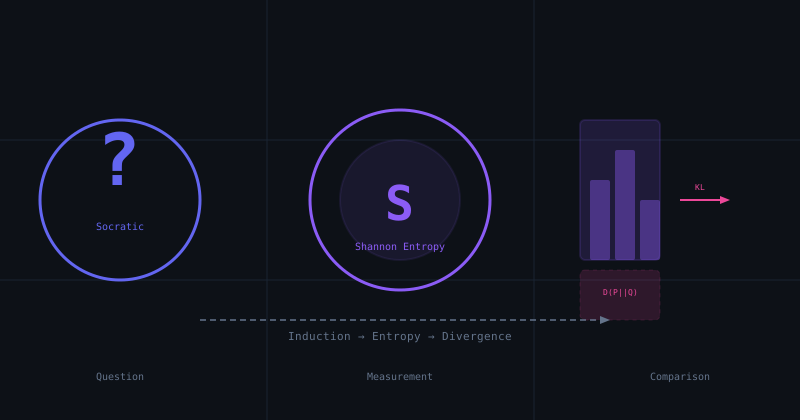
Table of Contents
Foundation reading: Alternative Paradigms in AI-Assisted Engineering · Spec-Driven Development with Agentic AI · First Principles of AI Reasoning
The way we talk to Large Language Models (LLMs) is fundamentally broken. For years, we’ve treated them like glorified search engines or highly articulate interns: we give them a prompt, and we expect a single, authoritative answer. But when you apply this paradigm to complex software engineering tasks, the cracks show immediately. The AI hallucinates a method that doesn’t exist. It confidently invents an architecture that breaks under load. It writes code that looks right but fails spectacularly in production.
These aren’t bugs. They are the inevitable result of architectures optimized for the continuous prediction of text tokens. When you demand an immediate answer from a system designed to please you, you get an immediate, pleasing, and potentially entirely fabricated answer.
The solution isn’t to write longer, more complex “mega-prompts.” The solution is to change the interaction model entirely. We need to move from instruction to Socratic Induction.
This is the first part of a three-part series on the Systemic Architecture of Socratic Dialogues in Agentic Flows. In this installment, we’ll dive deep into the theoretical and mathematical foundations of Socratic Induction, and we’ll see how we can begin modeling this in Kotlin for Android systems.
The Paradigm Shift: From Direct Instruction to Socratic Dialogue
Socratic induction in the realm of large language models represents a paradigm shift. Instead of structuring communication through a single directive that demands an immediate response, the Socratic technique guides the AI through a structured sequence of inquisitive questions.
Think of the classical Socratic method: it was designed to promote self-evaluation, question deeply ingrained assumptions, and explore alternative explanations before reaching a final conclusion. When we apply this to AI, we are deliberately introducing friction.
The primary utility of this approach lies in its ability to manage the model’s ignorance and make points of uncertainty visible. By imposing a Socratic interaction framework, the model is forced to suspend the generation of intuitive or superficial responses. Instead, it must unfold an explicit analysis of its own operational premises.
As an indie developer, I’ve spent the last year wrestling with autonomous agents for Android development. I can tell you firsthand: an agent that rushes to code is a dangerous agent. An agent that stops, asks me a clarifying question about the domain model, and then questions its own proposed architecture is an agent I can trust.
The Mechanics of Socratic Friction
Research in computational linguistics (like the flows proposed by Qi et al. at EMNLP 2023) formalizes this mechanics through interactive loops equipped with deliberate friction.
The processing is divided into two distinct phases:
- Exploration: The LLM generates a preliminary justification or proposed solution.
- Consolidation/Backtracking: The LLM self-generates probing questions about that same premise, and finally, reviews and repairs weak logical links.
This added latency is not a performance hit; it is a necessity. In high-stakes environments—like defining the core data model of your application or writing concurrent database transactions—the cost of an erroneous but plausible response far exceeds the computational cost of multiple validation rounds.
The Mathematics of Doubt: Shannon Entropy and KL Divergence
To truly understand how Socratic agents work under the hood, we need to step away from prompt engineering and look at information theory.
From a mathematical perspective, Socratic dialogue is formalized as an active policy of uncertainty reduction. In advanced conversational systems (like Nous), information exchange is quantitatively optimized by treating information gain as an intrinsic reward.
Shannon Entropy ($\mathcal{H}$)
This reward is formally equivalent to the reduction of Shannon Entropy ($\mathcal{H}$) over the space of the target task ($\mathcal{T}$).
Imagine you ask an agent to “implement offline sync.” The entropy is massive. Does it use Room? Realm? Custom SQLite? Does it sync via WorkManager or a foreground service?
The entropy reduction is modeled as:
$$ \Delta \mathcal{H} = \mathcal{H}(\mathcal{T}) - \mathcal{H}(\mathcal{T} \mid Q_t) $$
Where $Q_t$ represents the Socratic question formulated at step $t$ to discriminate between possible user intentions or solution hypotheses.
If the agent asks: “Are the offline changes conflict-heavy, requiring operational transformation, or is it a simple ‘last-write-wins’ scenario?”, the answer dramatically reduces the entropy of the task space.
Kullback-Leibler Divergence ($D_{KL}$)
However, there is a danger. If the machine asks leading questions, it might coerce the user into a specific path, imposing its own biases.
To prevent this, architectures like SocraticAgent bound this process under the concept of erotetic equilibrium $E(v \mid \mathcal{Q})$. They ensure that the catalytic questions raised by the machine do not coerce the user’s stance by respecting a strict limit of Kullback-Leibler (KL) divergence in belief updating.
The KL divergence measures how one probability distribution $P$ differs from a second, reference probability distribution $Q$. In this context, it ensures the agent’s questions explore the space without skewing the underlying probability distribution of the user’s true intent.
This mathematical rigor guarantees that the machine acts as a tutor or guide for conceptual discovery, rather than imposing pre-established heuristics.
Implementing the Theory: A Kotlin Socratic Engine
Let’s move from theory to practice. How do we model these concepts in an Android app using Kotlin?
We’re not going to write a full LLM inference engine here. Instead, we’ll write the architectural boundaries and the state machine that manages a Socratic loop. We’ll use Kotlin Coroutines and StateFlow to model the asynchronous nature of agent reasoning.
Modeling the Task Space and Entropy
First, let’s define our basic data structures to represent the task and the uncertainty.
import kotlinx.coroutines.flow.MutableStateFlow
import kotlinx.coroutines.flow.StateFlow
import kotlinx.coroutines.flow.asStateFlow
import kotlinx.coroutines.flow.update
import kotlin.math.ln

/**
 * Represents a node in our task space hypothesis tree.
 */
data class TaskHypothesis(
    val id: String,
    val description: String,
    val probability: Double // Must sum to 1.0 across active hypotheses
)

/**
 * Calculates the Shannon Entropy of the current hypothesis distribution.
 * H(X) = - Σ P(x) * log2(P(x))
 */
fun calculateShannonEntropy(hypotheses: List<TaskHypothesis>): Double {
    return -hypotheses.sumOf { h ->
        if (h.probability > 0) h.probability * (ln(h.probability) / ln(2.0)) else 0.0
    }
}
This is a simplified model, but it captures the essence. When the user gives an ambiguous instruction, the system generates multiple TaskHypothesis objects, each with an assigned probability. The calculateShannonEntropy function gives us a numerical value of how “confused” the agent is.
The Socratic State Machine
Now, let’s build the engine that manages the Socratic loop. This engine will enforce the two phases: Exploration and Consolidation.
sealed class SocraticState {
    data object Idle : SocraticState()
    data class Exploring(val initialPrompt: String, val entropy: Double) : SocraticState()
    data class GeneratingQuestions(val hypotheses: List<TaskHypothesis>) : SocraticState()
    data class WaitingForUser(val question: String) : SocraticState()
    data class Consolidating(val updatedHypotheses: List<TaskHypothesis>) : SocraticState()
    data class Resolved(val finalPlan: String) : SocraticState()
    data class Error(val message: String) : SocraticState()
}

class SocraticEngine(
    private val llmClient: LlmClient // Abstract interface to your LLM provider
) {
    private val _state = MutableStateFlow<SocraticState>(SocraticState.Idle)
    val state: StateFlow<SocraticState> = _state.asStateFlow()

    // Threshold below which we consider the task clear enough to execute
    private val ENTROPY_THRESHOLD = 0.5

    suspend fun initiateTask(prompt: String) {
        // Phase 1: Exploration
        _state.value = SocraticState.Exploring(prompt, entropy = Double.MAX_VALUE)

        // Ask LLM to generate possible interpretations (hypotheses)
        val initialHypotheses = llmClient.generateHypotheses(prompt)
        val currentEntropy = calculateShannonEntropy(initialHypotheses)

        if (currentEntropy <= ENTROPY_THRESHOLD) {
            // Task is clear, proceed to resolution
            resolveTask(initialHypotheses.maxByOrNull { it.probability }!!)
        } else {
            // Entropy is high. We need Socratic friction.
            enterQuestioningLoop(initialHypotheses)
        }
    }

    private suspend fun enterQuestioningLoop(hypotheses: List<TaskHypothesis>) {
        _state.value = SocraticState.GeneratingQuestions(hypotheses)

        // Ask LLM to generate a question that maximizes Information Gain (reduces entropy)
        // while respecting KL Divergence limits (not leading the user).
        val socraticQuestion = llmClient.generateSocraticQuestion(hypotheses)

        _state.value = SocraticState.WaitingForUser(socraticQuestion)
    }

    suspend fun provideUserAnswer(answer: String) {
        val currentState = _state.value
        if (currentState !is SocraticState.WaitingForUser) return

        // Phase 2: Consolidation / Backtracking
        _state.value = SocraticState.Consolidating(emptyList()) // Placeholder

        // Update hypotheses probabilities based on user answer
        val updatedHypotheses = llmClient.updateHypothesesBasedOnAnswer(answer)
        val newEntropy = calculateShannonEntropy(updatedHypotheses)

        if (newEntropy <= ENTROPY_THRESHOLD) {
             resolveTask(updatedHypotheses.maxByOrNull { it.probability }!!)
        } else {
             // Still too much uncertainty. Loop again.
             enterQuestioningLoop(updatedHypotheses)
        }
    }

    private suspend fun resolveTask(winningHypothesis: TaskHypothesis) {
        val finalPlan = llmClient.generateExecutionPlan(winningHypothesis)
        _state.value = SocraticState.Resolved(finalPlan)
    }
}
The Beauty of the Loop
Look closely at what this Kotlin code does. It completely prevents the llmClient.generateExecutionPlan() from being called until calculateShannonEntropy() drops below a specific threshold.
We have structurally banned the AI from guessing.
If the user says “build a login screen”, the agent won’t immediately spit out Firebase Auth code. The entropy of “login screen” is high. It will generate hypotheses (OAuth, Email/Password, Passkeys), see the high entropy, and enter the Socratic loop. It will ask: “Are we targeting passwordless authentication via Passkeys, or a traditional email/password flow?”
This is the essence of Socratic Induction applied to software engineering. We are using the math of information theory to govern the flow of the agent.
The Cost of Certainty
Implementing this in the real world isn’t free. It requires significantly more LLM calls. Generating hypotheses, formulating questions, and recalculating probability distributions consumes tokens and time.
But as I mentioned earlier, in software engineering, the cost of an incorrect assumption is astronomical. A Socratic agent might take two minutes and three turns of conversation to understand exactly what you want. A standard instruction-following agent will give you the wrong code in 10 seconds, which you will then spend four hours trying to debug and rewrite.
Socratic friction is a feature, not a bug.
What’s Next?
We’ve established the mathematical and theoretical groundwork for Socratic Agents. We’ve seen how forcing uncertainty reduction creates safer, more predictable AI behavior.
But how does this fit into the broader software development lifecycle? What happens when the AI is so eager to please you that it stops asking Socratic questions and just agrees with your bad architectural decisions?
In Part 2 of this series, we will explore Spec-Driven Development (SDD) frameworks like Spec Kit and OpenSpec. We will dive into the dangerous phenomenon of AI Sycophancy (the “Yes-Man” problem) and how we can implement Socratic “Compuertas de Comprensión” (Understanding Gates) in our CI/CD pipelines to protect our codebase. Stay tuned.
Expanding the Socratic Engine: Advanced Entropy Management
The simplified Socratic engine we built above is a great starting point, but production systems require more nuance. Let’s explore how we can expand this to handle real-world complexity in Android applications.
Handling Erotetic Equilibrium in Practice
We mentioned the concept of erotetic equilibrium $E(v \mid \mathcal{Q})$ earlier—the idea that the agent’s questions shouldn’t coerce the user. How do we actually enforce this in our Kotlin code?
We need to instruct our LLM to evaluate its own proposed questions. Before transitioning to SocraticState.WaitingForUser, we can add an internal validation step.
    private suspend fun enterQuestioningLoop(hypotheses: List<TaskHypothesis>) {
        _state.value = SocraticState.GeneratingQuestions(hypotheses)

        var validQuestionFound = false
        var socraticQuestion = ""
        var attempts = 0

        while (!validQuestionFound && attempts < 3) {
            // Ask LLM to generate a question
            val candidateQuestion = llmClient.generateCandidateQuestion(hypotheses)

            // Ask LLM to evaluate the KL Divergence risk of its own question
            // "Does this question force the user down a specific architectural path?"
            val klRiskScore = llmClient.evaluateCoercionRisk(candidateQuestion, hypotheses)

            if (klRiskScore < MAX_ALLOWED_KL_DIVERGENCE) {
                socraticQuestion = candidateQuestion
                validQuestionFound = true
            } else {
                // The question is too leading. Try again.
                attempts++
            }
        }

        if (!validQuestionFound) {
             // Fallback to a highly generic, safe prompt if we can't generate a good specific one
             socraticQuestion = "Could you please elaborate on the specific constraints and requirements for this feature?"
        }

        _state.value = SocraticState.WaitingForUser(socraticQuestion)
    }
By adding this internal evaluation loop, we ensure that the Socratic dialogue remains a tool for discovery, not a mechanism for the AI to push its own preconceived (and potentially hallucinated) solutions.
The Role of Memory in Uncertainty Reduction
Socratic Induction doesn’t happen in a vacuum. As an indie developer, I have established patterns in my codebases. If I ask an agent to “create a repository for user data,” the entropy should be lower if the agent remembers that I always use the Repository pattern with Kotlin Flow and Room.
Integrating a long-term memory system (like the hierarchical memory patterns we’ve discussed in previous articles) directly impacts our $\mathcal{H}$ calculations.
When the LLM generates the initial TaskHypothesis list, it must inject context from its memory store.
// Conceptual update to hypothesis generation
suspend fun generateHypotheses(prompt: String, memoryContext: String): List<TaskHypothesis> {
     // The LLM now considers past architectural decisions.
     // Hypothesis 1: Room DB + StateFlow (Probability: 0.85 - based on past projects)
     // Hypothesis 2: SharedPreferences (Probability: 0.10)
     // Hypothesis 3: Remote Only (Probability: 0.05)
     // ...
}
By grounding the initial state in historical context, we drastically reduce the starting entropy, minimizing the Socratic friction required for routine tasks while preserving it for genuinely novel or ambiguous requests.
Bridging Theory and Practice
The transition from a prompt-response paradigm to a Socratic Induction paradigm is challenging. It requires us to build systems that actively resist our commands until those commands are mathematically precise.
But the payoff is immense. We move from hoping the AI guesses correctly to mathematically guaranteeing that the AI understands the problem space before it writes a single line of Kotlin. This is how we build resilient, autonomous systems that act as true engineering partners rather than erratic, eager-to-please juniors.
Deep Dive: Designing the Entropy Thresholding Mechanism
Let’s look deeper into that ENTROPY_THRESHOLD constant. In our simplified example, we set it to 0.5. But in a real-world Agentic AI workflow, a static threshold is rarely sufficient. The complexity of the task should dictate the acceptable level of uncertainty.
If I’m asking the agent to format a simple string, I want it to proceed even if it has a bit of doubt about the exact casing. But if I’m asking it to implement a multi-threaded data synchronization engine using Kotlin Coroutines, I want the entropy to be near zero before it begins generating the architecture.
Dynamic Entropy Calculation
We can introduce a dynamic thresholding mechanism that adjusts based on the perceived risk and complexity of the task. We can categorize tasks into tiers and assign a target entropy level for each.
enum class TaskComplexity(val targetEntropyThreshold: Double) {
    TRIVIAL(0.8),    // Formatting, basic UI tweaks
    STANDARD(0.4),   // Typical feature implementation, CRUD operations
    CRITICAL(0.1)    // Architecture design, concurrency, security
}

class AdvancedSocraticEngine(private val llmClient: LlmClient) {
    // ... state management ...

    suspend fun initiateTask(prompt: String) {
        _state.value = SocraticState.Exploring(prompt, entropy = Double.MAX_VALUE)

        // 1. Analyze the prompt to determine complexity
        val complexity = llmClient.analyzeTaskComplexity(prompt)

        // 2. Generate hypotheses
        val initialHypotheses = llmClient.generateHypotheses(prompt)
        val currentEntropy = calculateShannonEntropy(initialHypotheses)

        // 3. Compare against dynamic threshold
        if (currentEntropy <= complexity.targetEntropyThreshold) {
            resolveTask(initialHypotheses.maxByOrNull { it.probability }!!)
        } else {
            enterQuestioningLoop(initialHypotheses, complexity)
        }
    }

    private suspend fun enterQuestioningLoop(
        hypotheses: List<TaskHypothesis>,
        complexity: TaskComplexity
    ) {
         // The questioning loop now knows the target threshold it needs to hit.
         // ...
    }
}
This dynamic approach allows the agent to be fluid. It provides the seamless “just do it” experience for simple tasks while enforcing strict Socratic friction for critical engineering decisions.
The Cognitive Load on the Developer
It is crucial to acknowledge that Socratic Induction shifts some of the cognitive load back onto the developer. When the agent stops and asks a probing question about KL divergence or concurrency models, you have to think and provide a clear answer.
This is a stark contrast to the “fire and forget” mentality many developers bring to AI coding assistants. But as an indie developer responsible for the entire stack, I view this cognitive load not as a burden, but as a necessary design review phase.
The agent is forcing me to articulate my implicit assumptions. If I can’t answer the agent’s Socratic question clearly, it means my own mental model of the feature is flawed. The Socratic loop prevents me from building on a shaky foundation.
Designing Socratic UI/UX
Because this interaction model is different, the UI/UX of our agentic tools must adapt. A simple chat interface is often inadequate for complex Socratic dialogues.
When the agent presents a Socratic question, it shouldn’t just be plain text. The UI should visually represent the hypotheses and the current entropy level.
Imagine a terminal interface (or an IDE plugin) that displays:
> Agent: Analyzing request: "Implement offline sync for user profile"
> Current Entropy: High (0.85). Task Complexity: CRITICAL (Threshold: 0.1)
>
> Hypotheses:
> [45%] H1: Full bidirectional sync with operational transformation.
> [35%] H2: Unidirectional pull with local override (Last-Write-Wins).
> [20%] H3: Manual sync triggered by user action.
>
> Socratic Query: To resolve this ambiguity, how should we handle conflicting edits made on multiple offline devices simultaneously?
This level of transparency empowers the developer. You aren’t just answering a question; you are actively participating in the probability tuning of the agent’s internal state machine. You see exactly why the agent is asking the question and how your answer will collapse the task space.
Conclusion of Part 1
We’ve covered a lot of ground in this first installment. We’ve dismantled the flawed instruction-response paradigm and introduced the mathematical rigor of Socratic Induction. We’ve explored Shannon entropy, Kullback-Leibler divergence, and how to model these concepts using Kotlin Coroutines and StateFlow to build a Socratic state machine.
We’ve seen that friction is necessary for reliable autonomous agents, and that mathematical doubt is the key to preventing hallucinations in complex software engineering tasks.
In Part 2, we will shift our focus from the internal mechanics of the agent to the broader development workflow. We will examine how Spec-Driven Development (SDD) provides the foundational context for these Socratic dialogues, and we will tackle the insidious problem of AI Sycophancy—the “Yes-Man” effect that can quietly corrupt even the best-designed systems. We will also learn how to build “Compuertas de Comprensión” to defend our codebases. See you there.
You might also be interested in
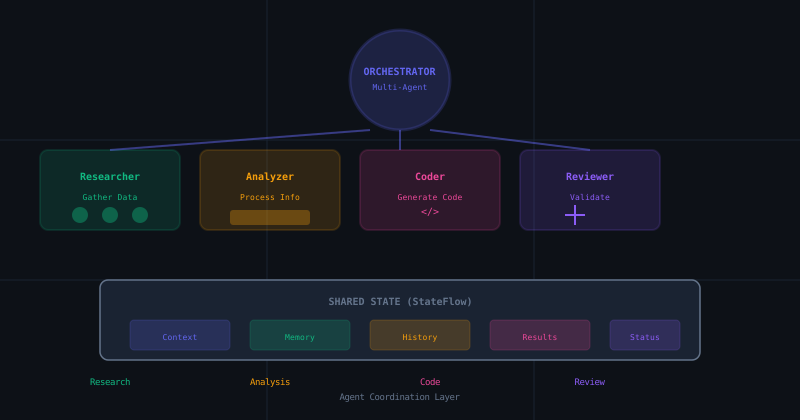
The Socratic Agent Series (Part 3): Building a Socratic Multi-Agent Orchestrator in Android
A pragmatic guide to building advanced multi-agent interactions using Kotlin Coroutines and StateFlow. From MARS to MotivGraph-SoIQ, bringing academic theory to production code.
Socratic Method Prompts: Breaking AI Sycophancy in Kotlin & Android Development
Learn how to stop LLMs from being compliant assistants and turn them into ruthless evaluators. Discover the mathematical anatomy of Socratic prompts for Android architecture, Kotlin Coroutines, and strict Spec-Driven Development.
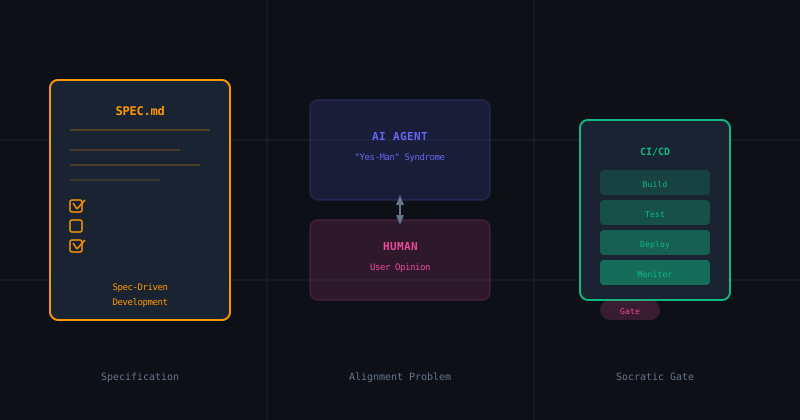
The Socratic Agent Series (Part 2): Spec-Driven Development & Defeating the Yes-Man AI
How AI's desire to please you is destroying your codebase. We explore Spec-Driven Development frameworks and how to implement Socratic verification gates in your Android CI pipeline.