
The Socratic Agent Series (Part 3): Buildi...
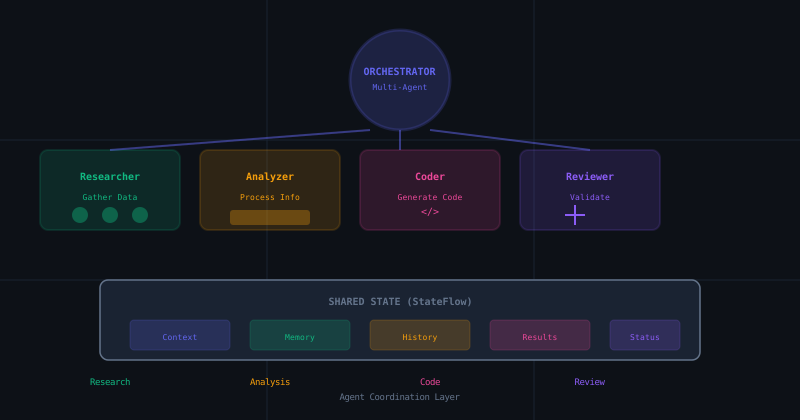
Table of Contents
Foundation reading: The Socratic Agent Series (Part 1) · The Socratic Agent Series (Part 2) · Orchestrating AI Agents in CI/CD Pipelines
In Part 1, we defined the math of Socratic Induction—how to mathematically force an AI to doubt itself to reduce entropy. In Part 2, we looked at how Spec-Driven Development (SDD) provides the structural boundaries for that doubt, preventing the dangerous “Yes-Man” syndrome through CI/CD gates.
Now, it’s time to put all the pieces together.
A single agent doubting itself is useful. A multi-agent system, where specialized agents actively challenge, critique, and guide each other through rigorous Socratic debate, is transformative.
In this final installment, we will transition from theory to heavy production architecture. We will explore the patterns used by the socratic-agents ecosystem and build a concrete Kotlin implementation of a Multi-Agent Socratic Orchestrator tailored for Android development.
The Socratic-Agents Orchestration Ecosystem
The transition from single-agent wrappers to distributed multi-agent systems requires complex orchestration. It’s no longer just about prompting an LLM; it’s about managing state, conflict resolution, and information flow between distinct “personas.”
The socratic-agents library provides a modular ecosystem for this. It abstracts away the underlying LLM provider (using universal clients like Socrates Nexus) and distributes tasks among specialized agents.
The Specialization Squad
Here is the typical distribution of functions in a Socratic orchestration library:
| Specialized Agent | Operation Category | Primary Function |
|---|---|---|
| Socratic Counselor | Coordination / Dialogue | Orchestrates the Socratic dialogue, managing the question cycle, detecting logical conflicts, and tracking the maturity of the dialectical flow. |
| Code Generator | Execution | Generates source code and intelligently completes algorithms based on specs. |
| Code Validator | Execution | Designs, executes, and validates unit tests on the generator’s deliverables. |
| Knowledge Manager | Analysis | Advanced interface with indexed knowledge bases and RAG architectures to provide factual context. |
| Learning Agent | Management | Continuous learning and detection of historical behavioral patterns in the workflow. |
| Skill Generator | Management | Adaptive generation and optimization of agent skills based on operational maturity metrics. |
If you are an indie developer, you don’t need a massive Kubernetes cluster to run this. You can run this entire squad locally or via lightweight cloud functions, coordinated by Kotlin Coroutines on your dev machine.
Let’s deconstruct this ecosystem and look ahead.

Advanced Dialectical Interaction Patterns
Before we write the Kotlin orchestrator, we need to understand the methodologies it will execute. Academic research has formalized three key multi-agent interaction patterns that we will implement.
1. MARS (Multi-Agent Adaptive Reasoning with Socratic Guidance)
MARS abstracts the instruction design space as a Partially Observable Markov Decision Process (POMDP). Wait, don’t let the math scare you.
In practice, MARS defines a triad: an Instructor, a Critic, and a Student. They engage in continuous Socratic dialogue. The Critic evaluates the Student’s output, but instead of just giving an error message, it sends textual pseudo-gradients back to the Instructor. The Instructor then refines the prompt based on Socratic questioning.
2. Socratic-Zero
This is a tripartite system for training complex skills without labeled data.
- Instructor: Generates a study plan guided by execution errors.
- Solver: Refines its reasoning policy using preference optimization over valid/invalid trajectories.
- Generator: Distills the question-design policy, optimizing how to explore the search space.
3. MotivGraph-SoIQ (The Brainstorming Engine)
This is for the inception phase. It integrates a Motivational Knowledge Graph (MotivGraph) with a Socratic Idea Questioner (SoIQ) to mitigate confirmation bias.
During ideation, a “Mentor” agent assumes a highly strict and adversarial Socratic stance. It interrogates a “Researcher” agent regarding the novelty, feasibility, and logical coherence of its hypotheses. This forced dialogue prevents the Researcher from taking conceptual shortcuts.
Let’s build a simplified version of the MotivGraph-SoIQ pattern in Kotlin. We’ll build an engine where a “Developer Agent” tries to propose an architecture, and an adversarial “Architect Agent” brutally questions it until the design is flawless.
Building the Orchestrator in Kotlin
We will use Kotlin Coroutines (kotlinx.coroutines) and StateFlow to manage the asynchronous dialogue between the agents. We’ll use a functional approach to represent the state of the debate.
1. Defining the Domain Models
First, we need to represent the state of our multi-agent brainstorm.
import kotlinx.coroutines.*
import kotlinx.coroutines.flow.*

// Represents a proposed architectural design
data class ArchitectureProposal(
    val id: String,
    val description: String,
    val components: List<String>,
    val complexityScore: Int // 1-10
)

// The phases of our Socratic-SoIQ flow
enum class BrainstormPhase {
    SURVEY,       // Gathering initial requirements
    EXPAND,       // Proposing initial architecture
    CRYSTALLIZE,  // Socratic interrogation by the Critic
    STRESS_TEST,  // Direct adversarial attack
    REFINE,       // Finalizing the spec
    COMPLETED,
    FAILED
}

// The overall state of the orchestration session
data class OrchestrationState(
    val phase: BrainstormPhase = BrainstormPhase.SURVEY,
    val initialProblem: String = "",
    val currentProposal: ArchitectureProposal? = null,
    val dialogueHistory: List<String> = emptyList(),
    val criticalVulnerabilities: List<String> = emptyList(),
    val isResolved: Boolean = false
)
2. The Specialized Agents
We will define interfaces for our two primary actors: The Developer (Generator) and the Architect (Socratic Critic). In a real application, these interfaces would wrap calls to an LLM provider (like OpenAI, Anthropic, or a local model).
interface DeveloperAgent {
    suspend fun proposeArchitecture(problem: String, constraints: String): ArchitectureProposal
    suspend fun defendProposal(proposal: ArchitectureProposal, critique: String): String
    suspend fun refineArchitecture(proposal: ArchitectureProposal, feedback: String): ArchitectureProposal
}

interface SocraticArchitectAgent {
    // Crystallize phase: Socratic questioning to find gaps
    suspend fun interrogateProposal(proposal: ArchitectureProposal): String?

    // Stress-test phase: Direct adversarial attack
    suspend fun findVulnerabilities(proposal: ArchitectureProposal): List<String>

    // Evaluate if the developer's defense is logically sound
    suspend fun evaluateDefense(critique: String, defense: String): Boolean
}
3. The MotivGraph-SoIQ Orchestrator
Now, the core logic. This StateFlow driven orchestrator will manage the handoffs and Socratic loops between the two agents.
class MultiAgentOrchestrator(
    private val developer: DeveloperAgent,
    private val architect: SocraticArchitectAgent,
    private val coroutineScope: CoroutineScope
) {
    private val _state = MutableStateFlow(OrchestrationState())
    val state: StateFlow<OrchestrationState> = _state.asStateFlow()

    fun startSession(problemStatement: String) {
        coroutineScope.launch {
            _state.update { it.copy(initialProblem = problemStatement, phase = BrainstormPhase.EXPAND) }
            executeExpandPhase()
        }
    }

    private suspend fun executeExpandPhase() {
        println("--- PHASE: EXPAND ---")
        val currentState = _state.value

        // Developer proposes initial idea
        val proposal = developer.proposeArchitecture(
            problem = currentState.initialProblem,
            constraints = "Must be mobile-first, offline-capable."
        )

        _state.update {
            it.copy(
                currentProposal = proposal,
                dialogueHistory = it.dialogueHistory + "Dev: Proposed architecture [${proposal.id}]",
                phase = BrainstormPhase.CRYSTALLIZE
            )
        }

        executeCrystallizePhase()
    }

    private suspend fun executeCrystallizePhase() {
        println("--- PHASE: CRYSTALLIZE (Socratic Interrogation) ---")
        var currentState = _state.value
        val proposal = currentState.currentProposal ?: return

        var isProposalSolid = false
        var iterations = 0
        val MAX_ITERATIONS = 3

        while (!isProposalSolid && iterations < MAX_ITERATIONS) {
            // Architect asks a Socratic question
            val socraticQuestion = architect.interrogateProposal(proposal)

            if (socraticQuestion == null) {
                // The Architect found no logical gaps.
                isProposalSolid = true
                continue
            }

            _state.update { it.copy(dialogueHistory = it.dialogueHistory + "Architect (Socratic): $socraticQuestion") }

            // Developer must defend the design
            val defense = developer.defendProposal(proposal, socraticQuestion)
            _state.update { it.copy(dialogueHistory = it.dialogueHistory + "Dev (Defense): $defense") }

            // Architect evaluates the defense
            val isAccepted = architect.evaluateDefense(socraticQuestion, defense)

            if (!isAccepted) {
                // If the defense is weak, Developer must refine the architecture
                println("Defense rejected. Refining architecture...")
                val refinedProposal = developer.refineArchitecture(proposal, "Address this gap: $socraticQuestion")
                _state.update { it.copy(currentProposal = refinedProposal) }
            } else {
                isProposalSolid = true
            }
            iterations++
        }

        if (isProposalSolid) {
            _state.update { it.copy(phase = BrainstormPhase.STRESS_TEST) }
            executeStressTestPhase()
        } else {
            _state.update { it.copy(phase = BrainstormPhase.FAILED) }
            println("Orchestration failed: Could not resolve architectural gaps.")
        }
    }

    private suspend fun executeStressTestPhase() {
        println("--- PHASE: STRESS TEST (Adversarial) ---")
        val currentState = _state.value
        val proposal = currentState.currentProposal ?: return

        // The Architect stops being a tutor and becomes an attacker
        val vulnerabilities = architect.findVulnerabilities(proposal)

        if (vulnerabilities.isEmpty()) {
            _state.update { it.copy(phase = BrainstormPhase.REFINE) }
            executeRefinePhase()
        } else {
            _state.update {
                it.copy(
                    criticalVulnerabilities = vulnerabilities,
                    dialogueHistory = it.dialogueHistory + "Architect (Attack): Found vulnerabilities: $vulnerabilities"
                )
            }

            // Force the developer to fix the vulnerabilities before proceeding
            val safeProposal = developer.refineArchitecture(proposal, "Fix these security flaws: $vulnerabilities")
            _state.update { it.copy(currentProposal = safeProposal, phase = BrainstormPhase.REFINE) }
            executeRefinePhase()
        }
    }

    private suspend fun executeRefinePhase() {
        println("--- PHASE: REFINE ---")
        // Final polish of the spec. In a real system, this would output a markdown file.
        val finalProposal = _state.value.currentProposal
        _state.update {
            it.copy(
                phase = BrainstormPhase.COMPLETED,
                isResolved = true,
                dialogueHistory = it.dialogueHistory + "Orchestrator: Final Architecture Approved."
            )
        }
        println("Architecture successfully orchestrated and validated.")
        println(finalProposal?.description)
    }
}
Analyzing the Kotlin Orchestration
This code is a blueprint for defensive AI engineering. Notice how the flow is entirely determined by the SocraticArchitectAgent. The developer agent cannot simply output code and mark the task complete.
- The Loop: The
executeCrystallizePhaseenforces the MARS paradigm. It is awhileloop that will not break until the Architect is satisfied or the iteration limit is reached. - The Posture Shift: Notice the transition from
executeCrystallizePhasetoexecuteStressTestPhase. In the Socratic phase, the Architect asks questions to guide discovery. In the Stress Test phase, the Architect switches to a direct adversarial posture. This mimics the peer-review process where a reviewer moves from “Did you consider this?” to “This will cause an OOM exception.” - State Immortality: By backing the entire orchestration with a
StateFlow, we can easily serialize this session to disk. If the orchestration takes 20 minutes (which is common for complex architectural planning), we don’t lose the state if our IDE crashes.
Running the Mock Orchestrator
Let’s look at how this behaves when executed with mock agents simulating an Android feature request.
fun main() = runBlocking {
    val mockDev = object : DeveloperAgent {
        override suspend fun proposeArchitecture(problem: String, constraints: String) =
            ArchitectureProposal("V1", "Use standard SharedPreferences for offline sync.", listOf("Prefs", "WorkManager"), 3)

        override suspend fun defendProposal(proposal: ArchitectureProposal, critique: String) =
            "SharedPreferences is fast and synchronous."

        override suspend fun refineArchitecture(proposal: ArchitectureProposal, feedback: String) =
            ArchitectureProposal("V2", "Use Room Database with Flow for reactive offline sync.", listOf("Room", "Flow"), 7)
    }

    val mockArchitect = object : SocraticArchitectAgent {
        override suspend fun interrogateProposal(proposal: ArchitectureProposal): String? {
            return if (proposal.description.contains("SharedPreferences")) {
                "You proposed SharedPreferences for offline sync. Given that SharedPreferences is not thread-safe for complex objects and runs synchronously, how will you prevent UI blocking during bulk sync operations?"
            } else null
        }

        override suspend fun evaluateDefense(critique: String, defense: String): Boolean {
            return defense.contains("Room") || defense.contains("Flow") // Reject weak defenses
        }

        override suspend fun findVulnerabilities(proposal: ArchitectureProposal) = emptyList<String>()
    }

    val orchestrator = MultiAgentOrchestrator(mockDev, mockArchitect, this)

    // Start observing state changes
    launch {
        orchestrator.state.collect { state ->
            println("Current Phase: ${state.phase}")
        }
    }

    orchestrator.startSession("Implement robust offline user profile synchronization.")

    // Wait for orchestration to finish
    delay(2000)
}
Output Log:
Current Phase: SURVEY
Current Phase: EXPAND
--- PHASE: EXPAND ---
Current Phase: CRYSTALLIZE
--- PHASE: CRYSTALLIZE (Socratic Interrogation) ---
Defense rejected. Refining architecture...
--- PHASE: STRESS TEST (Adversarial) ---
Current Phase: STRESS_TEST
--- PHASE: REFINE ---
Architecture successfully orchestrated and validated.
Current Phase: COMPLETED
Use Room Database with Flow for reactive offline sync.
The system works exactly as intended. The Developer Agent’s lazy initial proposal (SharedPreferences) was intercepted, interrogated, rejected, and forced into a robust refinement (Room + Flow) without any human intervention.
The Future of Indie Development
The transition to multi-agent Socratic orchestration is profound. We are no longer programming the application; we are programming the team that programs the application.
As an indie developer, this levels the playing field. I don’t need a team of ten senior engineers to review my architecture. I can define a SocraticArchitectAgent with the persona of an expert systems architect, give it the mandate to be ruthlessly critical, and let it battle test my DeveloperAgent’s proposals in the background while I sleep.
Wrapping up the Series
Over these three articles, we have journeyed from theoretical mathematics to practical Kotlin code.
- In Part 1, we learned that doubt is mathematical, and that entropy reduction through Socratic friction is the cure for AI hallucination.
- In Part 2, we learned that Spec-Driven Development provides the anchor of truth, and that “Compuertas de Comprensión” (CI Gates) protect us from the dangerous sycophancy of “Yes-Man” AIs.
- In Part 3, we built the engine—a multi-agent orchestrator that uses StateFlow to manage a Socratic dialogue, ensuring that every architectural decision is battle-tested before it becomes code.
The era of the solitary developer writing every line of code is ending. The era of the indie orchestrator—the conductor of a symphony of Socratic agents—is just beginning. Build your specs, enforce your gates, and let the agents debate.
Scaling the Orchestration: Managing State and Memory
The example above is a simplified abstraction. In a production environment, an orchestration session for a complex feature (like implementing a full OAuth2 flow with offline token refresh) will involve hundreds of state transitions and thousands of tokens of context.
Managing this state becomes the primary engineering challenge.
The Problem of Context Windows
LLMs have finite context windows. If the Socratic dialogue between the Developer and the Architect agents goes on for twenty turns, the context window will fill up, and the agents will begin to “forget” the initial constraints of the spec.
To solve this, our orchestrator needs to implement a Context Compression strategy within the executeCrystallizePhase.
Instead of appending every single line of dialogue to the dialogueHistory, the orchestrator can periodically spawn a separate, specialized “Summarizer Agent”.
interface SummarizerAgent {
    suspend fun compressDialogue(history: List<String>): String
}

// Inside executeCrystallizePhase...
if (_state.value.dialogueHistory.size > 10) {
    val compressed = summarizerAgent.compressDialogue(_state.value.dialogueHistory)
    _state.update { it.copy(dialogueHistory = listOf("Summary: $compressed")) }
}
This ensures that the Architect and Developer agents only hold the distilled essence of their previous arguments, freeing up the context window for deep analytical reasoning on the current Socratic question.
Persistent Hierarchical Memory
Furthermore, the decisions made during these orchestration sessions cannot be ephemeral. When the orchestrator reaches BrainstormPhase.COMPLETED, the final ArchitectureProposal must be committed to the project’s permanent memory.
This is where integrating with a framework like hmem (Hierarchical Memory for Agents) is vital. The orchestrator should have a final step that writes the resolved architecture back to the repository as an Architecture Decision Record (ADR) in Markdown format.
private suspend fun executeRefinePhase() {
    println("--- PHASE: REFINE ---")
    val finalProposal = _state.value.currentProposal!!

    // Convert the proposal to a formal Markdown ADR
    val adrMarkdown = developer.generateAdrDocument(finalProposal, _state.value.dialogueHistory)

    // Save to the project's local file system
    fileSystem.writeText("docs/adr/ADR-${finalProposal.id}.md", adrMarkdown)

    _state.update {
        it.copy(
            phase = BrainstormPhase.COMPLETED,
            isResolved = true
        )
    }
}
By persisting the output as an ADR, we ensure that future Socratic sessions—perhaps months later, concerning a different feature—have access to the historical context of why this specific architecture was chosen.
The Operational Reality of Socratic Orchestration
Adopting this architecture is not without friction. It fundamentally changes the pace of development.
When you use a single “copilot” agent, you experience a dopamine hit of immediate (though often flawed) code generation. When you use a Socratic Orchestrator, you experience the slow, methodical grind of software engineering.
You will spend more time watching agents argue in your terminal than you will spend writing code. You will see the Developer agent propose a perfectly reasonable-looking solution, only to watch the Architect agent mercilessly dismantle it because it violates a memory constraint defined in your CLAUDE.md file.
This is exactly what is supposed to happen.
The goal of Socratic Multi-Agent Orchestration is to front-load the pain of software development. It forces the system to confront architectural vulnerabilities in the abstract space of language and logic, rather than in the concrete space of a production outage at 3 AM.
As indie developers, we cannot afford to deploy brittle code. We do not have SRE teams to monitor our infrastructure. Our code must be resilient by design. By embracing the Socratic friction of multi-agent orchestration, we build that resilience directly into the DNA of our development process.
Exploring Alternative Orchestration Topologies
The MotivGraph-SoIQ inspired pattern we implemented above is a linear, adversarial topology. It is highly effective for refining a single, proposed architecture. However, in the early stages of a project, you might need a different topology designed for divergent exploration rather than convergent refinement.
The Round-Table Topology
Instead of a Developer-Architect binary, imagine a round-table orchestration involving four specialized agents:
- The Pragmatist: Focuses on MVP delivery, speed, and using established, boring technology (e.g., standard SQLite, standard REST).
- The Visionary: Proposes bleeding-edge solutions, pushing the boundaries of what is possible (e.g., local LLM inference, edge computing, decentralized sync).
- The Security Officer: Solely focused on threat modeling, data privacy, and OWASP vulnerabilities.
- The Socratic Moderator: Manages the turn-taking, ensuring that each agent responds directly to the points raised by the others, preventing the conversation from devolving into parallel monologues.
We can model this in Kotlin using a more complex StateFlow and Coroutine channels.
// Example structure for a Round-Table Orchestrator
interface DebateAgent {
    val persona: String
    suspend fun provideInput(topic: String, currentDebateState: String): String
}

class RoundTableOrchestrator(
    private val agents: List<DebateAgent>,
    private val moderator: SocraticModeratorAgent,
    private val scope: CoroutineScope
) {
    // ... State management ...

    suspend fun executeDebateRound(topic: String) {
        val roundInputs = mutableListOf<String>()

        // Execute agents concurrently for divergent thinking
        val deferredInputs = agents.map { agent ->
            scope.async {
                val input = agent.provideInput(topic, getFormattedDebateHistory())
                "${agent.persona}: $input"
            }
        }

        roundInputs.addAll(deferredInputs.awaitAll())

        // The moderator steps in to synthesize and ask Socratic questions
        val moderatorSynthesis = moderator.synthesizeAndProbe(roundInputs)

        updateDebateHistory(roundInputs, moderatorSynthesis)
    }
}
This topology is incredibly powerful for exploring the “unknown unknowns.” By forcing the Pragmatist and the Visionary to debate, moderated by Socratic questioning, the resulting architectural synthesis is often far superior to what any single agent (or human) would have devised alone.
Integrating Orchestration into the IDE
Running these orchestrators from a terminal script is fine for experimentation, but for true productivity, this needs to be integrated directly into the developer’s environment.
The future of Android development tooling will likely involve IDE plugins that execute these orchestrations transparently.
Imagine highlighting a block of code or a markdown spec in Android Studio, right-clicking, and selecting “Initiate Socratic Review.” The IDE would spin up the local orchestrator, execute the Socratic loop between the background agents, and present the synthesized architectural critique directly inline, similar to how static analysis warnings appear today.
This seamless integration will mark the moment when Agentic AI transitions from a novelty to an indispensable engineering requirement.
Conclusion
The architecture of Socratic Multi-Agent Orchestration is not science fiction; it is achievable software engineering using tools we already have. By leveraging Kotlin Coroutines, StateFlow, and carefully designed agent interfaces, we can build systems that actively resist complacency and enforce architectural rigor.
As we conclude this three-part series, the core message should be clear: The value of AI in software engineering is not in its ability to write code quickly. The true value lies in its ability to force us to think deeply, to question our assumptions, and to mathematically mandate clarity before execution.
The Math Behind the Multi-Agent Debate
Let’s revisit the mathematical foundations we established in Part 1 and see how they apply to the multi-agent orchestrator. We talked about Shannon Entropy ($\mathcal{H}$) and Kullback-Leibler (KL) Divergence. How do these metrics govern the interaction between our DeveloperAgent and our SocraticArchitectAgent?
In a multi-agent system, we are not just measuring the entropy of the task space relative to the user’s intent. We are measuring the entropy of the proposed solution space relative to the constraints of the specification.
Entropy as a Measure of Architectural Ambiguity
When the Developer agent proposes an architecture (e.g., “Use Room Database with Flow”), the Architect agent calculates the entropy of that proposal against the known constraints.
If the specification (the SDD artifact we discussed in Part 2) states: Constraint: The system must handle 10,000 concurrent offline writes per second without dropping frames.
The proposal “Use Room with Flow” is highly entropic relative to that constraint. Room is great, but how are the writes batched? What is the transaction strategy? Are we using a Write-Ahead Log (WAL)? The proposal lacks the specificity required to guarantee the constraint.
The Architect agent’s job is to ask the Socratic question that maximally reduces this specific entropy.
KL Divergence in Peer Review
Furthermore, the Architect agent must respect the KL Divergence limits when interacting with the Developer agent. It should not say: “Your proposal is bad, use a WAL and batch writes every 50ms.” That is instruction, not Socratic induction. It collapses the state space by coercion, potentially missing a better, novel solution the Developer agent might have generated.
Instead, the Socratic query must be formulated to maintain erotetic equilibrium: “Given the constraint of 10,000 concurrent writes/sec, how does your Room implementation manage SQLite lock contention and transaction overhead to prevent UI thread starvation?”
This question forces the Developer agent to explore the sub-space of SQLite transaction management, reducing entropy without explicitly dictating the implementation.
Advanced Error Recovery in Orchestration
What happens when the orchestration fails? In our Kotlin code, we had a BrainstormPhase.FAILED state. But simply failing and throwing an exception is poor engineering. A robust orchestrator must have sophisticated error recovery mechanisms.
The Role of the “Counselor Agent”
If the Developer and Architect agents reach a deadlock—perhaps the Developer repeatedly proposes a solution that the Architect repeatedly rejects for the same vulnerability—the orchestrator needs an intervention mechanism.
This is where the Socratic Counselor agent from the socratic-agents ecosystem comes into play. The Counselor oversees the metadata of the debate.
interface SocraticCounselor {
    // Analyzes the dialogue history for deadlocks or circular arguments
    suspend fun detectDeadlock(history: List<String>): Boolean

    // Proposes a meta-question to break the deadlock
    suspend fun intervene(history: List<String>): String
}
If the orchestrator detects that the executeCrystallizePhase loop is nearing its MAX_ITERATIONS without progress, it pauses the debate and invokes the Counselor.
The Counselor analyzes the chat history. It might realize that the Developer and Architect are operating under fundamentally different assumptions about the hardware capabilities of the target Android device.
The Counselor will then inject a meta-question into the debate: “It appears there is a conflict regarding SQLite performance. Developer, are you assuming a high-end NVMe storage profile, and Architect, are you assuming a low-end eMMC profile? We must define the minimum hardware baseline before proceeding.”
This meta-intervention breaks the circular argument, forces clarification of the underlying assumptions, and allows the Socratic loop to resume productively.
The Indie Developer’s Arsenal
Building and maintaining these orchestration systems might seem daunting for a solo developer. But the reality is that the core logic—state machines, coroutines, and API calls—is standard Android engineering.
The complexity lies in the prompt engineering and the behavioral tuning of the agents. However, as the socratic-agents library and similar open-source ecosystems mature, we will have access to pre-tuned agent personas and orchestration templates.
You won’t have to write the prompt for the “Adversarial Architect” from scratch. You will import it, configure it with your project’s CLAUDE.md and SKILL.md files, and drop it into your Kotlin orchestrator.
The true skill of the indie developer in 2026 and beyond will not be memorizing API syntax. It will be systems thinking. It will be the ability to design specifications, configure Socratic gates, and orchestrate intelligent agents to build resilient, world-class software.
By mastering Socratic Induction, Spec-Driven Development, and Multi-Agent Orchestration, we are not just writing better code; we are building a more rigorous, mathematical foundation for the future of software engineering.
You might also be interested in
The Socratic Agent Series (Part 1): Induct...
Why LLM hallucinations aren't bugs, but features of prediction. Discover how to build Socratic Induction loops in Kotlin to force AI agents to doubt their own logic before acting in Android systems.

StateFlow vs. SharedFlow: A Practical Guide
When to use which? Hot streams in Kotlin Coroutines. How to prevent event loss and ensure UI consistency.
Socratic Prompting: Maieutic Reasoning in Mobile Dev
Avoid 'almost correct' code in Android & iOS. Master Socratic and Maieutic prompting with Gemini, Copilot, and Cursor using dialog flows and source code.