

Table of Contents
🏛️ Theory: Why Room and not pure SQLite?
SQLite is powerful but raw. Writing SQL by hand in Strings is error-prone, and mapping Cursor to Objects is tedious and repetitive.
Room is an abstraction layer (ORM - Object Relational Mapper) over SQLite that offers:
- Compile-time validation: If you miswrite your SQL query, the app won’t build.
- Coroutines/Flow integration: Simple asynchronous operations.
- Automatic mapping: From Columns to Properties.
- Managed migrations: Helps evolve the schema without losing data.
🏗️ The 3 Major Components
1. Entity (The Table)
Defines the table structure.
@Entity(tableName = "users")
data class UserEntity(
    @PrimaryKey val id: String,
    @ColumnInfo(name = "full_name") val name: String,
    val age: Int // Default column name is "age"
)
2. DAO (Data Access Object)
Defines operations. It’s an interface; Room generates the code.
@Dao
interface UserDao {
    // 1. Reactive Read (Flow)
    // Emits a new value every time the table changes.
    @Query("SELECT * FROM users")
    fun getAllUsers(): Flow<List<UserEntity>>

    // 2. Suspend Write (One-shot)
    @Insert(onConflict = OnConflictStrategy.REPLACE)
    suspend fun insertUser(user: UserEntity)

    @Delete
    suspend fun delete(user: UserEntity)
}
3. Database (The Access Point)
The main container. Must be a Singleton.
@Database(entities = [UserEntity::class], version = 1)
abstract class AppDatabase : RoomDatabase() {
    abstract fun userDao(): UserDao
}
🔄 Relationships
Room doesn’t support object lists directly (because SQL doesn’t). You have two options.
Option A: TypeConverters (For simple data)
Convert a List<String> to a JSON String to save it, and vice versa when reading.
class Converters {
    @TypeConverter
    fun fromString(value: String): List<String> {
        return Json.decodeFromString(value)
    }
    @TypeConverter
    fun fromList(list: List<String>): String {
        return Json.encodeToString(list)
    }
}
Option B: @Relation (For real relational data)
If a User has many Posts.
data class UserWithPosts(
    @Embedded val user: UserEntity,
    @Relation(
        parentColumn = "id",
        entityColumn = "user_id"
    )
    val posts: List<PostEntity>
)

// In DAO
@Transaction // Important for consistency
@Query("SELECT * FROM users")
fun getUsersWithPosts(): Flow<List<UserWithPosts>>
⚠️ Migrations: The Production Terror
If you change your Entity (add a field) and bump the DB version without providing a migration, the app will crash for existing users (or wipe data if you use fallbackToDestructiveMigration).
val MIGRATION_1_2 = object : Migration(1, 2) {
    override fun migrate(database: SupportSQLiteDatabase) {
        database.execSQL("ALTER TABLE users ADD COLUMN age INTEGER NOT NULL DEFAULT 0")
    }
}

// When building DB
Room.databaseBuilder(...)
    .addMigrations(MIGRATION_1_2)
    .build()
Pro Tip: Use Room’s automated migration tests to verify your migration works before releasing.
🎯 Conclusion
Room is the centerpiece of any “Offline-First” strategy. Its ability to expose Flow makes UI-Database synchronization trivial. Although it requires initial setup, the type safety and robustness it offers are worth every line of code.
You might also be interested in
Room Database: Robust Persistence in Android
Complete guide to Room: from entities and DAOs to complex migrations, one-to-many relationships, and advanced Flow and Coroutines usage.

Room Database: Scalability and Performance in Android
Discover the hidden performance issues when scaling Room Database on Android and learn how to mitigate them using indexes and external libraries.
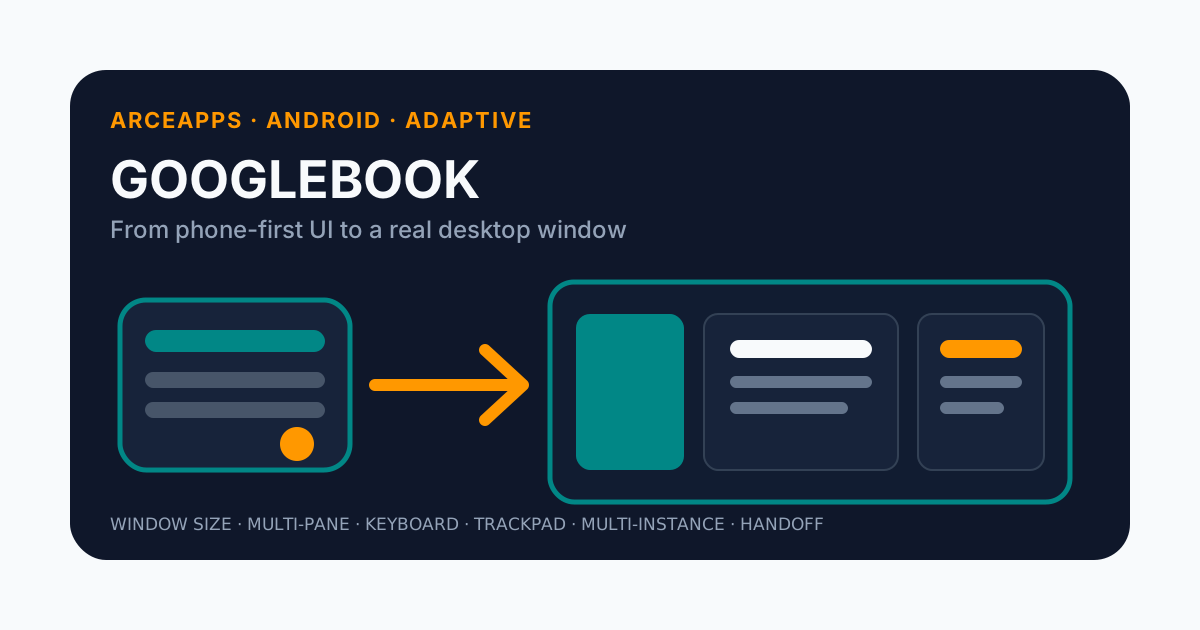
Googlebook: Adaptive Android Reaches the Laptop
Learn how to prepare an Android app for Googlebook with adaptive UI, freeform windows, keyboard, trackpad, multi-instance workflows, and device continuity.