
Overcoming Imposter Syndrome as a Developer in 2026

Table of Contents
“I don’t belong here. Eventually they’ll realize I don’t know anything.”
If you’ve ever had this thought, you’re not alone. It’s called Imposter Syndrome, and in 2026 it’s hitting developers harder than ever. Why? Because now, we’re not just comparing ourselves to other humans, we’re comparing ourselves to AI models that have read every existing documentation page.
This article is the expansion of the one I originally published on February 10, 2026 with only 360 words. I’m rewriting it five months later with perspective, data, and a concrete framework that’s worked for me (and for people close to me). If you’re feeling this pressure right now, keep reading.
The “AI Effect” Isn’t the Same as Classic Imposter Syndrome
When a Junior Developer sees Claude 4.6 generate a perfect Jetpack Compose screen in 5 seconds, it’s easy to feel obsolete. “If a machine can do this, what’s my value?”
The quick answer is: your value is elsewhere. The long answer, the one that actually helps, requires separating two things that imposter syndrome usually mixes:
- Classic imposter syndrome (Clance & Imes, 1978): chronic feeling of not deserving your achievements, attributing success to luck or timing, fear of being “found out”. It existed before IDEs.
- “AI Effect” (2023+): new feeling, specific to the era of generative models, where the comparison is no longer with your team colleague but with a system that produces competent output in seconds.
The difference matters because the treatment is partially different. The first is addressed with inner work (therapy, journaling, Brag Document). The second also requires redefining the yardstick for what it means to be a good developer in 2026. Journaling is useless if your yardstick is still “write code fast”.
Why AI Amplifies Imposter Syndrome (Doesn’t Create It)
AI didn’t invent imposter syndrome. What it did was give it an external enemy to compare yourself against almost daily. Before, the “impostor” looked at their human colleagues and thought “Juan knows way more”. Now, they look at the model’s output and think “the machine is better than me at my thing”. The problem is that the machine isn’t doing the same thing you are, even if at first glance it looks like it. When you internalize this, the effect diminishes.
You Are the Architect, Not the Bricklayer
For decades, we equated “being a developer” with “writing syntax”. That was the bricklayer part. Now, AI lays the bricks. Your job is to decide where the wall goes, why we’re building it, and whether it’ll withstand an earthquake (scalability/security).
Your value is in:
- Context: Understanding the business domain. AI doesn’t know why your client hates green colors. You do.
- Constraints: Knowing that the “perfect” solution won’t work on low-end devices, on 3G connections, on 2019 Android tablets, or in your country’s regulatory context.
- Correction: Fixing the subtle bugs AI introduces. This isn’t going to change. AI writes the first 80% fast; the last 20% is still ours.
One way to visualize it: AI is a glorified search engine that also writes prose. Your job is still the same as always: think before generating, validate after generating, and take responsibility for what ships. No model automates that, and none will in 2026.
The Learning Treadmill
The volume of new technology (Android 16, KMP, AI Agents) is overwhelming. You can’t learn it all. Accepting this is liberating.
Instead of trying to memorize APIs (which AI can do), focus on First Principles:
- How does HTTP work? (request/response, headers, status codes, caching)
- What is concurrency? (threads, locks, race conditions, Java’s memory model)
- How do databases index data? (B-trees, indexes, query plans)
- How is a program compiled? (parsing, AST, bytecode, JIT)
- What does “thread-safe” mean in practice?
These fundamentals don’t change every year. Android 17 will still use the same concurrency principles as Android 5. Investing in first principles is the only bet that stays profitable decade after decade.
The anti-pattern: AI-augmented “tutorial hell”
The classic “tutorial hell” was tutorial after tutorial without building anything of your own. The 2026 version is “AI-augmented tutorial hell”: asking AI to generate the next tutorial, the next snippet, the next “explanation”. The result is the same — you know a lot, build nothing — but now you don’t even have to read.
The cure is the same as always: build something of your own, no matter how small. An app your grandmother publishes on Google Play. A script that automates something at work. A bot that tells you the weather. Whatever. Building kills the impostor faster than any reading.
The “Brag Document”: Why It Works and How I Implement It
Document Your Victories: Maintain an “Achievements Document” (Brag Document). Write down every bug you fixed, every feature you shipped. When you feel down, read it.
Sounds like LinkedIn advice. It isn’t. It’s been used in the industry for three decades and works for one concrete reason: imposter syndrome is a selective memory update problem. Your brain vividly remembers the last bug you couldn’t solve, and forgets the 47 you solved last week. The Brag Document is an external memory that compensates for that bias.
How I implement it (and it works)
It’s not a diary. It’s a list, in a single document, with this structure per entry:
## 2026-07-15 — RadioHub: equalizer without metallic clicks

**Context**: Client reported "clicks" when equalizer activated cold.
**What I did**: Implemented a reactive controller that postpones equalizer
activation until ExoPlayer's Session ID is fully established.
**Impact**: Eliminated 100% of reported clicks. A Play Store review went
from 3★ to 5★ for this fix.
**What I learned**: Initialization order matters more than algorithm.
Max 5 minutes per entry. If it takes longer, you’re not doing it in real-time. The point is to write it the same day, when the memory is fresh. Re-reading it every Sunday night, before bed, is the part that changes the effect.
Don’t publish it on social media. That turns it into vanity. It’s private, for you.
Practical Steps That Actually Work
- Document Your Victories (Brag Document). 5 minutes at the end of the day. Every day. No exceptions.
- Talk about it. Mention it to a colleague. 90% of the time, they’ll say: “Me too”. The other 10% will tell you something even more useful.
- Teach someone. Mentoring a junior (or writing a blog post) reminds you how much you actually know. If you can explain something, you understand it.
- Measure output, not perception. Keep an objective counter of what you produce: PRs merged, features shipped, issues closed. Numbers don’t lie. Your head does.
- Find a “brag buddy”. Someone with whom you can exchange Brag Documents once a month. External validation works, even if culturally we struggle to admit it.
A fifth step that almost nobody recommends and should: find a therapist. Imposter syndrome isn’t a bug, it’s a feature of an emotional system that malfunctions under certain conditions. A professional helps you in months what self-help takes years. It’s not weakness, it’s maintenance.
When “Imposter Syndrome” Isn’t Imposter (A Caution)
There’s a borderline case that deserves its own paragraph. Sometimes what we call “imposter syndrome” is actually “incompetent syndrome”: your intuition is detecting a real skills gap that you don’t want to admit. The clearest signal: the feeling isn’t diffuse (“I don’t know anything”), but specific (“I don’t know Kubernetes and my job requires it”). If so, the solution isn’t journaling, it’s concrete training. Distinguishing one from the other requires brutal honesty.
Conclusion
You’re not an impostor. You’re a professional navigating the most changing industry in history. The fact that you care enough to worry about your competence is proof you’re exactly where you need to be.
If I had to leave you with one idea: redefine your yardstick before measuring yourself with it. If your yardstick is “write syntax fast”, AI always wins. If your yardstick is “understand the problem, decide the solution, and take responsibility for the outcome”, AI still doesn’t know how to do that. And it won’t in 2026.
Bibliography and References
- Effective Mentorship: A Senior’s Guide in the Era of AI — The flip side of the coin: when you’re already senior and you have to help juniors who feel exactly this.
- Junior to Senior: The Art of Prioritizing and Saying ‘No’ — The soft skills imposter syndrome prevents you from seeing you already have.
- Feeling Good — David Burns. The classic cognitive therapy book. The “Brag Document” is a modern version of his “Daily Record of Dysfunctional Thoughts” (the “Achievements Table” of his original).
- The Imposter Cure — Dr. Sameera Moussa. Modern treatment of imposter syndrome specifically for tech professionals.
- Hacker News thread on AI and Imposter Syndrome (2025) — Real discussions showing that you’re not alone. The feeling is epidemic in 2026.
You might also be interested in
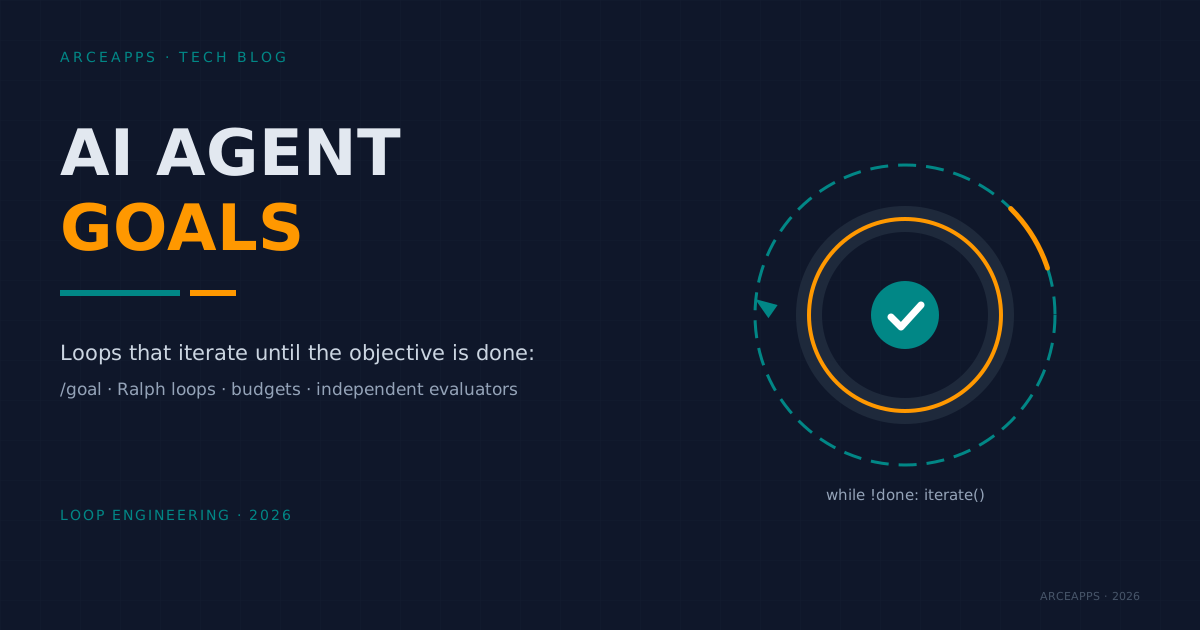
AI Agent Goals: Loops That Iterate Until Done
How to hand an AI agent a verifiable goal and let it iterate alone: /goal, Ralph loops, turn budgets, independent verifiers and real failure modes.
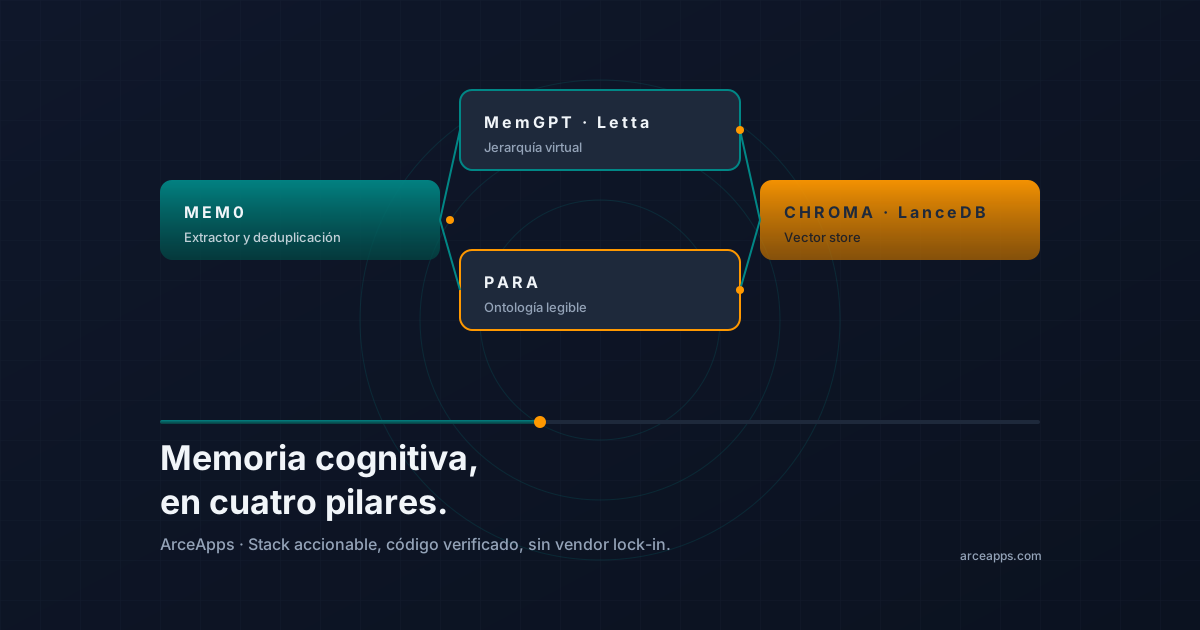
Mem0 & MemGPT: Cognitive Memory Stack for AI Agents
Build a cognitive memory stack for AI agents using Mem0, MemGPT/Letta, PARA, and Chroma or LanceDB. Actionable architecture with verified code.
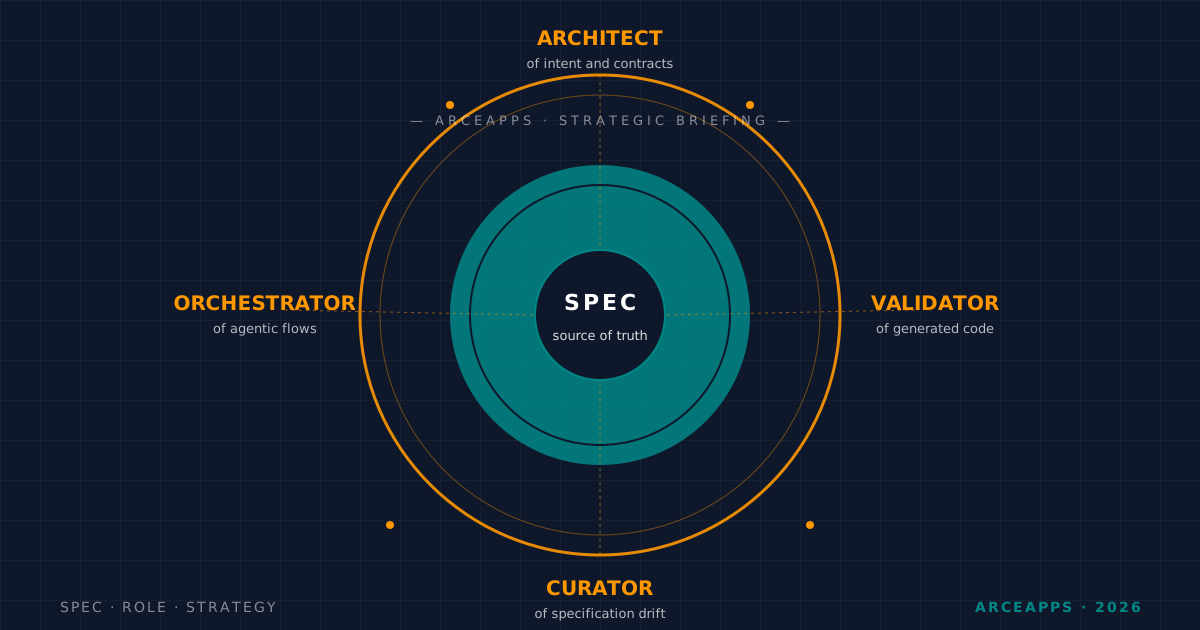
Spec-Driven Development: The Developer Role Redefined
How Spec-Driven Development flips the developer from typist to architect of intent. Inside the 40-60% waste map, the three maturity levels, and the Spec-as-Source role shift that ends vibe coding.