
Table of Contents
🤖 The Evolution: From “Suggesting” to “Acting”
Until 2024, tools like GitHub Copilot operated under the “Copilot” paradigm: you drive, it suggests. It saved you from writing boilerplate, but you had to know where to put it.
In 2025, we have entered the era of Autonomous Agents. Tools that not only suggest code but have permission to:
- Read your entire project.
- Create and edit multiple files simultaneously.
- Execute terminal commands (compile, run tests).
- Read errors and fix them automatically.
🖱️ Cursor & Windsurf: AI-Native IDEs
Cursor (a VS Code fork) popularized the concept with its “Composer” mode (Cmd+I). You no longer write code; you write high-level instructions:
“Refactor the authentication module to use JWT instead of sessions, and update all affected tests.”
Cursor analyzes the context, proposes changes across 10 files at once, and you just review and accept (Tab, Tab, Tab).
Windsurf (by Codeium) took this a step further with “Cascade”, an agent that deeply understands your application’s data flow.
🛠️ Cline (ex-Claude Dev): The Open Source Agent
If you prefer sticking with standard VS Code, Cline is the star of the moment. It is an open-source extension that acts as an autonomous junior software engineer.
What’s impressive about Cline is its ability to use tools. You give it a task and it:
- Analyzes the file structure (
ls,cat). - Proposes a plan.
- Writes the code.
- Executes
npm test. - If the test fails, it reads the error and fixes it.
- It asks for confirmation only when the work is ready.
🏠 The Winning Combo: Local + Private
The best thing about Cline is that it is model-agnostic. You can connect it to Claude 3.5 Sonnet (currently the best for code) or, for maximum privacy and zero cost, to a local model via Ollama.
Imagine having DeepSeek-R1 running on your machine, connected to Cline, working on your Jira issues without a single line of code leaving your local network.
🔌 MCP: The Connection Standard
Anthropic recently introduced the Model Context Protocol (MCP). It is an open standard for LLMs to connect to external data sources securely.
Previously, connecting an LLM to your Postgres database required custom code. With MCP, you simply “plug in” your database, your Git repository, and your Google Drive to the agent, and it has full context of your business, not just your code.
🚀 What Does This Mean for You?
The role of the developer is shifting from “code writer” to “architect and agent reviewer”.
- Key Skill 2024: Writing good clean code.
- Key Skill 2025: Describing complex problems clearly and auditing code generated by agents.
Do not fear replacement; fear being stuck with tools from two years ago while your competition builds software 10 times faster.
📚 Bibliography and References
For the writing of this article, the following official and current sources were consulted:
- Cursor Blog: The Future of Coding with AI - Cursor.sh
- Cline Repository: Autonomous Coding Agent for VS Code - GitHub - Cline
- Anthropic MCP: Introducing the Model Context Protocol - Anthropic News
- Ollama: Running Large Language Models Locally - Ollama.com
You might also be interested in
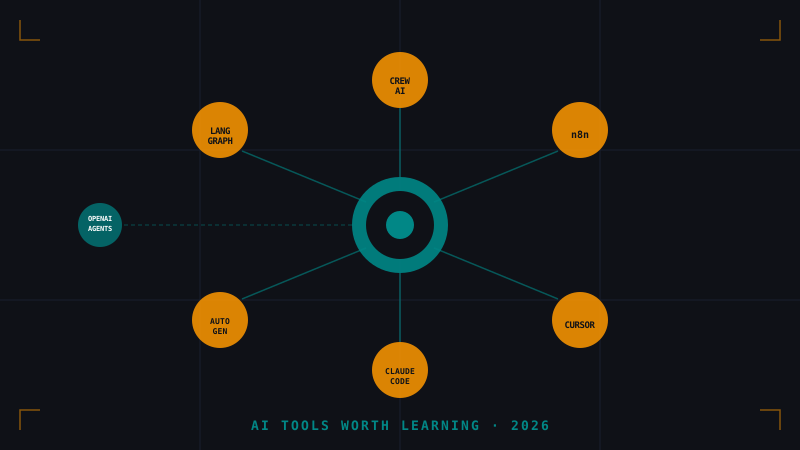
AI Tools Worth Learning in 2026: Investment vs. Hype
LangGraph, CrewAI, n8n, AutoGen, Cursor, Claude Code, OpenAI Agents SDK — a community debate emerged about which of these will still exist in a year. Here's an honest breakdown.
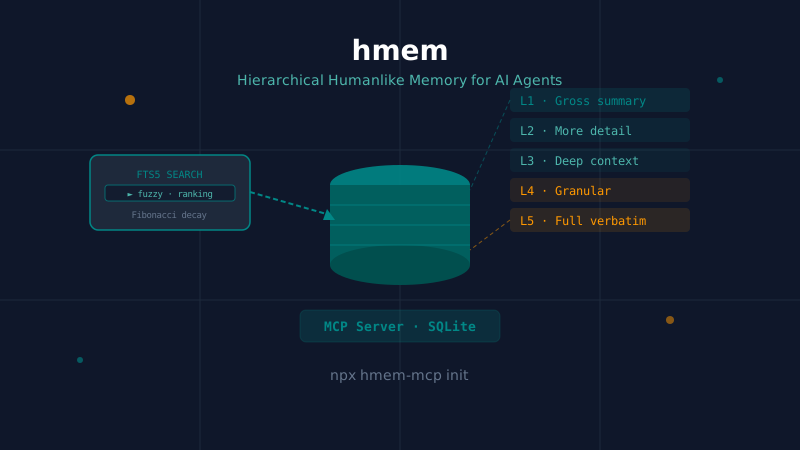
hmem: Hierarchical SQLite Memory for AI Agents That Actually Persists
A technical deep-dive into hmem (Humanlike Memory), an MCP server that models human memory in five lazy-loaded levels backed by SQLite + FTS5. How Fibonacci decay, logarithmic aging, and a curator agent solve the context window problem across sessions and machines.
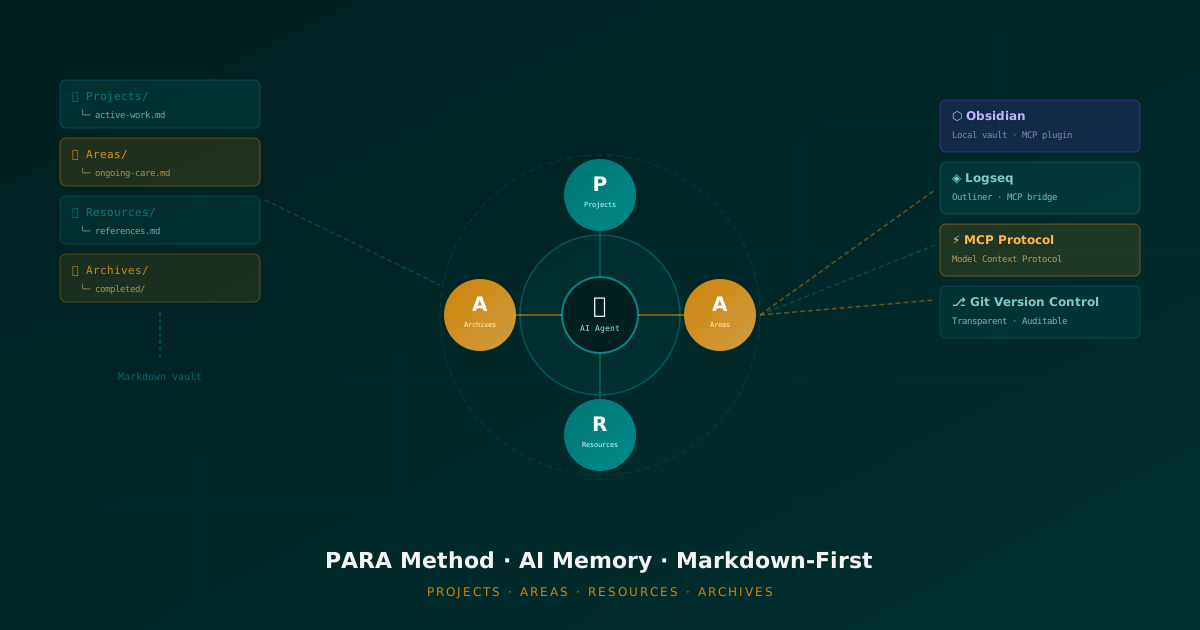
The PARA Method and File-Based AI Memory: Transparency, Obsidian, and the Markdown-First Architecture
A deep dive into using the PARA method (Projects, Areas, Resources, Archives) as a cognitive scaffold for AI agent memory. How Markdown files, Obsidian, and Logseq via MCP create transparent, human-editable memory systems that actually persist.