

Table of Contents
🧪 Testing DeepSeek R1 for Coding
DeepSeek R1 has been making waves as a powerful, open-weights reasoning model. But how does it fare in real-world coding scenarios? I put it to the test with a mix of complex Android tasks, algorithmic challenges, and refactoring jobs.
🧠 Reasoning Capabilities
Strengths
- Chain of Thought (CoT): R1 excels at breaking down problems. When asked to implement a complex algorithm, it explains its thought process clearly before writing code. This is invaluable for debugging the model’s logic.
- Context Retention: Handles long code files surprisingly well for its size (compared to GPT-4).
- Instruction Following: Strictly adheres to formatting rules (e.g., “Use Kotlin 1.9 syntax”, “No Java”).
Weaknesses
- Hallucinations: Occasionally invents APIs, especially for newer libraries like Jetpack Compose 1.7+. It confidently suggests modifiers that don’t exist.
- Verbose Output: Sometimes it explains too much, burying the actual code solution.
💻 Code Quality: Kotlin & Android
Clean Code
The code style is generally idiomatic. It uses modern Kotlin features like sealed interfaces, Flow, and extension functions correctly.
// Generated by DeepSeek R1 - Example
sealed interface UiState {
    data object Loading : UiState
    data class Success(val data: List<Item>) : UiState
    data class Error(val message: String) : UiState
}
Android Specifics
- Jetpack Compose: Good understanding of basic composables and state hoisting. Struggles with complex layouts (ConstraintLayout in Compose) and experimental APIs.
- Coroutines: Correctly uses
viewModelScopeand structured concurrency. Rarely forgets to switch dispatchers for IO.
🆚 Comparison: R1 vs. Claude 3.5 Sonnet vs. GPT-4o
| Feature | DeepSeek R1 | Claude 3.5 Sonnet | GPT-4o |
|---|---|---|---|
| Reasoning | High (CoT) | Very High | High |
| Creativity | Moderate | High | High |
| Code Accuracy | Good | Excellent | Excellent |
| Speed | Moderate | Fast | Fast |
| Cost | Low (Open) | High | High |
🛠️ Use Cases for R1
- Code Explanation: “Explain this complex regex or SQL query.” R1 shines here due to its verbose CoT.
- Test Generation: “Write unit tests for this ViewModel covering edge cases.” It’s great at identifying edge cases.
- Refactoring Ideas: “Suggest improvements for this legacy Java class.” Good at spotting potential issues.
⚠️ The Verdict
DeepSeek R1 is a formidable contender, especially considering its open nature. It’s not quite at the level of Claude 3.5 Sonnet for pure coding accuracy (“one-shot perfect code”), but its reasoning capabilities make it a fantastic pair programmer.
Recommendation: Use it for brainstorming, understanding complex logic, and generating tests. Always verify the API calls it suggests for bleeding-edge libraries.
You might also be interested in

Reasoning Models: From o1 to R1
The evolution of reasoning in AI. How OpenAI's o1 and DeepSeek's R1 compare. Chain-of-Thought prompting and the future of coding agents.
Reasoning Models (o1, R1): Why Prompt Engineering is Dying
The arrival of OpenAI o1 and DeepSeek R1 marks the end of complex 'Prompt Engineering'. Understand how reasoning models (System 2) work and when to use them.
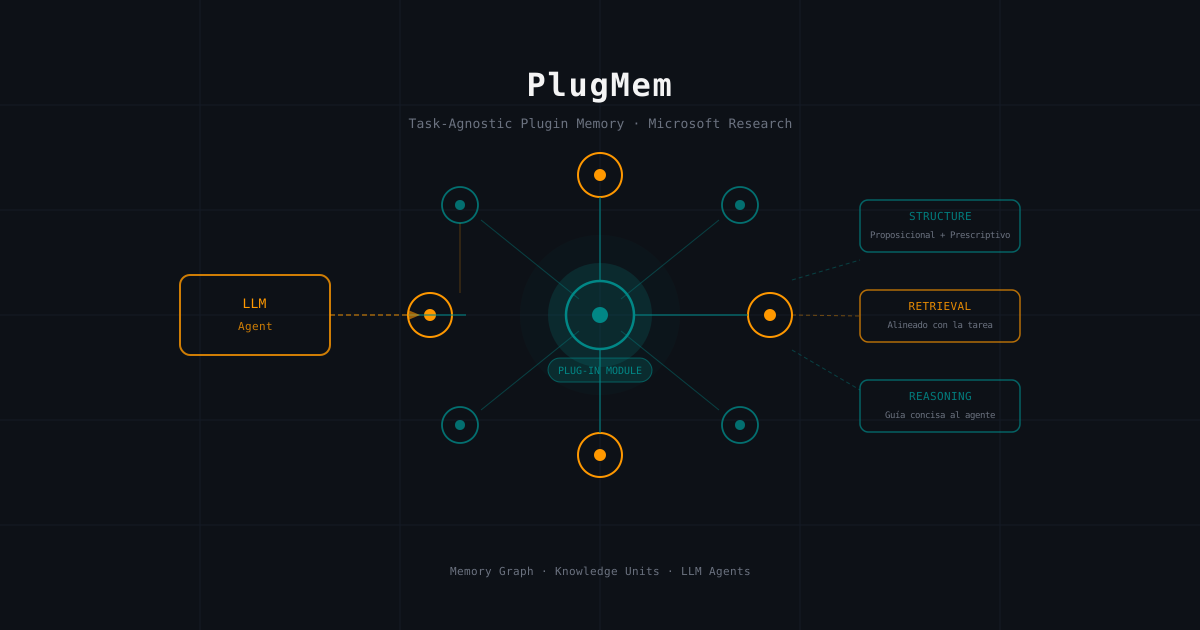
PlugMem: Microsoft Research's Task-Agnostic Memory Module That Every LLM Agent Needs
A technical deep-dive into PlugMem, Microsoft Research's plugin memory system that transforms raw LLM agent interactions into reusable structured knowledge. How its three-component architecture (Structure, Retrieval, and Reasoning) outperforms task-specific memory designs.