
Table of Contents
🌍 From Experiment to Industry Standard
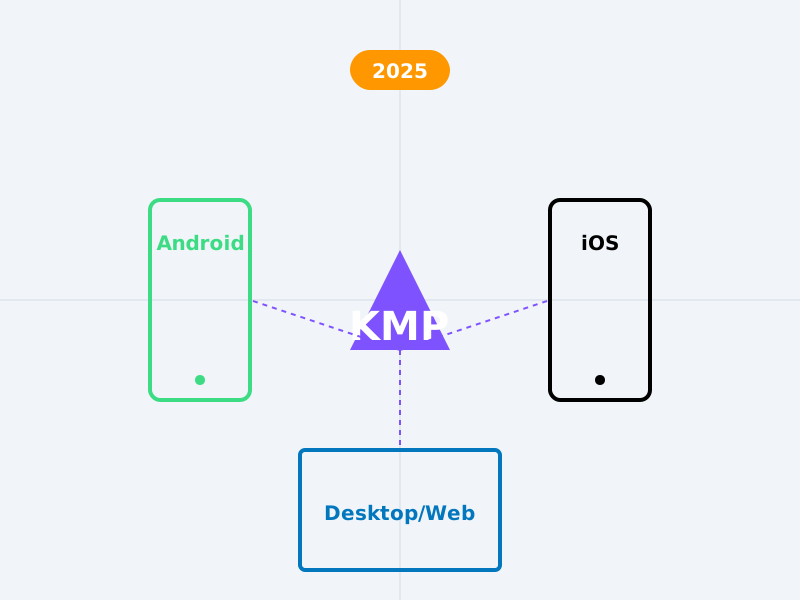
Two years ago, using Kotlin Multiplatform (KMP) was a risky bet. Today, in February 2025, the question is no longer “Should we use KMP?” but “Why are we not using KMP?”.
High-impact projects have migrated critical parts of their business logic to shared Kotlin, reducing code duplication by 40-60% without sacrificing native performance.
🎨 Compose Multiplatform: The “Game Changer”
What has really driven mass adoption this year is the maturity of Compose Multiplatform.
Until recently, KMP was great for sharing logic (Networking, Database, Analytics), but you had to write the UI twice: SwiftUI for iOS and Jetpack Compose for Android.
With Compose Multiplatform reaching remarkable stability on iOS (Solid Beta), you can now share the UI too.
// Shared code in commonMain
@Composable
fun UserProfile(user: User) {
    Column(modifier = Modifier.padding(16.dp)) {
        AsyncImage(
            model = user.avatarUrl,
            contentDescription = null,
            modifier = Modifier.clip(CircleShape)
        )
        Text(text = user.name, style = MaterialTheme.typography.h4)

        // Adaptive button
        Button(onClick = { /* ... */ }) {
            Text("Edit Profile")
        }
    }
}
This code renders using Skia on iOS, achieving pixel-perfect performance identical to Android. And the best part: if you need a specific native component (e.g., MapKit), you can easily interoperate with UIKitView.
🛠️ The Ecosystem has Matured
The biggest headache of KMP was finding compatible libraries. In 2025, the ecosystem is vibrant:
- Network: Ktor 3.0 is the standard.
- Database: Room now has official KMP support (Alpha/Beta), and SQLDelight remains rock solid.
- Dependency Injection: Koin annotations makes DI trivial in multiplatform.
- Images: Coil 3.0 is fully KMP.
You no longer have to “reinvent the wheel” or write expect/actual wrappers for everything.
🆚 KMP vs. Flutter vs. React Native
Why choose KMP in 2025?
- Real Performance: KMP compiles to native binaries. There is no JS bridge (React Native) or weird virtual machine (Flutter). On iOS, it’s just another Objective-C/Swift framework.
- Flexibility: You can share just the logic (100% native UI) or share everything (Compose). Flutter forces you to paint everything with its engine.
- Gradual Adoption: You can start by sharing just a small utility library in your existing app. You don’t need to rewrite everything from scratch.
⚠️ Not everything is rosy
There are still challenges:
- Tooling on iOS: Debugging Kotlin code from Xcode is still… improvable (although Fleet helps a lot).
- Binary Size: Including the Kotlin runtime on iOS adds a few MBs (negligible today, but existing).
- Learning Curve: Your iOS team needs to learn Kotlin and Gradle.
🎯 Verdict 2025
If you are starting a “Greenfield” project today, KMP with Compose is the most sensible default choice. It gives you the development speed of Flutter with the safety and performance of native development.
If you have giant native apps, KMP for the data layer is the best investment you can make to reduce bugs and development times by half.
📚 Bibliography and References
For the writing of this article, the following official and current sources were consulted:
- Kotlin Multiplatform: The State of Kotlin Multiplatform 2025 - JetBrains Survey
- Compose Multiplatform: Compose Multiplatform 1.8 Release Notes - GitHub Releases
- Google Developers: Sharing code with Kotlin Multiplatform - Android Developers
- Netflix Tech Blog: Switching to Kotlin Multiplatform - Netflix TechBlog
You might also be interested in

Advanced KMP: UI Sharing Strategies with Compose Multiplatform 1.8
Exploring complex navigation patterns and state management across Android and iOS using Kotlin Multiplatform in 2026.

Advanced Kotlin Flow: Operators and Patterns
Level up with Kotlin Flow. Master operators like combine, zip, flatMapLatest, and learn to handle complex reactive streams in Android.

Clean Architecture: The Ultimate Guide for Modern Android
Demystifying Clean Architecture: A deep dive into layers, dependencies, and data flow to build indestructible Android apps.