
Spec Kit 1.0: SDD Becomes Composable Workflows
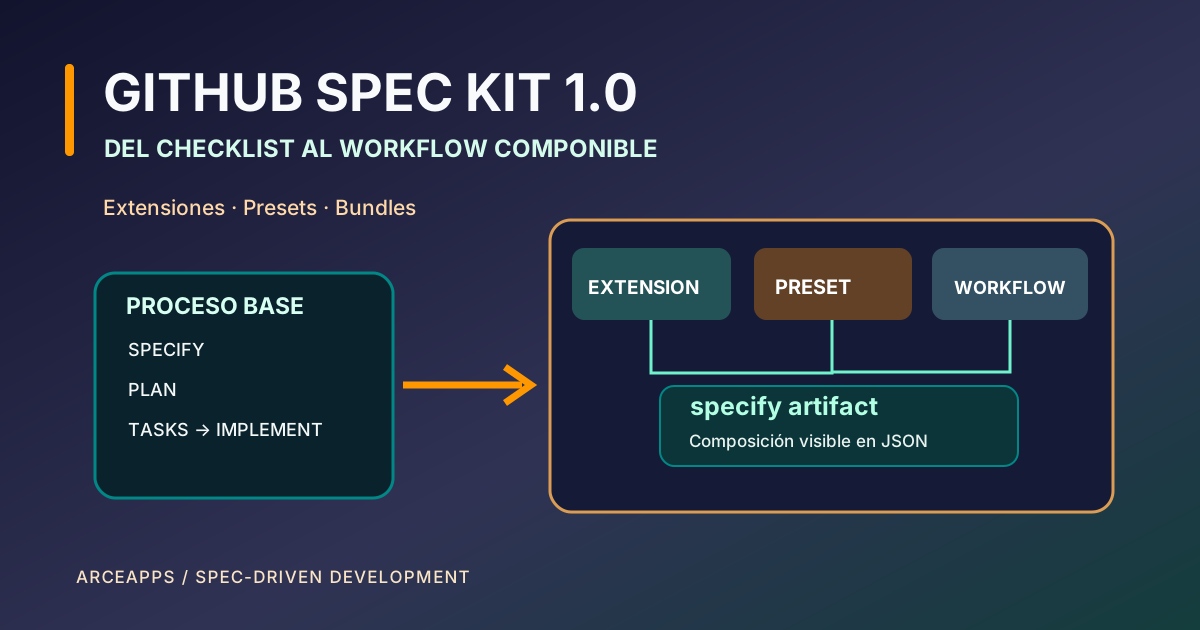
Table of Contents
Previously on ArceApps: the blog already has a comparison of GitHub Spec Kit, OpenSpec and BMAD and a foundational guide to Spec-Driven Development. Rather than repeating those pieces, this one examines what actually changed in Spec Kit 1.0 and the September releases, and whether its new architecture makes life easier for an independent developer.
When your development method starts looking like a framework
Spec-driven development begins with a sensible idea: before asking an AI agent to write code, describe what you need, what must not change and how success will be verified. The harder problems emerge after months of use, when each repository carries copied templates, partially overlapping skills, project instructions, forgotten review steps and several agents that interpret the same workflow differently.
GitHub Spec Kit provides one way to externalize that process. Its traditional sequence—constitution, specify, plan, tasks and implement—gave developers a recognizable structure for moving from intent to a code change. By version 1.0.0 in August 2026, however, the project was no longer interesting only as a set of prompts and command templates. It was growing into a platform for composing agent workflows out of separately maintained pieces.
The project’s official August and September newsletters document that transition. September alone brought eleven releases, numbered v1.0.3 through v1.0.13, as well as more expressive presets, reusable workflow slots, per-step integrations, artifact introspection and a campaign to harden how components are fetched and installed.
For an indie developer the important question is not whether we can install every new feature. It is whether any of those pieces reduce actual defects in the projects we build in our spare time. A configurable system is useful when it replaces repeated, fragile decisions. Otherwise we risk creating a second codebase dedicated to maintaining our process.
Version 1.0 was a milestone, not a promise to stop changing
A major version often suggests long-term stability. That assumption is unsafe here. The September newsletter explicitly describes a month of continued evolution: eleven patch releases between September 1 and 29, a wide CLI reorganization and new contracts for how component types interact.
None of that proves the tool is poorly maintained. Rapid iteration may reflect a healthy community addressing practical limitations. But anyone adopting Spec Kit should expect to pay attention to the exact version of its CLI, extensions, catalog entries and integration adapters. A working configuration is something to record and reproduce, not a property we should infer from a familiar 1.0 label.
The project also argues that agents can sometimes help accommodate breaking changes in generated workflows. That is a useful aspiration, but it is not a blanket compatibility guarantee. An automated migration can still misinterpret an old project file or silently select an inappropriate replacement.
When a personal project is only touched once every few weeks, upgrades need discipline. I would keep a known-good version, review release notes, and avoid reinstalling the newest catalog on the same day as a critical feature change.
For a small repository with a single agent, Markdown instructions plus existing tests may be enough. For a family of repositories sharing repeated constraints, a more expressive CLI may justify its maintenance cost. The size and uncertainty of the work—not the version number—should decide.
From one linear recipe to reusable primitives
It helps to split the system into two questions. The first is the order of work: understand intent, specify requirements, plan, implement, review and verify. The second is how the rules for that order are composed: which capabilities are available, which project conventions override defaults, which steps are reusable and how the final result can be inspected.
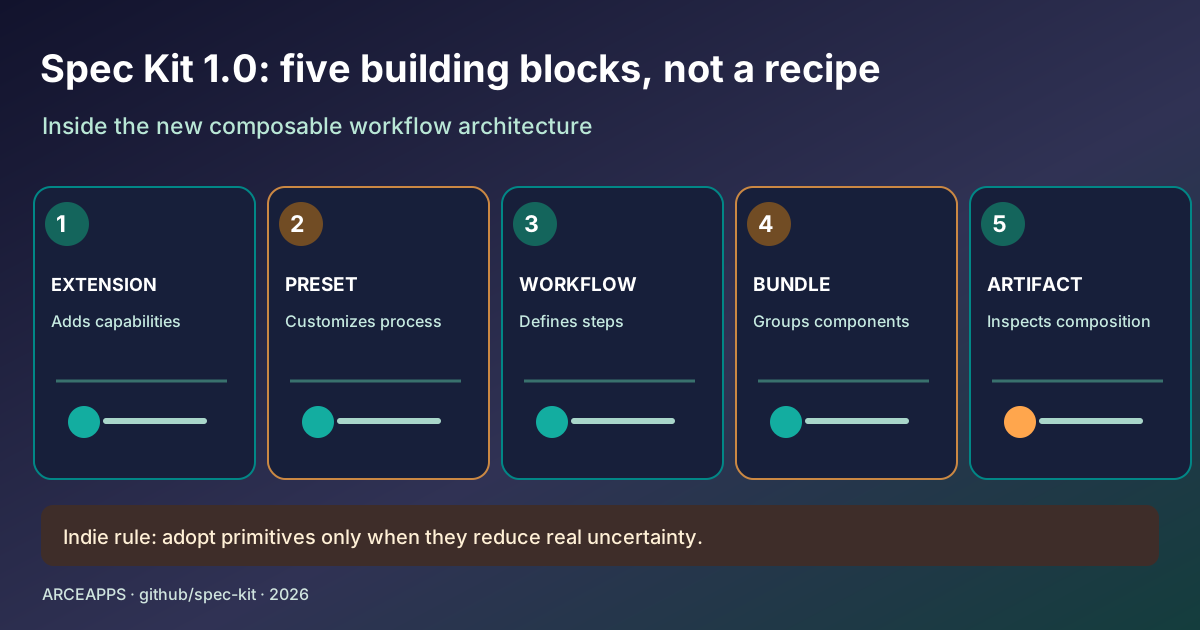
Spec Kit’s newer architecture describes five relevant primitives: integrations, extensions, presets, workflows and workflow steps. Integrations adapt the system to the chosen coding agent. Extensions supply specialized capabilities. Presets configure and combine resources for a context. Workflows define the sequence of work. Steps make that sequence granular enough to customize individual phases.
For a one-file bug fix this vocabulary is undoubtedly more complex than a checklist. The value emerges when the same concerns recur: security checks across projects, release rules shared by apps or requirements carried from one agent to another. In those situations, versioned reusable components may be more reliable than copying a folder of prompts and hoping every copy stays current.
Imagine an accessibility extension, a preset that requires it for front-end projects and a workflow that places the resulting gate before approval. The point is not adding three nouns; it is representing an architectural relationship that previously lived only in a maintainer’s memory.
A lightweight plan-and-tasks workflow remains a legitimate alternative. The framework earns its place only when those reusable boundaries save more effort than they create.
Extensions: adding capability at a deliberate stage
In older prompt-heavy setups, developers often write “remember to check security” or “verify accessibility” in a global instruction file. That may work until context changes, an agent ignores the line or the check is carried out without meaningful evidence. An extension can package a specific behavior and attach it to a known place in the process.
The September project report lists 176 community extension entries at the end of the month, fourteen more than at the start. New entries cover areas such as threat modeling, browser testing, requirement validation, product definitions and review. The number indicates breadth, not a quality certificate for every entry.
A valuable extension has understandable inputs, observable outputs and a failure condition independent of the agent’s confidence. “Security review complete” is not helpful if no check was performed and no evidence exists. Moving that sentence into a named package does not automatically make it more trustworthy.
In my own projects I would start by identifying recurring gaps. If GitHub Actions already validates a build, I do not want another extension that merely reruns the same command without adding coverage. If a useful check is repeatedly forgotten, and an extension performs it transparently, that is a more convincing reason to adopt it.
The community catalog is also a discovery mechanism, not an unconditional security endorsement. Review the component’s source, dependencies and privileges before enabling it in an agent that can touch real project files or credentials.
Presets: adapting the process without forking it
Presets configure and combine resources for a particular working style. Instead of maintaining separate copies of the core process for Android apps, static websites and command-line tools, a developer can express which checks and conventions are important in each context.
September introduced requires.extensions for presets. That addresses a common failure in extensible systems: a preset quietly assumes some other component exists, and the user discovers the missing dependency only after a confusing failure. Declaring that relationship makes it more visible to the installer and to diagnostic tooling.
There is a realistic indie use case. Suppose several Android applications share release policies, a design system and a handful of checks for permissions and persistence. A reusable preset could keep those expectations aligned. Updating a well-tested preset once may be safer than changing several manually copied instruction files.
The warning is that preset layers can multiply. A base preset, a language preset, a platform preset and a project-specific preset may interact in ways nobody clearly understands. At that point we are maintaining a configuration inheritance system rather than reducing effort.
I would only introduce a new layer when it represents a stable difference. A project with one special rule can keep it locally. A repeated contract across several repositories may justify packaging. Either way, an operator should be able to enumerate which rules are effective for a task without asking an AI model to guess.
Workflows: customizing named slots instead of copying everything
Reusable workflow slots were another September change. They allow defined insertion points rather than forcing users to replace an entire sequence to add one check. Related work introduced per-step integration configuration, so a step can use its own agent settings instead of inheriting a single set for the whole process.
Consider publishing a bilingual technical article. The base flow might research sources, draft a text, perform SEO checks, compile the site and publish. Our site also needs language-specific references, matching imagery and protection against leaking private notes into its public mirror. A controlled extension point could insert those checks without duplicating the entire publication workflow.
That sounds heavier than checking boxes in Markdown, because often it is. If you publish an article twice a year, a short checklist may be the right tool. If you repeat the same publication contract frequently, a defined workflow can reduce the risk that one important step is omitted.
The interesting engineering question is whether the composition makes the Definition of Done more observable. A workflow that ends with an agent saying “looks good” is not automatically more reliable because it is defined in a framework. It needs executable checks, relevant human review and a failure state that is actually respected.
I favor composing work where shared boundaries matter, not wherever a catalog offers a component.
Workflow steps: smaller permissions, more coordination
Individual steps offer a finer unit of orchestration. Research may require web access but no write permissions. Code generation may need a workspace but no release credentials. Verification can run in CI without granting the model authority to modify tests after they fail. Publishing may require an explicit approval gate.
This granularity can support least privilege. It also creates a record of which phase had access to which tools, and which evidence each phase produced. When several agents participate, those boundaries can reduce the chance that one unexpected response changes the next phase’s permissions.
There is a price. More steps mean more state, handoffs, possible incompatibilities and places where an operation can fail. If the framework hides context transformations or makes one agent dependent on an opaque chain of other agents, you may lose the ability to understand what happened.
I evaluate a proposed step by asking: what real failure does this separation prevent, and could a simpler test or checklist prevent it just as well? If the answer is “nothing measurable,” the step may not deserve to exist. If the answer is “the research phase must never publish a secret,” the extra boundary may be well worth maintaining.
A composable process succeeds when it makes authority and evidence clearer, not simply when it has more moving parts.
Bundles: sharing a collection with a coherent purpose
Bundles let users distribute related pieces as a group. September’s newsletter reports three community bundles, including one targeting multi-vendor architecture practices. This is useful for distributing a coherent working approach, especially when the components have documented relationships.
Presets with declared dependencies and bundles solve related but different problems. A preset describes how behavior should change and which capabilities it expects. A bundle packages components that belong together. A workflow defines when they execute. Keeping those distinctions helps avoid treating every directory in a plugin repository as interchangeable.
Convenience does introduce a supply-chain concern. Installing a group of extensions may bring in capabilities you would never have chosen individually. A component can extend an agent’s access to shell commands, context, remote APIs or project directories.
Before using a bundle, inspect what is actually included and which components are necessary. Prefer the smallest set that solves the problem. Pin compatible releases and keep a record of what was installed.
This is particularly important for a private-to-public publishing workflow. A bundle that writes internal notes or credentials into the public source tree can undermine an otherwise sound mirror policy. The release boundary has to be checked against real generated files, not merely the directory names that the framework expects.
specify artifact: explaining what the project actually loads
One of the most interesting September additions is specify artifact. The project’s release report describes an introspection surface that exposes composition stacks as JSON, then extends that output to hook contributions, runtime bindings and the artifact that owns each contribution.
Why does this matter? Because complex configuration systems eventually become difficult to observe. You install an extension, apply a preset, upgrade an integration and later notice that a familiar task behaves differently. Without an effective view of composition, diagnosis can require reading several unrelated files and guessing their precedence.
A machine-readable description could make the system easier to audit. In principle, a tool could compare effective components before and after an upgrade, identify missing dependencies or record which hooks were active when an agent produced a PR. These are plausible uses of the exposed structure, not proof that the base command performs every audit automatically.
If I were adopting Spec Kit today, I would keep the output alongside the CLI and component versions used in a reproducible experiment. Then I would check whether the result is understandable to a human reviewer. A giant JSON object that only another LLM can interpret may still be too opaque for dependable engineering.
Observability is especially valuable when the entire purpose of the platform is to manage complexity through composition. Without it, reusability can become a convenient way to hide the causes of a regression.
Integrations: supporting an agent does not prove feature parity
The official integration catalog grew to 42 entries by the end of September, according to the project newsletter. New additions included Docker Agent, DeepSeek Harness, Muse Code and MiniMax Code. The DeepSeek entry is notable alongside our recent look at its desktop application: the same specification vocabulary can potentially travel across very different runtimes.
That portability is useful, but there is a distinction between having an integration and achieving equivalent behavior. Agents differ in their tools, permission prompts, command syntax, model settings, context management and ability to run or inspect code. A common spec cannot erase those differences.
In a comparative experiment I would hold the acceptance criteria constant and document each integration’s effective capabilities. Then the outputs can be evaluated against independent tests. Without those controls, a performance difference could come from a tool permission, not the model or the specification.
The long-term value is that intent becomes a versioned asset not owned by a single provider. Even if a preferred coding tool changes, the project’s decisions and acceptance cases remain readable.
For a solo developer using one reliable agent, however, maintaining five integrations may add more work than it saves. Portability should answer a concrete risk, such as vendor lock-in or reproducibility, rather than become a collection hobby.
Security hardening matters more than catalog growth
September also saw significant security work around the component supply chain. The release newsletter lists tag-pinned catalog download URLs, checks on release-asset metadata, pinned component verification inside bundles, checksum validation and efforts to close time-of-check/time-of-use race windows.
These are not glamorous features, but they are the kinds of improvements a composable system needs. An extension may contain executable code, influence a model’s prompt or steer another tool’s decisions. Its integrity and provenance matter even when the package appears to be “only instructions.”
Pinning a tag reduces unexpected drift; a checksum helps confirm that the downloaded artifact matches an expected artifact. Neither measure proves that the publisher is trustworthy or the code is safe. They reduce specific failure classes within a broader trust model.
I would document each installed extension’s source, version, purpose and authority. I would also use exact catalog release selection where available, rather than allowing an unrelated change to alter a working project.
A healthy extension ecosystem is not measured only by how many entries it contains. It is measured by how well ordinary users can discover, validate, update and revoke those components while preserving their project boundaries.
The Azure Cosmos DB example: evidence with important caveats
September also brought a public-preview Azure Cosmos DB extension developed by Microsoft. It demonstrates how a domain-specific package can insert knowledge into a broader workflow: guidance on partitioning, request units and indexing can be attached to before- and after-implementation phases rather than pasted into every prompt.
The Spec Kit September newsletter reports that the Cosmos team measured an improvement of roughly ten percentage points in certain best-practice-conformance metrics. Crucially, the same summary notes that the overall result was approximately on par with Spec Kit alone in some end-to-end comparisons and still required human review.
That nuance is far more useful than the claim that a domain extension automatically guarantees production-quality database code. A package may improve a selected metric without dominating every measure of quality. Results depend on task selection, baseline behavior and evaluation criteria.
For a developer who does not use Cosmos DB, the extension is not immediately relevant. It is interesting as a pattern: specialized technical guidance inserted into a general process through a composable interface.
If a similar extension emerges for Android permission design, accessible UI or static-site SEO, I would evaluate it with the same caution. Does it detect mistakes our existing checks miss? How much maintenance does it add? Can we reproduce its claimed improvement?
Reddit’s warning: the ceremony can become expensive
One September discussion in r/SpecDrivenDevelopment describes Spec Kit as overengineered for smaller tasks and expensive in tokens. Some participants prefer OpenSpec or a custom lightweight flow, perhaps with a grilling session to clarify requirements. Other users value the persistent, portable context of Spec Kit when tasks are large or cross-agent.
These are personal experiences rather than randomized studies. We should not infer a universal productivity penalty from a handful of posts, nor dismiss feedback merely because it is anecdotal. The recurring tension is useful: stronger structure can protect important decisions while slowing down ordinary maintenance work.
I particularly like the suggestion to borrow ideas from frameworks and create a workflow that fits the work being done. That is not an excuse to abandon acceptance criteria. It is a reminder to keep the verifiable contract and remove process that does not improve the outcome.
Actual costs include model tokens, human review time, unused documents, maintenance of templates and regressions avoided. A methodology that generates a large amount of tidy Markdown may look productive while leaving all important uncertainty unresolved.
The right comparison is with the smallest alternative that could reliably satisfy the same task—not with unstructured prompting at its worst.
Adopting 1.0 in an existing codebase
I would not introduce Spec Kit to a mature repository by trying to document every subsystem. I would first inspect the architecture, existing GitHub Actions and recent failures. Next I would choose one bounded feature whose success conditions are meaningful and whose risk is low enough for a workflow experiment.
Start with the core process, without community presets or extension bundles. This provides a baseline for the useful parts of the method: a versioned description, a plan, tasks, tests and review. Then pick one recurring failure that an additional component might prevent, and measure whether it actually helps.
Only after that would I introduce a reusable preset or a workflow slot. When three repositories repeat the same release checks, packaging them can reduce divergence. When one repository needs one special rule, a local versioned instruction is likely clearer.
Define the intended improvement before adding the tool: less human review, fewer regression failures, better reproducibility or easier switching between agents. “Use more of Spec Kit” is not a product goal.
The best onboarding is gradual and reversible. Every new abstraction should make the next maintenance task easier, not become another dependency that prevents anyone from understanding the existing code.
When a two-file SDD method is the better fit
A lightweight process can be as simple as a plan describing objective and decisions, a checklist of tasks, a focused change, existing CI and a final diff review. In a personal repository this is often enough. The files survive context resets, are easy to inspect and do not require learning an additional workflow engine.
Its main advantage is transparency. Anyone can read what remains to be done. Verification belongs in conventional tests and GitHub Actions. If a change fails, the reviewer has a direct path to the relevant code and evidence.
The weakness appears when the same expectations are copied across many projects and begin to diverge. Reusable Spec Kit components may then be worthwhile, especially if introspection explains which exact combination was active at a given point.
Neither approach is automatically superior. The smallest process that reliably solves today’s problem should usually win. A composed platform becomes attractive when it consolidates recurring complexity into a more controlled and observable configuration.
Choosing less framework is not a lack of engineering rigor. It can be the result of applying engineering rigor to the maintenance cost of the framework itself.
A comparison worth running rather than inventing
To determine whether Spec Kit 1.0 improves an indie workflow, I would start two branches at the same commit and use a task with acceptance criteria established independently of the coding agent. Branch A uses a lightweight plan and task list. Branch B uses Spec Kit with documented components. Model, permissions, budget and time limits stay as close as possible.
Measure executable tests passed, scope violations, human review minutes, model usage, retries and how understandable the result remains after a context reset. Repeat scenarios with small and complex features. Also count time spent upgrading the method or repairing integration issues.
A mixed outcome would be informative. A heavier process may reduce missed edge cases in complex features and waste time on trivial fixes. The evaluation should allow that conclusion rather than force a winner across incompatible task types.
I have not run that controlled comparison for this article. The plan is reproducible, but publishing invented benchmark numbers would be worse than admitting what has not been tested.
Claims of superiority should survive the discipline that these frameworks encourage: explicit conditions, independent evidence and transparent limitations.
Frequently asked questions
Does Spec Kit 1.0 replace OpenSpec or BMAD?
They overlap in purpose but differ in philosophy, depth of composition and operating cost. Spec Kit 1.0 brings a larger modular ecosystem; OpenSpec has a comparatively lightweight proposal-oriented process; BMAD organizes work through another set of roles and stages. Evaluate real tasks rather than feature-count tables.
What does specify artifact offer?
A machine-readable surface describing project composition and artifact contributions. It can support inspection and other tooling, but does not automatically prove that every installed extension is safe or correct.
Does it integrate with DeepSeek Harness?
The September newsletter lists DeepSeek Harness among the added integrations. Check the installed Spec Kit version, adapter requirements and actual capabilities of the DeepSeek runtime before relying on it in a project.
Do I need huge specifications?
No. The appropriate amount of documentation depends on risk and ambiguity. A trivial change may need a clear goal, a relevant test and a diff review. A permission or database migration may justify a fuller contract and additional checks.
Conclusion: a platform matters when it clarifies the contract
Spec Kit 1.0 is an interesting transition from familiar SDD commands to a configurable platform. Extensions, presets, bundles and workflows can compose, while a machine-readable introspection surface makes the effective configuration more observable. August and September show genuine technical progress in both flexibility and supply-chain hardening.
That architecture is not an argument for applying a complete ceremony to every tiny feature. Reddit’s critical feedback is useful: producing documents and consuming tokens does not equal shipping better software. A method should improve decisions, review and recovery where those improvements matter.
For an indie developer, I would begin with the smallest contract that prevents real mistakes, rely on existing tests and CI, then adopt additional primitives only when their value can be demonstrated. Rigor and simplicity are not opposing goals. They are the combination worth pursuing.
Bibliography
- GitHub Spec Kit source repository — code, releases and adapters.
- August 2026 official newsletter — 1.0 milestone and roadmap.
- September 2026 official newsletter — versions 1.0.3–1.0.13, primitives and security.
- Official Spec Kit documentation — concepts and workflows.
- Azure Cosmos DB extension announcement — preview, measured results and limits.
- Reddit: Spec Kit overhead discussion — practitioner perspectives, not benchmarks.
- Reddit: two months with Spec Kit — strengths and drawbacks.
- Previous ArceApps framework comparison and SDD primer — prior art.
Research completed on October 10, 2026; October 7 is the editorial date for this series. No installation or controlled benchmark is presented as personally tested.
You might also be interested in

DeepSeek Harness Desktop: A Practical Technical Review
Explore DeepSeek Harness Desktop, its plugin architecture, automation, installation, privacy controls and practical trade-offs for indie developers.
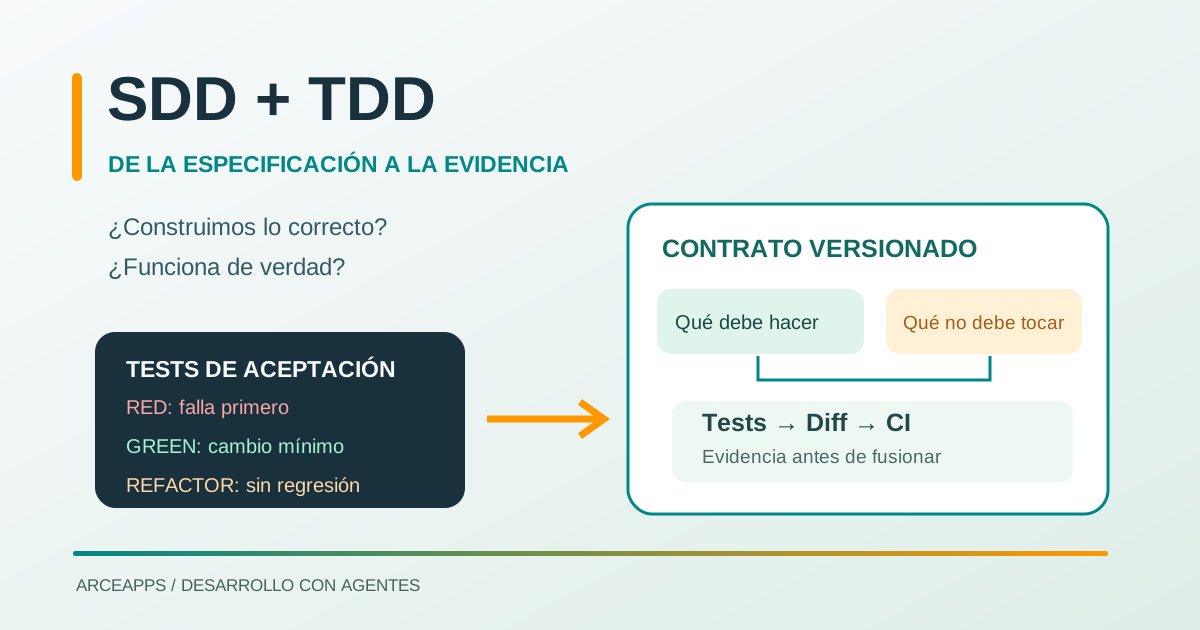
SDD + TDD: From Requirements to Verifiable Tests
Learn how to combine SDD and TDD with coding agents: lightweight specifications, acceptance criteria, Red-Green-Refactor and CI-backed evidence.
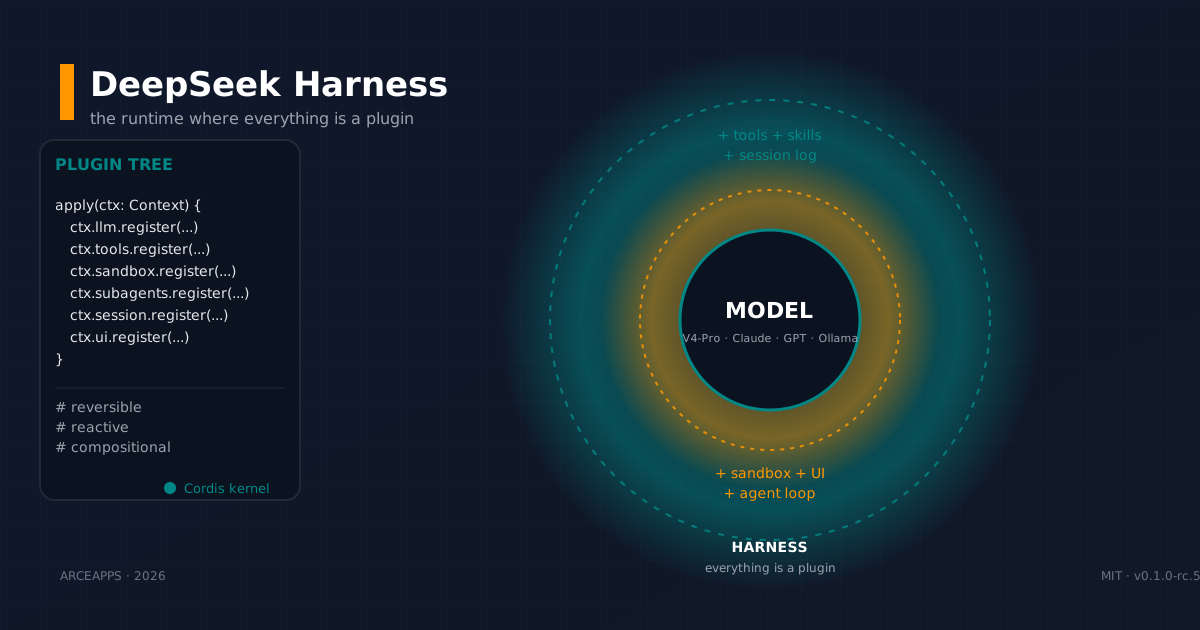
DeepSeek Harness: the runtime where everything is a plugin
DeepSeek Harness (dsh) is an MIT open-source runtime where model, tools, session, sandbox and even the loop are plugins. Deep-dive into Cordis, runtime modes, append-only session log and self-evolution.