
Table of Contents
The Rise of Agentic Frameworks in Production
The landscape of Artificial Intelligence has shifted dramatically. We are no longer merely chatting with Large Language Models (LLMs); we are engineering autonomous, reasoning entities capable of executing complex workflows, accessing external tools, and collaborating to solve multifaceted problems. These are what we call AI agents, and their integration into production environments requires robust, predictable, and scalable orchestration frameworks. The transition from simple conversational bots to fully autonomous agentic systems is perhaps the most significant leap in software engineering this decade.
As the demand for production-grade AI agents has surged, so has the ecosystem of frameworks designed to build and orchestrate them. Developers have moved beyond the wild west of raw prompt engineering and brittle API calls, seeking structured, maintainable, and type-safe abstractions. The discussions across developer communities—such as the vibrant debates in subreddits like r/LocalLLaMA—highlight a critical realization: not all agent frameworks are created equal, and the “best” framework depends heavily on the specific requirements of the production workload.
Today, a select few frameworks have emerged as the de facto standards for building agentic systems. LangGraph, CrewAI, PydanticAI, Smolagents, and Atomic Agents each offer unique philosophies, architectural patterns, and feature sets. Some prioritize complex, cyclical workflows and state management; others focus on multi-agent collaboration and role-playing; while some emphasize strict type safety, minimalism, and modularity. Understanding these nuances is crucial for any engineering team looking to deploy agents successfully.
In this comprehensive guide, we will conduct a deep technical dive into these five leading frameworks. We will explore their core architectures, key features, ease of installation, learning curves, and their readiness for production deployments. By analyzing practical code examples and comparing their strengths and weaknesses, we aim to provide a clear roadmap for selecting the right orchestration tool for your next AI project. Whether you are building a complex data analysis pipeline, an automated customer support system, or a collaborative research team of specialized agents, this guide will equip you with the knowledge to make an informed architectural decision.
The Evolution from Scripts to Systems
Initially, building an AI agent involved writing fragile scripts that chained together API calls, parsed JSON responses with regular expressions, and struggled with context windows. State management was often a messy affair of appending strings to a list. This approach quickly breaks down in production. Real-world applications require agents to maintain persistent memory, recover from errors, handle complex branching logic, and interact securely with external databases and APIs.
The new generation of agentic frameworks addresses these challenges by providing high-level abstractions. They introduce concepts like “Agents,” “Tasks,” “Tools,” and “Workflows.” They handle the intricate dance of context window management, token optimization, and structured output parsing. More importantly, they offer mechanisms for observability, debugging, and testing—essential requirements for any system deployed to real users. As we delve into LangGraph, CrewAI, PydanticAI, Smolagents, and Atomic Agents, keep these production requirements in mind. How well does each framework handle state? How easy is it to debug a failed agent interaction? How robust is the tool-calling mechanism? Let’s explore.
1. LangGraph: The State Machine Powerhouse
Developed by the team behind LangChain, LangGraph has rapidly established itself as a premier framework for building complex, stateful, and cyclical agentic workflows. While LangChain excels at linear pipelines (chains), LangGraph is designed to model agent interactions as directed graphs, specifically state machines. This architectural choice is profound; it allows developers to define complex routing logic, loops, and conditional execution paths that are difficult or impossible to represent with traditional linear chains.
Architecture and Philosophy
At its core, LangGraph relies on the concept of a shared “State.” The state is typically defined as a TypedDict (or a Pydantic model), representing the entire context of the application at any given moment. Nodes in the graph represent functions or agents that receive the state, perform some action (like calling an LLM or a tool), and return an updated state. Edges define the flow of execution between nodes, often utilizing conditional logic to determine the next step based on the current state.
This state-centric approach is LangGraph’s greatest strength for production environments. It provides a highly predictable and observable execution model. You can pause a graph mid-execution, inspect the state, modify it, and resume. This is invaluable for incorporating human-in-the-loop workflows, where an agent might need approval before executing a sensitive action, such as sending an email or modifying a database.
Key Features and Production Readiness
- Cyclical Workflows: Unlike many frameworks that force a linear progression, LangGraph natively supports loops. This is essential for agents that need to iterate on a problem, such as a coding agent that writes code, runs tests, and refactors based on the error output until the tests pass.
- State Management and Persistence: LangGraph provides built-in mechanisms for persisting the state to databases (like SQLite or Postgres). This means agents can maintain long-term memory across sessions, a critical requirement for production applications.
- Human-in-the-Loop: The ability to pause and resume execution seamlessly integrates human oversight into agent workflows.
- Streaming: LangGraph excels at streaming outputs, allowing you to stream not just the final response, but the intermediate steps and state updates in real-time, providing a highly responsive user experience.
- Ecosystem Integration: As part of the broader LangChain ecosystem, LangGraph benefits from immediate access to a vast array of tools, document loaders, vector stores, and LLM integrations.
Code Example: A Simple Cyclical Agent
Here is a simplified example demonstrating how to set up a basic agent that can use tools and loop until a condition is met:
from typing import TypedDict, Annotated, Sequence
import operator
from langchain_core.messages import BaseMessage, HumanMessage
from langgraph.graph import StateGraph, END
from langchain_openai import ChatOpenAI

# Define the state
class AgentState(TypedDict):
    messages: Annotated[Sequence[BaseMessage], operator.add]

# Define the model
model = ChatOpenAI(temperature=0)

# Define node functions
def call_model(state: AgentState):
    response = model.invoke(state['messages'])
    return {"messages": [response]}

def should_continue(state: AgentState):
    last_message = state['messages'][-1]
    # If there are no tool calls, finish
    if not last_message.tool_calls:
        return "end"
    # Otherwise, continue to tools
    return "continue"

# Initialize the graph
workflow = StateGraph(AgentState)

# Add nodes
workflow.add_node("agent", call_model)
# (Tool node definition omitted for brevity)

# Define edges
workflow.set_entry_point("agent")
workflow.add_conditional_edges("agent", should_continue, {
    "continue": "tools",
    "end": END
})
# workflow.add_edge("tools", "agent")

# Compile the graph
app = workflow.compile()
Installation and Learning Curve
Installing LangGraph is straightforward via pip (pip install langgraph). However, the learning curve can be steep, especially for developers who are not already familiar with LangChain’s abstractions (like runnables and message types). The graph-based paradigm requires a shift in thinking. You are no longer just writing procedural code; you are defining a state machine. While this complexity pays off in robust production scenarios, it can feel like overkill for simple conversational agents. Furthermore, debugging complex graphs requires a good understanding of LangGraph’s internal state management.
2. CrewAI: Multi-Agent Role-Playing Collaboration
If LangGraph is the complex state machine for engineering robust workflows, CrewAI is the organizational chart for coordinating teams of specialized agents. Built on top of LangChain (though increasingly offering independence), CrewAI focuses heavily on multi-agent collaboration through a role-playing paradigm. It allows developers to define “Agents” with specific roles, goals, and backstories, and organize them into “Crews” to execute complex “Tasks.”
Architecture and Philosophy
CrewAI’s architecture is intuitive and mirrors real-world team structures. The core components are:
- Agents: Defined by a role (e.g., “Senior Software Engineer”), a goal (e.g., “Write robust Python code”), and a backstory. This rich context heavily influences how the underlying LLM behaves and interacts.
- Tasks: Specific assignments given to agents, complete with descriptions and expected output formats.
- Tools: Capabilities granted to agents (e.g., web search, code execution).
- Crew: The organizational unit that groups agents and tasks, defining the process by which tasks are executed (e.g., sequential, hierarchical).
This design philosophy drastically lowers the barrier to entry for building multi-agent systems. Instead of wrestling with complex graph logic, developers define the who and the what, and CrewAI handles the how of inter-agent communication and task delegation.
Key Features and Production Readiness
- Role-Playing Mechanics: The emphasis on backstories and specific roles leads to highly specialized agent behavior. An agent playing a “QA Tester” will approach a codebase entirely differently than a “Product Manager” agent.
- Process Management: CrewAI offers different execution processes. The default is sequential (Task A, then Task B). However, it also supports hierarchical processes, where a “Manager” agent dynamically delegates tasks to worker agents based on the overall objective, mimicking complex corporate workflows.
- Delegation and Collaboration: Agents can automatically delegate tasks or ask questions to other agents in the crew if they lack the necessary tools or context to complete their assignment.
- Memory Systems: CrewAI incorporates short-term memory, long-term memory, and entity memory, allowing crews to learn from past executions and maintain context across complex, multi-step tasks.
- Ease of Use: CrewAI is arguably the most approachable framework for defining multi-agent systems quickly. The declarative syntax is clean and readable.
Code Example: A Research and Writing Crew
from crewai import Agent, Task, Crew, Process
# Assume search_tool is defined

# Define Agents
researcher = Agent(
    role='Senior Research Analyst',
    goal='Uncover cutting-edge developments in AI',
    backstory='You work at a leading tech think tank.',
    verbose=True,
    allow_delegation=False,
    tools=[search_tool]
)

writer = Agent(
    role='Tech Content Strategist',
    goal='Craft compelling content on tech advancements',
    backstory='You are a renowned Content Strategist.',
    verbose=True,
    allow_delegation=True
)

# Define Tasks
task1 = Task(
    description='Analyze 2025 trends in Agentic Frameworks.',
    expected_output='A comprehensive bulleted list of trends.',
    agent=researcher
)

task2 = Task(
    description='Write a blog post based on the research.',
    expected_output='A 4-paragraph blog post formatted in markdown.',
    agent=writer
)

# Instantiate Crew
crew = Crew(
    agents=[researcher, writer],
    tasks=[task1, task2],
    verbose=2,
    process=Process.sequential # Tasks execute one after another
)

# Run the crew
result = crew.kickoff()
print("######################")
print("RESULT:")
print(result)
Installation and Learning Curve
Installation is simple: pip install crewai. The learning curve is exceptionally gentle compared to LangGraph. Developers can conceptualize their system as a team of humans working together, which makes designing the architecture highly intuitive. However, this high-level abstraction can sometimes obscure the underlying LLM calls, making fine-grained debugging or highly customized routing slightly more challenging than in a state-graph framework. CrewAI is excellent for production scenarios where the problem can be decomposed into distinct, role-specific tasks that require collaboration.
3. PydanticAI: Type-Safe, Pythonic Agent Engineering
PydanticAI represents a shift towards strict software engineering principles in agent development. Created by the team behind Pydantic—the ubiquitous data validation library for Python—PydanticAI leverages Python’s type hints to bring rigorous validation, structured outputs, and dependency injection to AI agents. It aims to make agent code as robust and testable as traditional backend systems.
Architecture and Philosophy
PydanticAI is fundamentally model-agnostic and built around the core concept of generating strongly-typed data structures from LLM outputs. In many frameworks, structured output parsing is an afterthought or an add-on. In PydanticAI, it is the foundation.
The architecture emphasizes:
- Type Safety: Every interaction, tool definition, and expected output is defined using Pydantic models. This ensures that the application only proceeds if the LLM returns data in the exact format required, drastically reducing runtime errors caused by hallucinations or malformed JSON.
- Dependency Injection: PydanticAI introduces a robust dependency injection system. This allows developers to pass external services (like database connections or API clients) into agents and tools cleanly, facilitating easier testing and modular design.
- Minimalism and Transparency: Unlike heavier frameworks that abstract away the LLM interaction entirely, PydanticAI aims to provide a thin, transparent layer over the model, giving developers fine-grained control while ensuring type safety.
Key Features and Production Readiness
- Guaranteed Structured Outputs: This is the killer feature. By defining the expected response as a Pydantic model, developers can rely on robust validation. If the LLM output fails validation, PydanticAI can automatically retry with error feedback to the model, ensuring the final output strictly adheres to the schema.
- Streaming with Validation: PydanticAI supports streaming not just text, but structured data. It can validate partial Pydantic models as they stream in, allowing for highly responsive UIs that depend on structured data.
- Testability: The dependency injection model makes it trivial to mock external services and tools during unit testing. You can test agent logic without actually hitting the LLM API, saving costs and ensuring deterministic tests.
- Model Agnostic: It supports OpenAI, Anthropic, Gemini, and local models out of the box, with a unified interface for defining tools and structured outputs across all providers.
- Agent Composition: Agents can be composed and called by other agents, allowing for hierarchical structures while maintaining strict type boundaries.
Code Example: A Type-Safe Support Agent
from pydantic import BaseModel, Field
from pydantic_ai import Agent, RunContext

# Define strict output structure
class SupportResolution(BaseModel):
    issue_type: str = Field(description="Category of the issue")
    resolution_steps: list[str] = Field(description="Step-by-step fix")
    requires_human: bool = Field(description="True if escalation needed")

# Define dependencies
class SupportDeps:
    def __init__(self, db_connection):
        self.db = db_connection

# Initialize Agent
agent = Agent(
    'openai:gpt-4o',
    deps_type=SupportDeps,
    result_type=SupportResolution,
    system_prompt='You are a helpful IT support agent.'
)

# Define a tool using dependency injection
@agent.tool
async def check_user_status(ctx: RunContext[SupportDeps], user_id: str) -> str:
    # Access the injected DB connection
    status = ctx.deps.db.get_status(user_id)
    return f"User {user_id} status is {status}"

# Run the agent (sync or async)
# result will be a validated SupportResolution object
# result = await agent.run('My screen is frozen', deps=SupportDeps(db_conn))
Installation and Learning Curve
Installation is standard: pip install pydantic-ai. The learning curve is heavily tied to your familiarity with Pydantic and Python type hinting. For experienced Python backend developers, PydanticAI feels incredibly natural and idiomatic. It brings the rigor of modern Python development to the chaotic world of LLMs. For production environments where reliability, strict data formatting, and testability are paramount—such as financial systems or data pipelines—PydanticAI is arguably the most robust choice.
4. Smolagents: The Minimalist Code-First Approach
Developed by Hugging Face, Smolagents takes a radically different approach to agentic frameworks. Its core philosophy is minimalism and leveraging code as the primary mechanism for agent actions. Instead of writing complex JSON schemas to dictate how an LLM should use a tool, Smolagents encourages agents to write and execute actual Python code to solve problems.
Architecture and Philosophy
The defining characteristic of Smolagents is its “CodeAgent.” While traditional frameworks use JSON-based tool calling (where the LLM outputs a JSON object specifying the tool name and arguments), Smolagents allows the LLM to output a block of Python code. This code is then executed in a secure, sandboxed environment.
This architecture offers several massive advantages:
- Expressiveness: Python code is infinitely more expressive than JSON. An agent can use loops, conditionals, and complex logic within a single action, drastically reducing the number of round trips required to the LLM.
- Performance: By executing logic locally via code rather than relying entirely on LLM reasoning steps, Smolagents can be significantly faster and cheaper.
- Simplicity: The framework itself is remarkably small (around a thousand lines of code). It avoids heavy abstractions, making it easy to understand, fork, and modify.
Key Features and Production Readiness
- Code-Driven Actions: As mentioned, the ability for agents to write and execute Python code is the standout feature, enabling complex data manipulation and logic without rigid tool definitions.
- Built-in Sandboxing: Executing LLM-generated code in production is inherently risky. Smolagents addresses this by running code in restricted environments by default, though extreme caution is still required for production deployments.
- Hugging Face Integration: Unsurprisingly, it integrates seamlessly with the Hugging Face Hub, allowing developers to easily pull in open-source models, datasets, and even specific tools hosted on the platform.
- Minimalist API: The API is designed to get out of your way. You can build powerful agents with very few lines of code, without needing to understand complex graph structures or deep class hierarchies.
- Multi-Modal Capabilities: Smolagents natively supports passing images and other modalities to agents, making it suitable for vision-based tasks.
Code Example: A Code-Executing Agent
from smolagents import CodeAgent, DuckDuckGoSearchTool, HfApiModel

# Initialize a tool
search_tool = DuckDuckGoSearchTool()

# Initialize the model (using Hugging Face API)
model = HfApiModel("Qwen/Qwen2.5-Coder-32B-Instruct")

# Create the CodeAgent
agent = CodeAgent(tools=[search_tool], model=model)

# The agent will likely write a python script to search,
# parse the results, and perform the calculation
result = agent.run(
    "Search for the current stock price of Apple and Microsoft, "
    "and tell me the difference between them."
)
print(result)
Installation and Learning Curve
Installation is quick: pip install smolagents. The learning curve is practically non-existent for anyone familiar with Python and basic LLM usage. The framework’s simplicity is its biggest draw. However, for highly complex, multi-stage production workflows where strict state management or complex human-in-the-loop approvals are required, Smolagents might require you to build those routing systems yourself. It excels in scenarios where agents need to perform complex programmatic tasks rapidly.
5. Atomic Agents: The Modular Building Blocks
Atomic Agents approaches framework design from the perspective of extreme modularity and composability. Inspired by principles of atomic design in UI development, this framework encourages developers to build small, single-purpose “atomic” tools and agents that can be seamlessly chained together to form complex systems.
Architecture and Philosophy
The philosophy of Atomic Agents is that complex behaviors arise from the interaction of simple, well-defined components. It rejects monolithic agent structures in favor of granular building blocks.
- Atomic Tools: Highly focused, reusable functions that perform one specific task well.
- Chaining: The framework provides intuitive mechanisms for passing the output of one atomic agent or tool directly into the input of the next.
- Flexibility: Atomic Agents aims to be highly unopinionated. It doesn’t force you into a specific cognitive architecture (like React or Plan-and-Solve); instead, it provides the tools to build whatever architecture suits your needs.
Key Features and Production Readiness
- Extreme Composability: The defining feature. You can build a library of atomic tools (e.g., “Extract URL,” “Summarize Text,” “Translate”) and assemble them in endless configurations.
- Test-Driven Development Friendly: Because components are small and isolated, they are incredibly easy to unit test. You can verify the behavior of individual tools with high confidence before assembling them into an agentic workflow.
- Clear Data Flow: The chaining mechanisms make the flow of data through the system explicit and easy to trace, which is beneficial for debugging production issues.
- Custom Architectures: Developers are free to implement their own control flows and reasoning loops without fighting against the framework’s internal assumptions.
Code Example: Chaining Atomic Tasks
(Note: Atomic Agents API syntax may vary as it evolves rapidly; this represents the core concept).
from atomic_agents.lib.components.system_prompt_generator import SystemPromptGenerator
from atomic_agents.agents.base_agent import BaseAgent, BaseAgentConfig
import os

# Define a simple prompt generator
system_prompt_generator = SystemPromptGenerator(
    background=["You are a concise summarization expert."],
    steps=["Read the input text.", "Provide a 2-sentence summary."]
)

# Configure the agent
agent_config = BaseAgentConfig(
    client=client, # Assume an OpenAI/Anthropic client is initialized
    model="gpt-4o-mini",
    system_prompt_generator=system_prompt_generator,
)

# Initialize the agent
summarization_agent = BaseAgent(config=agent_config)

# Run the atomic task
# result = summarization_agent.run(user_input="Long text goes here...")
Installation and Learning Curve
Installation: pip install atomic-agents. The learning curve involves adopting the mindset of breaking down problems into their absolute smallest components. While the framework itself is straightforward, designing an effective architecture using atomic principles requires careful thought. It is an excellent choice for teams that value reusability, strict unit testing, and custom control flows over “out-of-the-box” complex agent behaviors.
Comparative Analysis: Choosing the Right Framework
Selecting the right framework for production depends entirely on the specific requirements of the project. Here is a high-level comparison:
| Feature/Requirement | LangGraph | CrewAI | PydanticAI | Smolagents | Atomic Agents |
|---|---|---|---|---|---|
| Primary Paradigm | State Machine / Graphs | Multi-Agent Roleplay | Type-Safe Engineering | Code-Execution | Modular Composability |
| Best Use Case | Complex, cyclical workflows, human-in-the-loop | Collaborative tasks, specialized roles | Robust data pipelines, strict formatting | Code generation, programmatic problem solving | Highly customized architectures, heavy reusability |
| State Management | Excellent (Native persistence) | Good (Memory systems) | External (Developer managed) | Minimal | Minimal (Chained context) |
| Type Safety | Moderate | Low | Excellent (Pydantic) | Low | Moderate |
| Learning Curve | Steep | Gentle | Moderate (Requires Pydantic knowledge) | Very Gentle | Moderate |
| Ease of Setup | Moderate | Easy | Easy | Easiest | Easy |
Architectural Decision Guide
- Choose LangGraph if: Your application requires complex loops, conditional routing based on state, long-term memory persistence, and precise control over exactly when and how the agent executes (e.g., enterprise customer support workflows).
- Choose CrewAI if: The problem naturally decomposes into distinct human-like roles (e.g., a “researcher” passing notes to a “writer” who passes drafts to an “editor”). It is phenomenal for rapid prototyping of multi-agent systems.
- Choose PydanticAI if: You are building critical backend infrastructure where a malformed JSON response from an LLM would cause a system crash. If you love static typing, dependency injection, and robust validation, this is the framework.
- Choose Smolagents if: Your agents primarily need to manipulate data, solve math problems, or interact with APIs where writing a quick Python script is more efficient than playing “20 questions” with JSON tool definitions.
- Choose Atomic Agents if: You want to build a highly reusable library of AI components and have total control over the overarching architecture, refusing to be locked into an opinionated framework’s way of doing things.
Conclusion: The Path Forward
The “Best Agent Framework” discussion on r/LocalLLaMA and across the broader AI community rarely ends with a single victor. As we have seen, the landscape is diverse, offering specialized tools for different engineering philosophies. LangGraph offers robust state control; CrewAI democratizes multi-agent design; PydanticAI brings much-needed software engineering rigor; Smolagents champions minimalist code execution; and Atomic Agents provides the ultimate modular toolkit.
As you move from experimental scripts to production deployments, the critical shift is recognizing that AI agents are no longer just magic text boxes; they are software components. By evaluating frameworks based on state management, observability, testability, and type safety—rather than just “vibes”—you can architect agentic systems that are not only intelligent but also reliable, scalable, and maintainable. The era of production agents is here; choose your tools wisely.
You might also be interested in
AI Tools Worth Learning in 2026: Investment vs. Hype
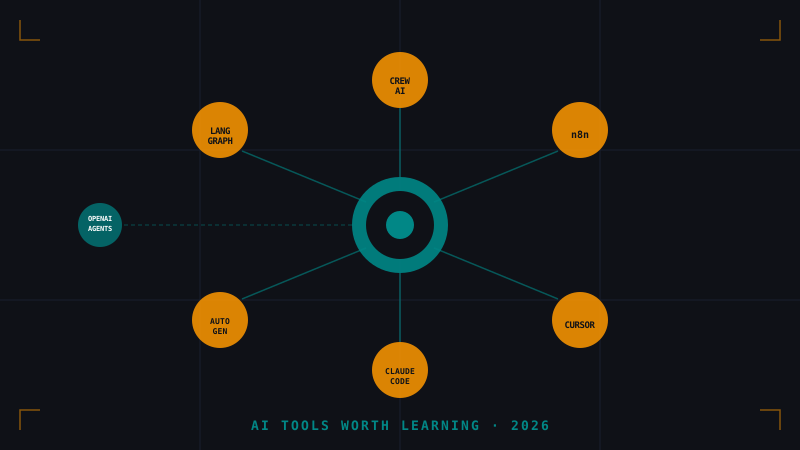
LangGraph, CrewAI, n8n, AutoGen, Cursor, Claude Code, OpenAI Agents SDK — a community debate emerged about which of these will still exist in a year. Here's an honest breakdown.
Hipocampus
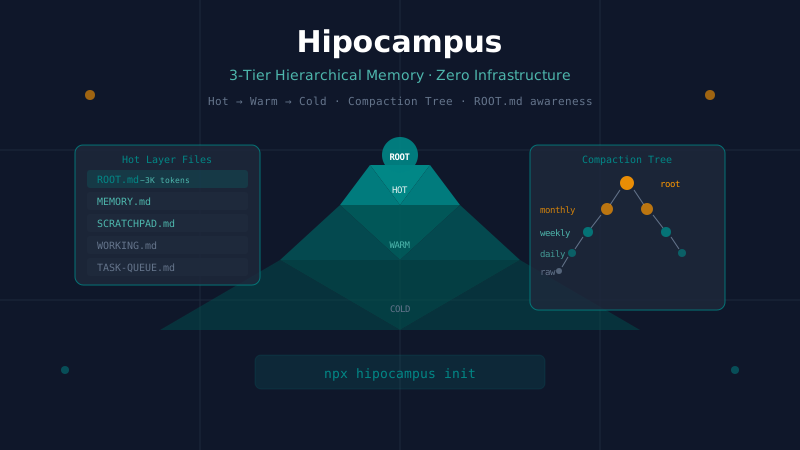
A technical deep-dive into Hipocampus, a drop-in memory harness for AI agents that uses a 3-tier Hot/Warm/Cold architecture and a 5-level compaction tree. How ROOT.md enables constant-cost memory awareness and how it compares to hmem, Mem0, and Letta.
hmem: Hierarchical SQLite Memory for AI Ag...
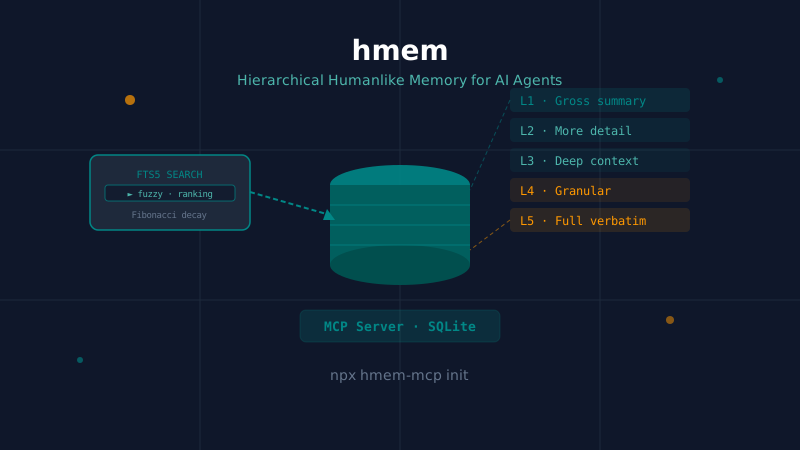
A technical deep-dive into hmem (Humanlike Memory), an MCP server that models human memory in five lazy-loaded levels backed by SQLite + FTS5. How Fibonacci decay, logarithmic aging, and a curator agent solve the context window problem across sessions and machines.