
Kotlin Coroutines: The Android Guide

Table of Contents
🔄 The Async Problem
Android apps are single-threaded by default (Main Thread). Long operations (Network, DB) block the UI, causing ANRs (Application Not Responding).
Callbacks vs. RxJava vs. Coroutines
- Callbacks: Callback Hell (
onSuccess,onErrornested 5 levels deep). - RxJava: Powerful but steep learning curve and verbose.
- Coroutines: Write async code sequentially. Built-in language support.
🧵 Dispatchers
Where does the code run?
- Dispatchers.Main: UI Thread (Updating views).
- Dispatchers.IO: Network, Disk (Reading files, API calls).
- Dispatchers.Default: CPU Intensive (Parsing JSON, sorting lists).
Best Practice: Inject Dispatchers
Don’t hardcode Dispatchers.IO. Inject them to make testing easier.
class UserRepository(
    private val ioDispatcher: CoroutineDispatcher
) {
    suspend fun getUser() = withContext(ioDispatcher) { ... }
}
🏗️ Structured Concurrency
Coroutines are launched in a Scope. When the scope dies, all coroutines are cancelled.
ViewModelScope
Tied to ViewModel lifecycle. Cleared when ViewModel is cleared.
viewModelScope.launch {
    // Automatically cancelled if user leaves screen
    repository.getData()
}
LifecycleScope
Tied to Fragment/Activity lifecycle.
lifecycleScope.launch {
    repeatOnLifecycle(Lifecycle.State.STARTED) {
        // Collect flows safely
    }
}
⚠️ Common Pitfalls
- GlobalScope: Avoid it. It has no lifecycle and can leak memory.
- Catching CancellationException: Don’t catch generic
Exceptioninside a coroutine, or you might break cancellation. RethrowCancellationException. - Blocking Code: Never call
Thread.sleepinside a coroutine. Usedelay.
🏁 Conclusion
Coroutines simplify async code dramatically. By understanding scopes and dispatchers, you can write safe, efficient, and readable concurrent code.
You might also be interested in
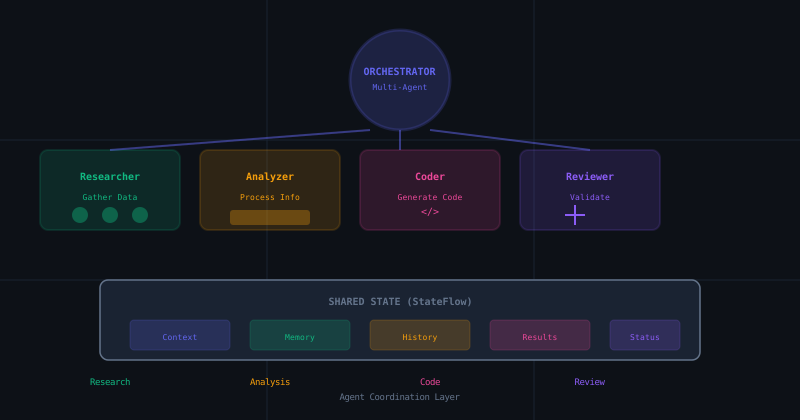
The Socratic Agent Series (Part 3): Buildi...
A pragmatic guide to building advanced multi-agent interactions using Kotlin Coroutines and StateFlow. From MARS to MotivGraph-SoIQ, bringing academic theory to production code.

Advanced Kotlin Flow: Operators and Patterns
Level up with Kotlin Flow. Master operators like combine, zip, flatMapLatest, and learn to handle complex reactive streams in Android.

Clean Architecture: The Ultimate Guide for Modern Android
Demystifying Clean Architecture: A deep dive into layers, dependencies, and data flow to build indestructible Android apps.