
Kotlin 2.1: Guard Clauses, K2 and the Future of the Language
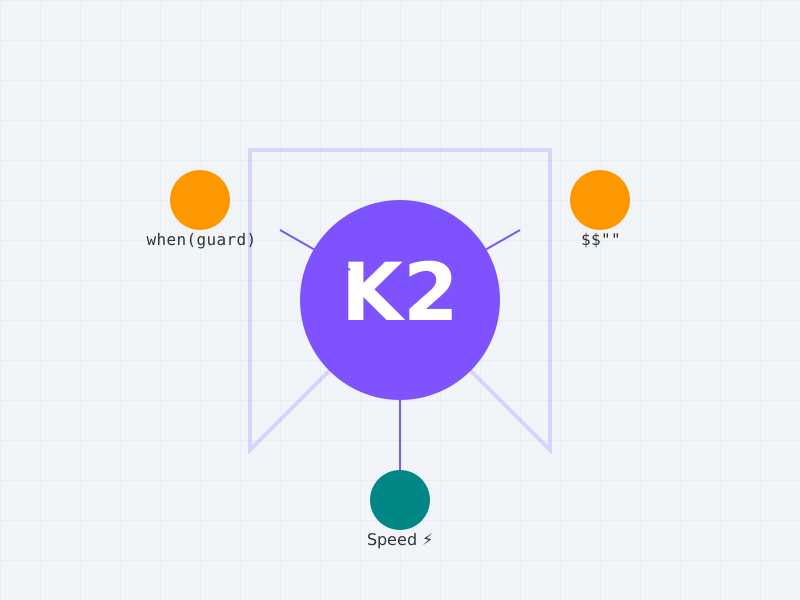
Table of Contents
⚡ The Post-K2 Era
If you updated to Kotlin 2.0, you’ve already noticed the difference: drastically reduced compilation times and a smarter IDE. Kotlin 2.1 is not just a minor update; it is the first version that builds on the stable foundation of K2 to bring features that were previously impossible to implement cleanly.
The new frontend compiler (K2) unifies the data structure for all platforms (JVM, Native, JS/Wasm), meaning new features arrive everywhere simultaneously.
🛡️ Guard Conditions in when
How many times have you written a when and had to nest an if inside a branch?
// Before (Kotlin < 2.1)
when (val response = api.call()) {
    is Success -> {
        if (response.data.isEmpty()) {
            showEmptyState()
        } else {
            showData(response.data)
        }
    }
    is Error -> showError(response.message)
}
Kotlin 2.1 introduces Guard Conditions, allowing for a much flatter and more readable syntax, similar to other modern languages like Rust or Swift.
// Now (Kotlin 2.1)
when (val response = api.call()) {
    is Success if response.data.isEmpty() -> showEmptyState()
    is Success -> showData(response.data)
    is Error -> showError(response.message)
}
This reduces cyclomatic complexity and makes business logic evident at first glance.
💲 Multi-Dollar String Interpolation ($$)
If you work with JSON, XML, or Regex in Kotlin, you know the pain of escaping the $ symbol.
// Escape hell
val json = """
{
    "price": "${'$'}9.99",
    "name": "$productName"
}
"""
Kotlin 2.1 introduces multi-dollar string literals. You can define how many $ are needed to interpolate a variable.
// Clean and no weird escapes
val json = $$"""
{
    "price": "$9.99",       // Literal, no interpolation
    "name": "$$productName" // Interpolates because we use two $
}
"""
This is a blessing for generating code, GraphQL queries, or prompts for LLMs within your Kotlin code.
🔄 Non-local break and continue
Inline functions (like forEach or run) have always had limitations with flow control. In Kotlin 2.1, these restrictions are significantly relaxed.
You can now use break and continue inside lambdas passed to inline functions in a more intuitive way, making it easier to refactor imperative for loops to functional operations without losing control.
list.forEach { item ->
    if (!item.isValid) break // Now supported in more inline contexts
    process(item)
}
🚀 Why Update?
Beyond syntax, Kotlin 2.1 brings silent performance improvements:
- K2 in IDE: IntelliJ and Android Studio now use K2 mode by default for code analysis, making highlighting and autocomplete much faster and more precise.
- Incremental Compilation: Improved to avoid unnecessary recompilations in large Gradle modules.
- Wasm Stable: If you are interested in Kotlin Multiplatform for the web, the WebAssembly target is much more mature in this version.
🎯 Conclusion
Kotlin 2.1 demonstrates that JetBrains’ investment in rewriting the compiler (K2) has paid off. Now that the technical debt of the old compiler is gone, we can expect a much faster pace of language innovation. Guard Conditions and Multi-Dollar Strings are just the beginning.
📚 Bibliography and References
For the writing of this article, the following official and current sources were consulted:
- Kotlin Blog: Kotlin 2.1.0 Released - JetBrains Blog
- Kotlin Language Specification: Guard conditions in when expressions - KEEP Proposal
- Kotlin Documentation: What’s new in Kotlin 2.1.0 - Kotlin Docs
- Google Developers: Kotlin updates for Android - Android Developers
You might also be interested in

Kotlin Collections vs Sequences
Map or Sequence? Learn how to optimize your lists in Kotlin for Android, avoiding memory overhead with Lazy Evaluation and mastering functional operations.

Socratic Prompting: Maieutic Reasoning in Mobile Dev
Avoid 'almost correct' code in Android & iOS. Master Socratic and Maieutic prompting with Gemini, Copilot, and Cursor using dialog flows and source code.

Koin vs Hilt: Mobile Architecture in 2026
Discover how to choose between Koin and Hilt for your next Android or Kotlin Multiplatform app, analyzing scalability, performance, and real use cases.