
Hermes Agent vs OpenClaw: The Complete Guide to Autonomous AI Agents in 2026
Table of Contents
🤖 Introduction: The Age of Autonomous AI Agents
In 2025-2026, autonomous AI agents have solidified as the next evolution of assisted software development. We’re no longer talking about simple assistants that complete code — we’re talking about complete systems capable of planning, executing, and delivering results independently. Among the growing ecosystem of agent frameworks, two names stand out for radically different approaches: Hermes Agent and OpenClaw.
Both are open source projects with MIT licenses, but their philosophies, creators, and use cases differ substantially. In this article we’ll perform a deep, honest comparison based solely on publicly verifiable information from their official repositories and documentation.
🏛️ What is Hermes Agent?
Origin and Philosophy
Hermes Agent is an open source autonomous AI agent developed by Nous Research (github.com/NousResearch/hermes-agent). It was released in February 2026 and is compatible with Linux, macOS, and WSL2.
The central philosophy of Hermes Agent is persistent memory and continuous self-improvement. The agent doesn’t start each session from scratch; it remembers user preferences, the state of previous projects, and established conventions. Furthermore, when it solves a difficult problem, it automatically writes a reusable skill document — creating its own skills without human intervention.
The project’s tagline summarizes it: “The AI agent that grows with you.”
Main Features
1. Persistent Memory
Hermes Agent maintains persistent memory that survives between sessions. It remembers your preferences, projects, and environment in every conversation. The longer it runs, the better it knows you. Data is stored locally in ~/.hermes/ on your machine.
2. Automatic Skill Creation
When Hermes solves a difficult problem, it writes a reusable skill document. This means the agent becomes exponentially more capable over time, accumulating knowledge in the form of documented skills. Compatible with the open standard agentskills.io.
3. Built-in Skills System
40+ built-in skills covering MLOps, GitHub, diagrams, notes, and more. Users can install community skills from agentskills.io and the SKILL.md format is portable and shareable.
4. Multi-Platform Gateway
Connect Telegram, Discord, Slack, WhatsApp, and Signal through a single gateway process. One daemon runs on your server and connects all messaging channels.
5. Parallel Sub-Agents
Generate isolated sub-agents for parallel workflows. Each has its own conversation and independent terminal.
6. Complete Browser Control
Web search, page extraction, complete browser automation. Visual analysis, image generation, and text-to-speech.
7. Scheduled Automations
Built-in cron scheduler for daily reports, nightly backups, weekly audits — all without supervision.
Technical Capabilities
Execution Environments:
- Local Terminal
- Docker (with security hardening: readonly root, reduced capabilities, PID limits)
- Remote SSH
- Modal / Singularity (cloud and HPC execution backends)
LLM Providers:
- Nous Portal (native OAuth integration)
- OpenRouter (access to 200+ models with API key)
- Custom API (any OpenAI-compatible endpoint)
- Local vLLM (run models entirely locally)
Security and Privacy:
- Zero telemetry, zero data collection
- Data stored locally in
~/.hermes/ - MIT License — fully auditable code
- Container hardening for secure execution
MLOps and AI Training
Beyond task automation, Hermes Agent is a platform for:
- Batch Processing: Generate thousands of tool-call trajectories in parallel with automatic checkpointing
- RL Training: Integration with Atropos for reinforcement learning on agent behaviors (11 tool-call parsers)
- Trajectory Export: Export conversations in ShareGPT format for fine-tuning
Installation
curl -fsSL https://raw.githubusercontent.com/NousResearch/hermes-agent/main/scripts/install.sh | bashOne command, no prerequisites. Installs uv, Python 3.11, clones the repository, and configures everything automatically.
🦞 What is OpenClaw?
Origin and Philosophy
OpenClaw is an AI personal assistant framework developed by Peter Steinberger (@steipete) and maintained by an active community of hundreds of contributors. The project was originally built for Molty, a space lobster AI assistant 🦞. The name combines the open source nature with the metaphor of an agent that can “claw” and manipulate the digital world.
OpenClaw’s philosophy centers on simplicity and accessibility. The framework is designed to be understandable by a single person, without platform engineering teams behind it. This is reflected in its lean architecture and documentation oriented toward practical use cases. The tagline: “Your own personal AI assistant. Any OS. Any Platform. The lobster way.”
Main Features
1. Extensible Plugin Architecture
OpenClaw is based on a plugin architecture where the core stays lean and optional capabilities ship as plugins:
- Code plugins: Run OpenClaw plugin code for deeper runtime extension
- Bundle-style plugins: Package stable external surfaces such as skills, MCP servers, and related configuration
2. Skills System via ClawHub
Skills are managed through ClawHub (clawhub.ai), a plugin and skills registry. Bundled skills ship for baseline UX, but new skills should first be published to ClawHub.
3. Multi-Channel Inbox
Supports an extensive range of messaging channels:
WhatsApp, Telegram, Slack, Discord, Google Chat, Signal, iMessage, IRC, Microsoft Teams, Matrix, Feishu, LINE, Mattermost, Nextcloud Talk, Nostr, Synology Chat, Tlon, Twitch, Zalo, WeChat, QQ, WebChat
4. Voice Wake + Talk Mode
Voice wake words on macOS/iOS and continuous voice on Android, using ElevenLabs + system TTS fallback.
5. Live Canvas
Agent-driven visual workspace with A2UI support.
6. Sandbox and Security
- For
mainsessions, tools run on the host with full access - For non-main sessions, you can run inside sandboxes (Docker, SSH, OpenShell)
- Safe defaults include: allow
bash,process,read,write,edit,sessions_list,sessions_history,sessions_send,sessions_spawn; denybrowser,canvas,nodes,cron,discord,gateway
7. Runtime and Stack
- Runtime: Node.js 24 (recommended) or Node.js 22.16+
- Language: TypeScript (strict ESM)
- Package Manager: pnpm (monorepo workspace)
- License: MIT
- Repository: github.com/openclaw/openclaw
- Sponsors: OpenAI, GitHub, NVIDIA, Vercel, Convex, Blacksmith
8. Native Apps
- macOS menu bar app
- iOS/Android nodes (voice trigger forwarding + Canvas surface)
Autonomy Model
OpenClaw operates in two main modes:
- Agentic Mode: The agent makes decisions autonomously within defined scope
- Supervised Mode: The agent proposes actions but waits for confirmation before executing
📊 Technical Comparison
Comparison Table
| Feature | Hermes Agent | OpenClaw |
|---|---|---|
| Developer | Nous Research | Peter Steinberger (@steipete) + community |
| Release Date | February 2026 | — |
| Repository | NousResearch/hermes-agent | openclaw/openclaw |
| License | MIT | MIT |
| Language | Python | TypeScript/Node.js |
| Operating Systems | Linux, macOS, WSL2 | macOS, Windows, Linux |
| Persistent Memory | ✅ Native (data in ~/.hermes/) | ✅ Memory plugin (multiple options) |
| Skills System | 40+ built-in + auto-creation + agentskills.io | ClawHub registry + bundled skills |
| Auto Skill Creation | ✅ When solving difficult problems | ❌ No |
| Messaging Integrations | Telegram, Discord, Slack, WhatsApp, Signal | 20+ channels (see list above) |
| LLM Providers | Nous Portal, OpenRouter, Custom API, Local vLLM | Multi-provider (configurable) |
| Voice/Wake | ❌ No | ✅ Voice Wake + Talk Mode |
| Live Canvas | ❌ No | ✅ |
| Native Apps | ❌ No | ✅ macOS, iOS, Android |
| Cron Jobs | ✅ Native | ✅ Native |
| Sub-Agents | ✅ Parallel sub-agents | ✅ sessions_spawn |
| Browser Control | ✅ Full (search, extraction, automation) | ❌ No |
| MLOps | ✅ Batch processing, RL training, trajectory export | ❌ No |
| Secure Containers | ✅ Docker hardening (readonly root, caps, PID limits) | ✅ Docker sandbox |
| Local vLLM | ✅ Native | ❌ No |
| Remote SSH | ✅ | ❌ No |
| Modal/Singularity | ✅ | ❌ No |
| Telemetry/Tracking | 0% (no telemetry) | Not specified |
| Installation | curl...install.sh | bash (1 command) | npm/pnpm global + onboard wizard |
| Quick Start | curl install, hermes setup, hermes | openclaw onboard —install-daemon |
Detailed Analysis
Memory and Persistence
Hermes Agent uses a declarative, structured memory system where facts persist between sessions in ~/.hermes/. Additionally, when it solves difficult problems, it automatically creates reusable skills — something OpenClaw doesn’t do.
OpenClaw supports multiple memory plugins, allowing you to choose between different approaches. It’s more flexible in options but requires selecting and configuring.
Skills System
Hermes Agent has 40+ built-in skills and can create new skills automatically when solving problems. The open agentskills.io standard allows portability.
OpenClaw uses ClawHub as a centralized skills registry, with a distinction between code plugins and bundle-style plugins. The community can publish and discover skills structured.
Messaging Integrations
OpenClaw supports more messaging channels (20+) but Hermes Agent covers the main ones (Telegram, Discord, Slack, WhatsApp, Signal) with a unified gateway architecture.
MLOps Capabilities
Here’s a fundamental difference: Hermes Agent is specifically built for MLOps, with trajectory batch processing, Atropos integration for RL training, and ShareGPT export for fine-tuning. OpenClaw has no documented MLOps capabilities.
Browser Control
Hermes Agent includes complete browser control for web search, page extraction, and automation. OpenClaw offers no such functionality.
Privacy
Hermes Agent explicitly emphasizes its zero-telemetry policy with all data remaining locally. OpenClaw doesn’t document a similar policy.
Technology Stack
Hermes Agent is built in Python (facilitating integration with ML tools), while OpenClaw uses TypeScript/Node.js (facilitating integration with web development and JavaScript tools).
💡 Use Cases
When to Choose Hermes Agent
1. Infrastructure Automation and Server Management
Hermes Agent shines in server management and personal infrastructure automation. Its SSH support, Docker hardening, and native cron jobs make it ideal for system administrators.
2. MLOps Projects and Training Data Generation
If you need to generate trajectories for model fine-tuning, Hermes Agent has built-in batch processing, automatic checkpointing, and ShareGPT export.
3. Total Privacy
If privacy is critical and you want zero telemetry with all data on your local machine, Hermes Agent explicitly guarantees this.
4. Automatic Skill Development
If you want an agent that self-improves by creating skills when solving problems, Hermes Agent is the only one with this capability.
5. Local Model Execution
If you want to run models locally with vLLM, Hermes Agent supports it natively. OpenClaw doesn’t have this option.
When to Choose OpenClaw
1. Multi-Channel Personal Assistant
If you want an assistant that responds on WhatsApp, Telegram, Discord, Signal, and many other channels simultaneously, OpenClaw is the most complete option with 20+ channels.
2. Voice-first Interaction
If you want to interact with your assistant via voice — with wake words and talk mode — OpenClaw has native support on macOS/iOS/Android.
3. Live Visual Workspace
OpenClaw includes Live Canvas, a visual workspace where the agent can manipulate and display information visually.
4. Native Desktop/Mobile Apps
If you want native apps for macOS menu bar, iOS, and Android, OpenClaw offers official companion apps.
5. Community and Resources
With 400+ contributors and corporate sponsors (OpenAI, GitHub, NVIDIA), OpenClaw has a more mature ecosystem with awesome lists and templates.
6. Native Windows
OpenClaw works directly on Windows (without WSL2), while Hermes Agent requires WSL2 on Windows.
✅ Pros and Cons
Hermes Agent
Pros:
- ✅ Automatic skill creation when solving problems
- ✅ 40+ built-in skills
- ✅ Complete MLOps (batch processing, RL training, trajectory export)
- ✅ Local vLLM support
- ✅ Documented zero telemetry
- ✅ Docker container hardening
- ✅ Complete browser control
- ✅ Remote SSH and Modal/Singularity execution
- ✅ 1-command installation (curl install)
Cons:
- ❌ No voice/wake or live canvas
- ❌ No native desktop/mobile apps
- ❌ No native Windows support (requires WSL2)
- ❌ Smaller community than OpenClaw
- ❌ No support for 20+ messaging channels
OpenClaw
Pros:
- ✅ Multi-channel (20+ messaging channels)
- ✅ Native Voice Wake + Talk Mode
- ✅ Live Canvas for visual workspace
- ✅ Native apps for macOS/iOS/Android
- ✅ Large community (400+ contributors)
- ✅ Corporate sponsors (OpenAI, GitHub, NVIDIA)
- ✅ Native Windows support
- ✅ Typed codebase (TypeScript strict ESM)
Cons:
- ❌ No automatic skill creation
- ❌ No MLOps or training capabilities
- ❌ No browser control
- ❌ No local vLLM
- ❌ No remote SSH execution
- ❌ Telemetry not specified
- ❌ No Modal/Singularity support
🔮 Future Perspectives
Hermes Agent
Hermes Agent is positioned as an MLOps platform with a focus on continuous self-improvement. Automatic skill creation means it becomes exponentially more capable over time. Nous Research behind the project suggests a roadmap centered on training and fine-tuning capabilities.
OpenClaw
OpenClaw is following a platform expansion trajectory with support for more channels, model providers, and improved computer-use. The relationship with corporate sponsors suggests deep integration with AI services.
🏆 Conclusion: Which to Choose?
Choose Hermes Agent if:
- You work with MLOps or need to generate training data
- You want an agent that self-improves by creating skills
- Total privacy is critical (guaranteed zero telemetry)
- You need to run models locally with vLLM
- You manage infrastructure via SSH and containers
- You prefer Python as your technology stack
- You use Linux or macOS
Choose OpenClaw if:
- You want an omnipresent assistant on 20+ messaging channels
- You need voice interaction with wake words
- You want live canvas and native apps
- You primarily work on Windows
- You value a large community with many resources
- You prefer TypeScript/Node.js as your stack
🔗 Resources
Hermes Agent
- Website: https://hermes-agent.org
- GitHub: github.com/NousResearch/hermes-agent
- Nous Research: https://nousresearch.com
- agentskills.io: https://agentskills.io
OpenClaw
- Website: https://openclaw.ai
- GitHub: github.com/openclaw/openclaw
- Docs: https://docs.openclaw.ai
- ClawHub: https://clawhub.ai
- Peter Steinberger: https://steipete.me
Comparison based on public information from repositories and official documentation. If you have experience with both frameworks and want to contribute your perspective, comments are open.
You might also be interested in
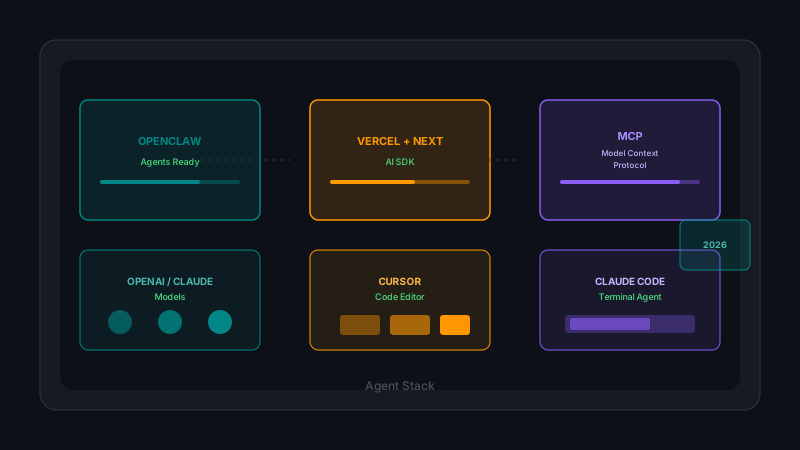
Complete Beginner's Guide: Recommended Stack for Building AI Agents in 2026
OpenClaw for ready-to-use agents, Vercel AI SDK with Next.js for custom development, OpenAI and Claude models, MCPs for integrations, and Cursor/Claude Code for programming. Complete analysis with practical examples and cost considerations.
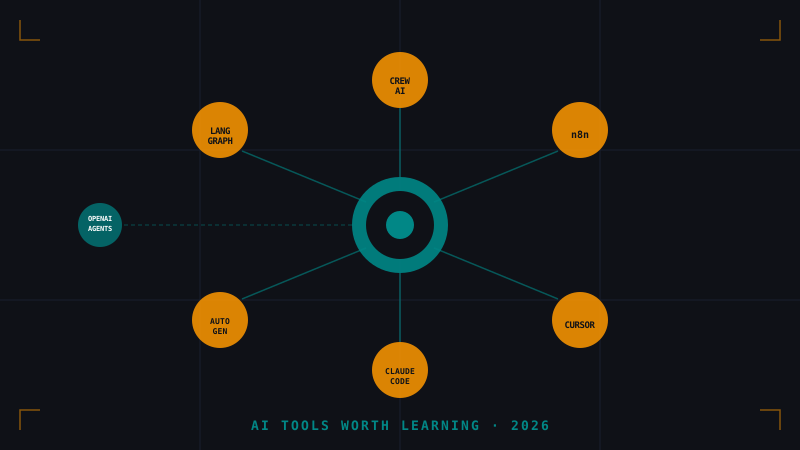
AI Tools Worth Learning in 2026: Investment vs. Hype
LangGraph, CrewAI, n8n, AutoGen, Cursor, Claude Code, OpenAI Agents SDK — a community debate emerged about which of these will still exist in a year. Here's an honest breakdown.
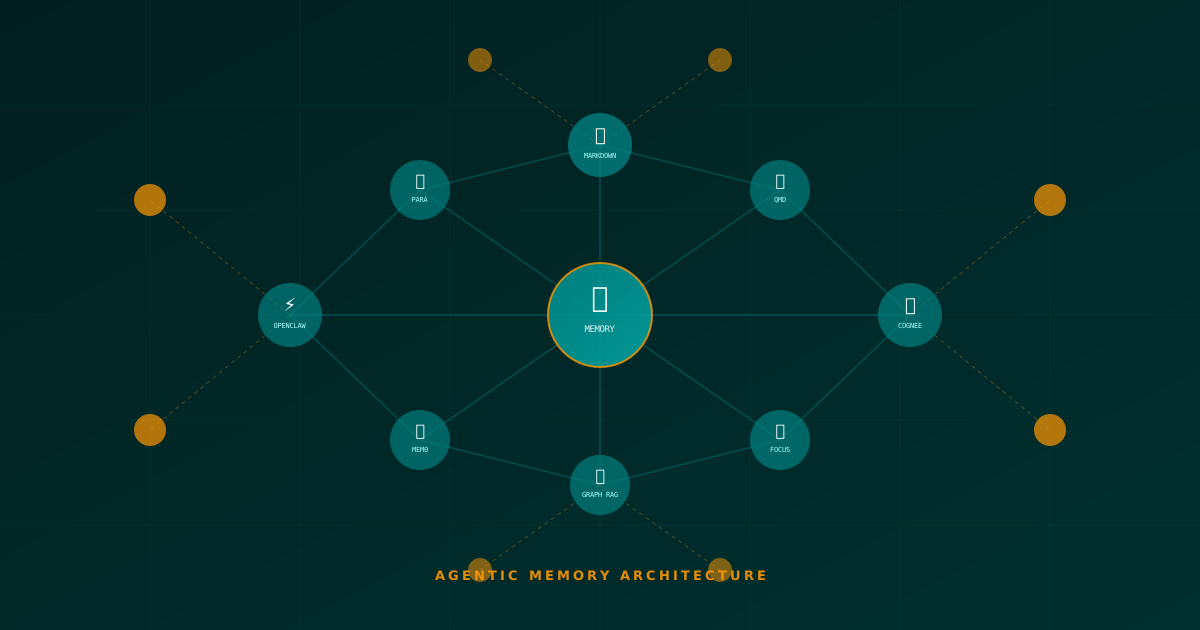
The Architecture of Persistent AI Agent Memory: Frameworks, Methodologies and the Evolution of Personal Knowledge Management
A deep technical analysis of how AI agents persist, consolidate and retrieve information autonomously. From OpenClaw and QMD to Mem0, Cognee and neurobiological memory models.