
Table of Contents
🤖 What is an AI Agent?
An AI Agent is more than just a chatbot. It’s a system capable of perceiving its environment, reasoning about it, and taking actions to achieve a goal. In the context of Android, an agent can be:
- Assistant: Helps the user perform tasks (e.g., booking a ride).
- Automation: Executes background workflows based on triggers.
- Enhanced UI: Dynamically adapts the interface based on user intent.
Key Characteristics
- Autonomy: Operates without constant human intervention.
- Reactivity: Responds to changes in the environment (app state, sensors).
- Proactivity: Takes initiative to fulfill goals.
- Social Ability: Interacts with other agents or humans.
🧠 The Brain: Large Language Models (LLMs)
LLMs (like GPT-4, Gemini, Claude) serve as the cognitive engine for modern agents. They provide the reasoning capabilities:
- Planning: Breaking down complex tasks into steps.
- Decision Making: Choosing the best tool or action.
- Context Awareness: Understanding user history and preferences.
On-Device vs. Cloud LLMs
- Cloud (API): Powerful, huge context window, but requires internet and has latency. Ideal for complex reasoning.
- On-Device (Gemini Nano): Private, offline, fast, but limited capability. Perfect for simple tasks and privacy-sensitive data.
🏗️ Architecture of an Android AI Agent
1. Perception Layer
How the agent “sees” the world.
- Input: Text, Voice, Image.
- Context: User location, App usage stats, Calendar events.
2. Cognitive Layer (The LLM)
Where the magic happens. The prompt engineering lives here.
- System Prompt: Defines the persona and constraints.
- Memory: Short-term (conversation history) and Long-term (Vector DB).
3. Action Layer (Tools)
The agent needs “hands” to effect change.
- Tools: Functions the LLM can call (e.g.,
sendEmail(),toggleFlashlight()). - Android Intents: Deep linking into other apps.
// Example Tool Definition for an Agent
interface AgentTools {
    @Tool("Turn on the flashlight")
    fun turnOnFlashlight()

    @Tool("Search for a contact")
    fun searchContact(name: String): Contact?
}
🚀 Challenges in Mobile
- Battery & Heat: Running inference is expensive.
- Latency: Users expect instant feedback.
- Privacy: Sending PII to the cloud is risky.
- Context Limitations: Mobile screens have limited real estate for output.
🔮 Future Trends
- Multi-Modal Agents: Agents that see (Camera) and hear (Mic) natively.
- App-less Interactions: Agents performing tasks across apps without opening them.
- Personalized Models: Fine-tuned small models for individual users.
🏁 Conclusion
AI Agents represent the next paradigm shift in mobile computing. Moving from “App-Centric” to “Intent-Centric” interaction. As developers, our job is to build the bridges (Tools and Context) that allow these agents to interact safely and effectively with our apps.
You might also be interested in
PlugMem: Microsoft Research's Task-Agnosti...
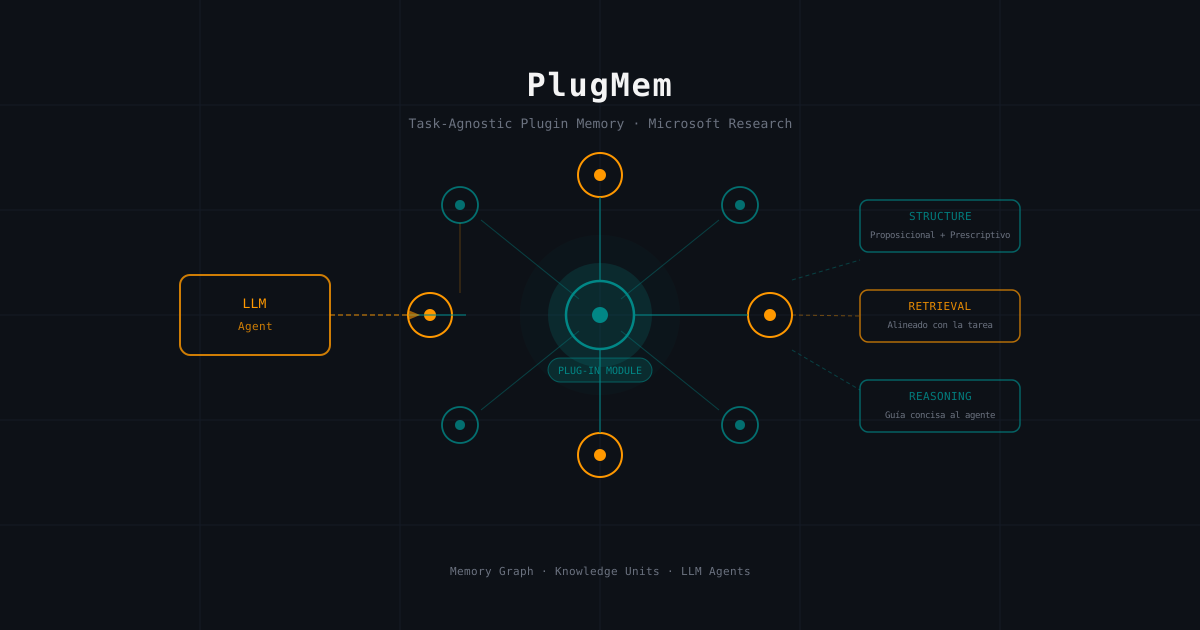
A technical deep-dive into PlugMem, Microsoft Research's plugin memory system that transforms raw LLM agent interactions into reusable structured knowledge. How its three-component architecture (Structure, Retrieval, and Reasoning) outperforms task-specific memory designs.
Android Skills: AI Guide for Smoke-Free Development
Learn how the Android Skills repository centralizes context so AI agents can build robust apps without legacy hallucinations.
Loop Engineering
Discover how Loop Engineering is replacing traditional prompting. Learn to design autonomous systems for mobile development with Kotlin and Android, managing risks and optimizing resources.