
Offline-First Synchronization Patterns Powered by AI

Table of Contents
Building Offline-First applications has always been one of the toughest challenges in mobile development. While tools like Room and WorkManager handle the mechanics of local storage and background jobs, the real pain point is Conflict Resolution.
Traditionally, we’ve relied on crude strategies like “Last Write Wins” or complex server-side versioning vectors. In 2026, with capable LLMs running on-device, we can introduce a new paradigm: Semantic Conflict Resolution.
The Problem with “Last Write Wins”
Imagine two users editing the same collaborative document offline:
- User A adds a paragraph about “Feature X”.
- User B fixes a typo in the introduction.
If User B syncs last, User A’s paragraph might be overwritten. Merging text by diffs is hard without context.
Pattern 1: The AI Arbiter
Instead of a hardcoded logic, we can ask a local model (like Gemini Nano) to merge the conflicting data.
// domain/sync/ConflictResolver.kt
class ConflictResolver(
    private val localModel: GenerativeModel
) {
    suspend fun resolveTextConflict(
        serverText: String,
        localText: String
    ): String {
        val prompt = """
            Merge the following two versions of a document into a single coherent text.
            Preserve changes from both if possible.

            Version A (Server):
            $serverText

            Version B (Local):
            $localText
        """.trimIndent()

        val response = localModel.generateContent(prompt)
        return response.text ?: localText // Fallback to local
    }
}
This approach is powerful for free-text fields, comments, or descriptions where semantic meaning matters more than byte-exactness.
Pattern 2: Smart Log Summarization
Sometimes, offline users generate massive amounts of telemetry or logs. Instead of syncing 10,000 raw log lines when connectivity returns, use an edge model to summarize the events.
- Capture: Log events locally to Room.
- Process: When
WorkManagertriggers a sync, read the logs. - Summarize: Feed them to the local LLM: “Summarize these 50 error logs into a single root cause analysis report.”
- Upload: Send only the summary and critical distinct errors.
Implementation with Room
You can integrate this directly into your repository pattern.
// data/repository/SyncRepository.kt
class SyncRepository(
    private val noteDao: NoteDao,
    private val api: NoteApi,
    private val conflictResolver: ConflictResolver
) {
    suspend fun syncNotes() {
        val unsynced = noteDao.getUnsyncedNotes()
        unsynced.forEach { note ->
            try {
                api.pushNote(note)
            } catch (e: ConflictException) {
                val serverNote = api.getNote(note.id)
                val mergedContent = conflictResolver.resolveTextConflict(
                    serverText = serverNote.content,
                    localText = note.content
                )
                val mergedNote = note.copy(content = mergedContent)
                // Save merged version locally and re-try push
                noteDao.insert(mergedNote)
                api.pushNote(mergedNote)
            }
        }
    }
}
Conclusion
AI on the Edge isn’t just about chatbots. It’s an infrastructural tool that can solve distributed system problems like data consistency in ways we couldn’t before. By moving conflict resolution to the client-side with semantic understanding, we create smoother experiences for collaborative apps.
References
You might also be interested in
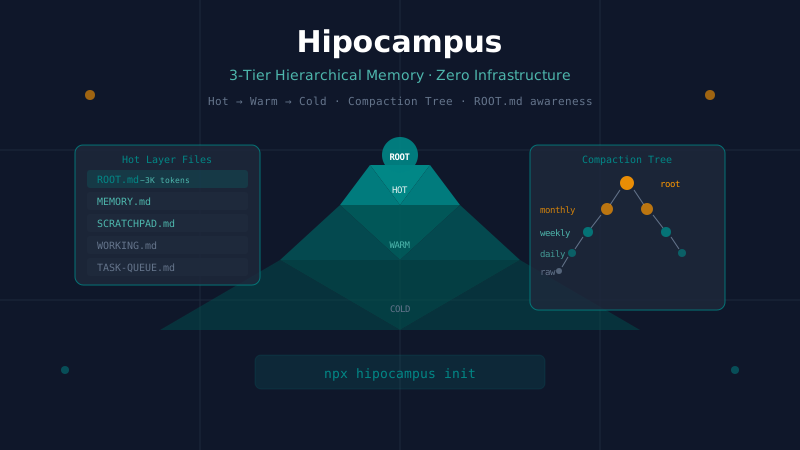
Hipocampus: Zero-Infrastructure Hierarchical Memory for AI Agents
A technical deep-dive into Hipocampus, a drop-in memory harness for AI agents that uses a 3-tier Hot/Warm/Cold architecture and a 5-level compaction tree. How ROOT.md enables constant-cost memory awareness and how it compares to hmem, Mem0, and Letta.
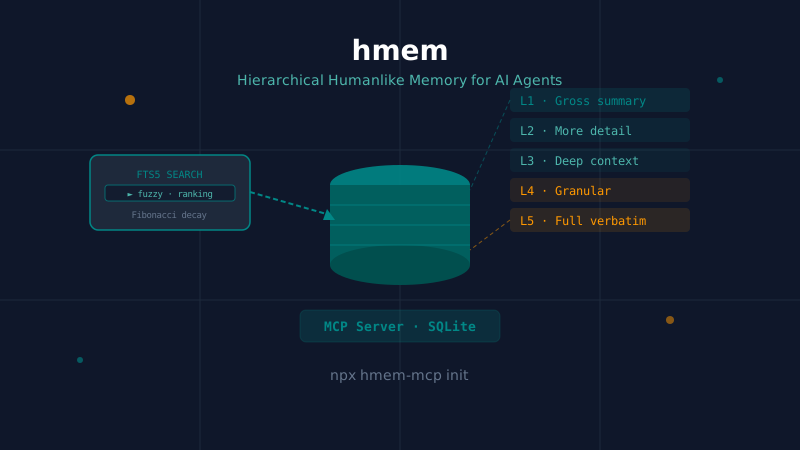
hmem: Hierarchical SQLite Memory for AI Agents That Actually Persists
A technical deep-dive into hmem (Humanlike Memory), an MCP server that models human memory in five lazy-loaded levels backed by SQLite + FTS5. How Fibonacci decay, logarithmic aging, and a curator agent solve the context window problem across sessions and machines.
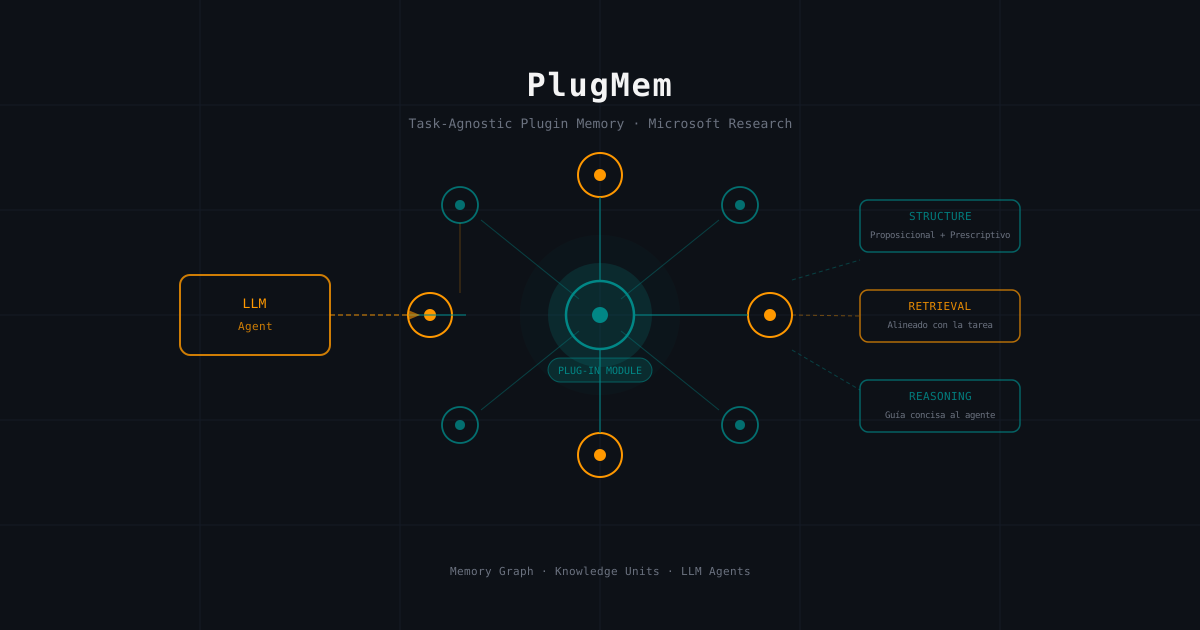
PlugMem: Microsoft Research's Task-Agnostic Memory Module That Every LLM Agent Needs
A technical deep-dive into PlugMem, Microsoft Research's plugin memory system that transforms raw LLM agent interactions into reusable structured knowledge. How its three-component architecture (Structure, Retrieval, and Reasoning) outperforms task-specific memory designs.