
Google Gemini 3.1 Pro: The New Standard in Reasoning and Creativity

Table of Contents
🧠 A Quantum Leap in Reasoning
Just weeks after the industry settled into the “Reasoning Era,” Google has shattered expectations with Gemini 3.1 Pro. While previous iterations focused on multimodal integration, version 3.1 takes a decisive aim at pure logic and complex problem-solving.
The headline metric is undeniable: 77.1% on the ARC-AGI-2 benchmark. For context, Gemini 3 Pro scored less than half of that just months ago. This isn’t just an incremental update; it’s a fundamental shift in how the model approaches abstract pattern recognition and novel logic puzzles.
The “Medium” Thinking Level
Developers using the API now have access to a new thinking_level="MEDIUM" parameter. This allows for a balanced approach between the rapid-fire responses of standard Pro models and the exhaustive, costly deliberation of “Deep Think” variants. It’s already proving to be the sweet spot for complex RAG (Retrieval-Augmented Generation) applications where accuracy is paramount but latency still matters.
🎨 Creative Coding: SVGs from Thin Air
One of the most visually stunning features of 3.1 Pro is its ability to generate website-ready, animated SVGs directly from text prompts.
“Gemini, create a loading spinner that looks like a galaxy spiraling into a black hole, using only SVG and CSS animations.”
Unlike pixel-based image generation, these outputs are code. They are infinitely scalable, lightweight, and editable. Early adopters in the frontend community are already using this to prototype UI interactions at lightning speed.
🎵 Lyria 3: The Sound of AI
Quietly bundled with this release is Lyria 3, Google’s most advanced music generation model. It now supports vocals in multiple languages with uncanny emotion.
The key innovation here is the “imperceptible watermark” (SynthID) which ensures that while the music is high-quality, it remains identifiable as AI-generated—a crucial step for copyright and artistic integrity.
🛠️ Integration & Availability
Gemini 3.1 Pro is rolling out immediately across the Google ecosystem:
- Vertex AI: For large scale deployments.
- Android Studio: Powering the next generation of “Bot-in-IDE” features.
- NotebookLM: Enhancing the popular research tool with deeper synthesis capabilities.
🗣️ Community Verdict
Reaction has been swift. On X (formerly Twitter) and Reddit, the consensus is that Google has finally closed the “reasoning gap” with Anthropic.
u/AI_Explorer_2026 notes:
“I threw my hardest logic puzzles at Gemini 3.1 Pro—the ones that used to trip up even Opus. It solved 9/10 on the first try without even needing a ‘Let’s think step by step’ prompt. The native reasoning is just… there.”
🚀 Conclusion
Gemini 3.1 Pro feels like the moment Google’s “DeepMind” heritage truly synced with its product speed. By combining rigorous logic (ARC-AGI-2) with creative freedom (SVG/Lyria), they’ve built a model that appeals equally to the data scientist and the creative director.
If you’re building agentic workflows that require complex decision-making, it’s time to rotate your API keys. Gemini 3.1 is here.
You might also be interested in
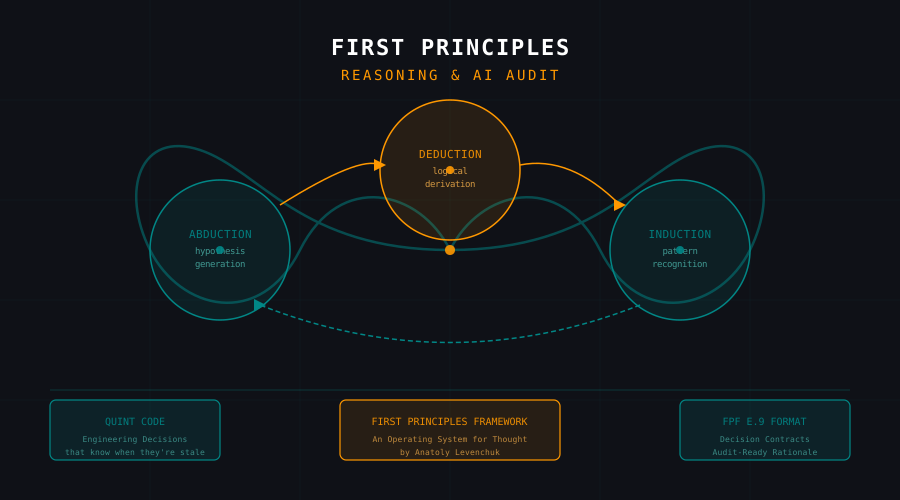
First Principles Reasoning and AI Audit: Quint Code, FPF, and the ADI Cycle in Software Engineering
How the First Principles Framework (FPF) and Quint Code enforce structured reasoning on AI agents. The Abduction–Deduction–Induction cycle applied to engineering decisions, auditable decision contracts, and why vibe-coded AI is not enough.

ChatGPT 5.3 Codex: The New Standard for Mobile Development?
A deep dive into ChatGPT 5.3 Codex, its new dedicated app, and what it means for Android developers. Includes comparison with Gemini 3.0 Pro.

Claude 4.6 (Sonnet and Opus): The Thinking Developer's Choice
Review of Anthropic's Claude 4.6 family. How 'Adaptive Thinking' and 'Computer Use v2' change the game for mobile CI/CD. Includes comparison with Gemini 3.0 Pro.