
Agents.md Standard: Blueprint for AI-Ready Projects

Table of Contents
📜 The Problem: Context Amnesia
Every time you start a new chat with an AI (Copilot, ChatGPT, Claude), it knows nothing about your project’s specific rules.
- “Use Hilt, not Koin.”
- “All ViewModels must extend
BaseViewModel.” - “Target SDK is 34.”
You repeat these instructions ad nauseam. This is inefficient and error-prone.
💡 The Solution: AGENTS.md
We propose a standard file, AGENTS.md, placed at the root of your repository. This file is written specifically for AI agents, not humans (though humans benefit too).
It serves as a “System Prompt Injection” for your codebase.
Structure of AGENTS.md
- Project Overview: High-level summary.
- Architecture: Layering, patterns (MVVM/MVI), directory structure.
- Tech Stack: Libraries, versions, constraints.
- Coding Conventions: Naming, formatting, prohibited patterns.
- Testing Strategy: Libraries, coverage goals.
- Common Tasks: “Few-shot” examples of how to implement common features.
📱 Example: Android Project
# Android Project - Agents Guide

## Overview
A modern task management app built with Jetpack Compose.

## Architecture
- **Clean Architecture**: `data` -> `domain` -> `presentation`.
- **UI**: Single Activity, Compose Navigation.
- **State**: `StateFlow` + `UiState` sealed hierarchy.

## Tech Stack
- **DI**: Hilt
- **Async**: Coroutines + Flow
- **Network**: Retrofit
- **DB**: Room

## Coding Rules
- Use `val` by default.
- ViewModels expose `StateFlow<UiState>`.
- Composables: Accept `modifier: Modifier` as the first optional param.
- **NO**: `LiveData`, `AsyncTask`, `Synthetics`.

## Testing
- Unit: JUnit5 + Mockk
- UI: Compose Test Rule
🚀 How to Use It
- Create the File: Add
AGENTS.mdto your root. - Reference It: When asking an AI to generate code, say:
“Generate a Login Screen following the guidelines in AGENTS.md.”
- Automate It: Configure tools like Cursor or Copilot to always index this file.
📈 Benefits
- Consistency: AI generates code that looks like your code.
- Speed: No need to prompt-engineer every request.
- Onboarding: New devs (humans) can read it to understand the “soul” of the project.
🔮 The Future
We envision IDEs automatically detecting AGENTS.md and pre-loading it into the context window of every AI interaction. It’s a small file that makes a massive difference in AI-assisted development.
You might also be interested in
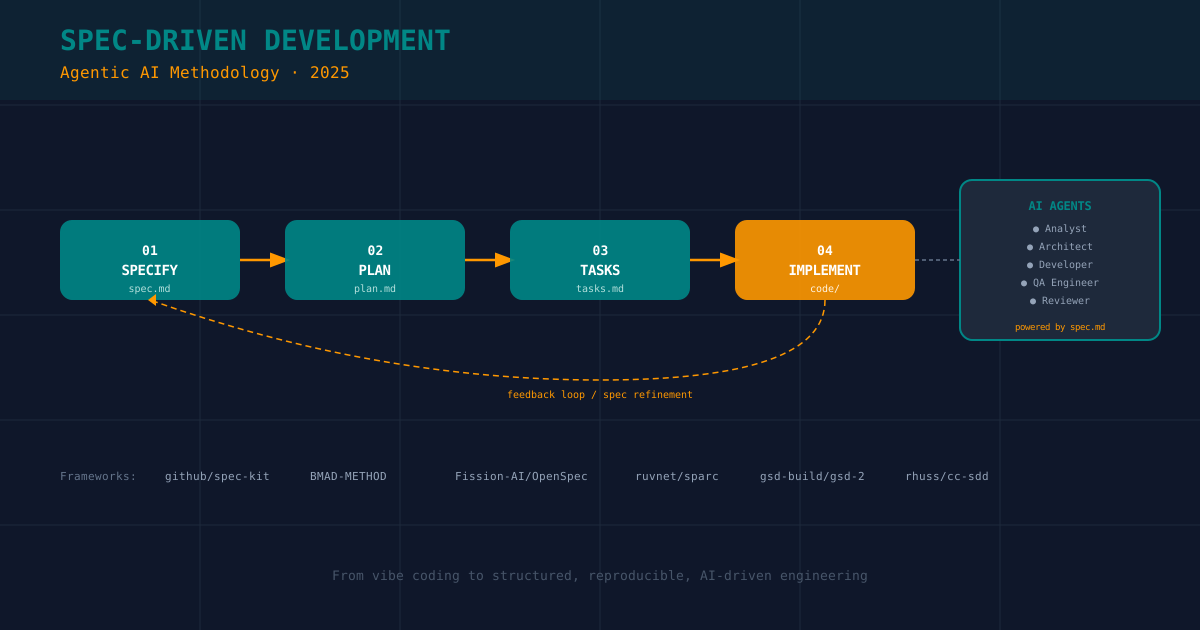
Spec-Driven Development with Agentic AI: Methodologies, Frameworks, and Real-World Implementation
A senior engineer's guide to SDD for agentic AI: from vibe coding to structured, reproducible development using GitHub Spec Kit, BMAD Method, OpenSpec, SPARC, and more.
Lean Task-First Development: Beads, LeanSpec, and Taskmaster in Practice
A deep dive into three tools that solve context rot and keep AI coding agents focused: Beads (git-native DAG issue tracker), LeanSpec (minimal spec-driven workflow), and Taskmaster (PRD-to-task orchestration). Real commands, real workflows, real indie dev perspective.
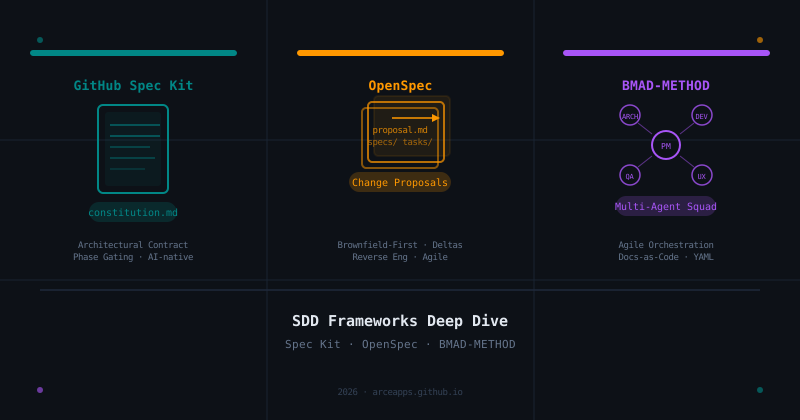
SDD Frameworks Deep Dive: GitHub Spec Kit, OpenSpec, and BMAD-METHOD Compared
A thorough analysis of the three leading Spec-Driven Development frameworks: the architectural contracts of GitHub Spec Kit, the change-proposal agility of OpenSpec, and the multi-agent orchestration of BMAD-METHOD.